Person-Level Attribution for LinkedIn Ads in B2B Campaigns
LinkedIn's contact-level model misses the committee-driven deals B2B actually closes.

- Written by
- Priya ChakravartiContributing Editor
- Published
- October 10, 2026
- Reading time
- 9 min read
What this covers
The campaign a dashboard marks as underperforming may be the one quietly carrying most of the pipeline. LinkedIn's native attribution model measures individual contacts within short windows, a design that fits a transactional purchase far better than it fits a B2B sale. Most LinkedIn campaigns default to a 30-day post-click and a 7-day view-through window, and both are too short for deals that commonly run for months and touch dozens of people before a contract is signed. The deeper flaw sits in who gets credit: B2B purchases move through committees, not individuals, so the person who clicks an ad is rarely the person who signs off, and a contact-level model rewards the click rather than the influence that actually closed the account. LinkedIn's own Campaign Manager API compounds the problem by requiring at least 3 interactions, meaning impressions, clicks, or engagements, from an account before it will surface company-level data at all, so a large share of the engagement relevant to account-based marketing never appears in native reporting.
Why browser-based tracking makes the undercounting worse
The contact-level model's flaws would matter less if the underlying data were complete, but it is not. LinkedIn's Insight Tag depends on browser-based pixel tracking, and ad blockers combined with iOS privacy restrictions erode that data continuously, stripping out conversions the platform would otherwise register. This is not a rounding error at the edges of a report. It is a structural blind spot, and it widens as browsers and operating systems keep tightening default privacy settings, so the gap between what LinkedIn ads actually drive and what Campaign Manager reports will keep growing rather than stabilizing. The practical fix is LinkedIn's Conversions API, a server-to-server connection that sends conversion data directly to LinkedIn, and it skips the browser pixel that half the audience never loads. CAPI works best with deterministic matching: capturing the click ID, li_fat_id, that LinkedIn appends to landing page URLs and returning that identifier through the API. Without that click ID, match rates drop significantly, leaving CAPI able to close only part of the gap.
Account-Level Attribution for B2B
B2B deals close at the account level, decided by committees rather than individuals, so the unit of attribution has to match the unit of the sale. Account-level attribution tracks impressions, engagement, and conversions across every person at a company instead of isolating a single contact's journey, and that shift in unit is what makes it the right model for B2B. A 200-person SaaS company's own numbers make the gap concrete, since LinkedIn had touched a large majority of its closed-won accounts in the prior quarter, yet last-touch attribution credited LinkedIn with only a small fraction of that pipeline. The honest limitation of this model is this. Account-level, impression-based attribution shows correlation, not causation, because a buying committee may have seen the ads simply for matching the ideal customer profile that LinkedIn's targeting was built to reach, not because the ads changed anyone's mind. Incrementality testing, using holdout groups to isolate the ads' true effect, is the rigorous way to answer that question, but it is operationally difficult for most B2B teams to run at scale. The pragmatic response is to treat no single model as ground truth and instead read multiple signals together, accepting a methodological compromise.
How LinkedIn's own platform has moved toward account-level measurement
LinkedIn's product roadmap has moved in the same direction the argument above points toward, which is a meaningful validation of account-level measurement as the right framework rather than a workaround invented outside the platform. Campaign Manager's earlier versions had no mechanism for tracking organization-wide engagement, but that changed in September 2025 with the launch of the Company Intelligence API, which lets advertisers track how entire organizations engage across paid and organic touchpoints through certified attribution partners. Early beta results from that launch reported a meaningful increase in companies reached, a substantial increase in pipeline attributed to marketing, and a significant reduction in cost per acquisition, indicating that the account-level view surfaces activity the contact-level model had been discarding all along. Early adopters of the September 2025 integration also reported increases in account visibility and in target accounts engaged, reinforcing that the gap between actual influence and reported influence was not a theoretical concern but a measurable one that better instrumentation closes. None of this means LinkedIn's native tools now tell the whole story. They confirm the direction is correct and leave open exactly the question the next section takes up: which companies engaged is now visible, but which individuals inside those companies did the engaging is not.
Native platform data versus person-level visitor identification
LinkedIn's account-level tools answer which companies engaged with an ad campaign, but they stop short of naming which individuals from those companies later visited the website, and that is where a marketing team's pipeline intelligence runs out. Company-level identification, typically done through reverse IP lookup, resolves the organization behind a given website visit, so it is genuinely useful for prioritizing which accounts to pursue, but it never produces a name, so it cannot support individual outreach or track engagement across a multi-stakeholder buying committee. Person-level identification closes that specific gap: using identity graphs, first-party cookie databases, and cross-device matching, it resolves the actual individual behind a visit, returning name, title, work email, LinkedIn URL, and phone number without requiring a form fill. The two tiers differ sharply in coverage. Company-level identification achieves a higher match rate on B2B traffic, while person-level identification returns a lower match rate but delivers something company-level data never can: the identity of the specific person. Coverage also varies by geography: person-level tools are built primarily around US data, so they offer more limited visibility into European B2B traffic, where different legal constraints apply. Those legal constraints are active: US CAN-SPAM law permits opt-out commercial email, but most major email service providers prohibit sending to contacts who never opted in, and European and UK operations typically require consent before an individual can be contacted. So a safe default is to email only high-intent, named individuals at their company domains instead of running them through a primary ESP built for consented lists. Maverick Intelligence operates squarely in this layer, enriching every website visit with name, company, title, LinkedIn profile, and email, which gives sales and demand-gen teams a live view of who is actually on the site, including the visitors who arrived after seeing a LinkedIn ad but never filled out a form.
Using identified visitor data to close the loop between LinkedIn ad exposure and named pipeline
Matching LinkedIn ad exposure data against identified website visitors, and connecting both to the CRM, turns a vague signal that an account engaged into a specific picture of which individuals engaged, what content they consumed, and whether a deal eventually followed. The mechanics of that loop are straightforward: a prospect sees a LinkedIn ad, clicks through immediately or returns organically weeks later, is identified by name and company once on the website, and that identification is pushed into the CRM and surfaced as a Slack alert, converting an impression that would otherwise vanish into the funnel into a named contact a rep can act on the same day. Maverick's real-time alerts carry that identity, name, verified email, LinkedIn profile, job title, into Slack, HubSpot, or Salesforce within minutes of the visit, which lets sales prioritize outreach to exactly the people LinkedIn ads surfaced but that Campaign Manager was never able to name. This also resolves the buying committee problem that contact-level attribution has always mishandled: when several individuals from the same account visit the site after ad exposure, each person is identified separately, building a genuine picture of committee-wide engagement instead of collapsing everything into a single contact's conversion. A further layer of visibility comes from detecting non-human traffic: Maverick identifies AI agents visiting the site, including ChatGPT and Claude, showing which content those agents read and who operates them, so teams can see not only which human buyers LinkedIn ads are influencing but also which AI systems are researching on those buyers' behalf. Identified visitor records can also feed directly into enrichment workflows, where a raw visit is automatically matched to the right contact, the contact's email is verified, and recent company news is surfaced, turning a single website visit into a fully contextualized opportunity for outreach.
Connecting identified visitors and LinkedIn data to HubSpot and Salesforce for closed-loop reporting
Person-level visitor intelligence only produces value once it reaches the systems where pipeline is actually tracked, so connecting it to HubSpot and Salesforce is what turns a list of identified visitors into attributed pipeline that finance and leadership will recognize as real. LinkedIn supports direct Business Manager connections to Salesforce and Microsoft Dynamics 365, along with a Business Manager connection to HubSpot through LinkedIn CRM Sync, and that connection creates conversions automatically from pipeline stage changes and unlocks the Revenue Attribution Report inside Campaign Manager. The HubSpot connection specifically routes data through CAPI: the Revenue Attribution Report links HubSpot or Salesforce to LinkedIn and displays revenue and pipeline data tied to LinkedIn ad exposure, including view-through influence on deals that never involved a click, using a lookback window that can be configured to capture longer sales cycles. Maverick's integrations with HubSpot, Salesforce, and Slack operate alongside these native connections rather than replacing them, pushing identified visitors directly into the CRM as new contacts or matching them to existing records, and triggering automated workflows, retargeting a visitor who did not convert, alerting a rep in Slack, enrolling an account in a sequence, without manual export or data wrangling standing between a website visit and a sales action.
Building an attribution stack that combines LinkedIn signals, visitor identity, and CRM data
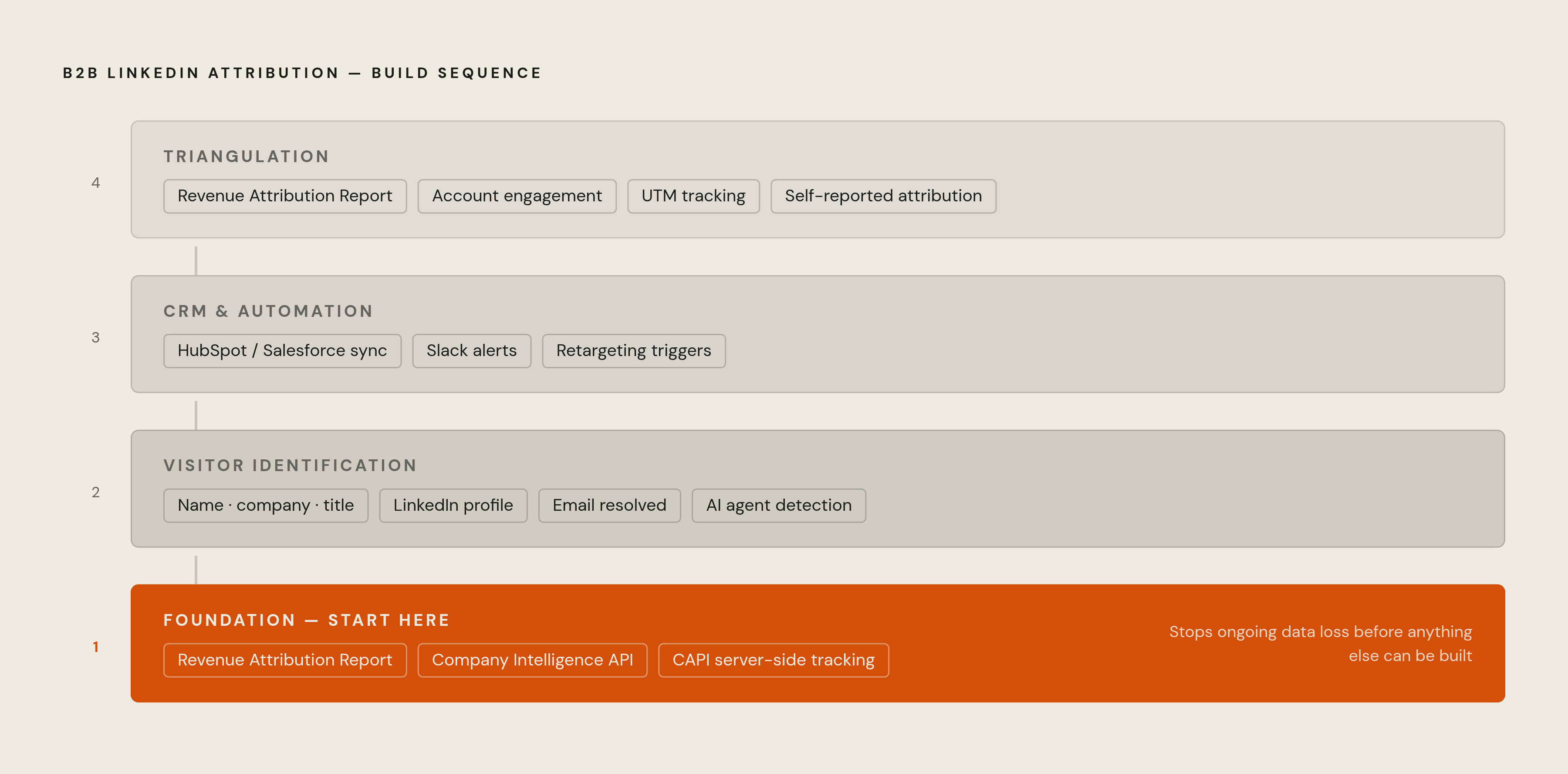
No single tool closes the full gap between what LinkedIn ads drive and what gets reported, so a durable system for B2B attribution has to layer LinkedIn's native account-level data, person-level visitor identification, server-side conversion tracking, and CRM-connected revenue reporting into one coherent stack. The first layer runs on LinkedIn's own platform: the Revenue Attribution Report connected to a CRM for account-level deal influence, the Company Intelligence API for organization-wide engagement signals across both paid and organic activity, and CAPI for the server-side conversion accuracy that a browser pixel alone can no longer guarantee. The second layer is person-level visitor identification, where a tool such as Maverick enriches anonymous visits with name, company, title, LinkedIn profile, and email, resolving the individuals behind the account-level signals LinkedIn already surfaces and detecting the AI agents that standard analytics tools miss. The third layer is CRM and workflow automation, where identified visitors and LinkedIn engagement data flow into HubSpot or Salesforce, pipeline stage changes trigger attribution events, Slack alerts route named contacts to the right rep, and ad platform integrations enable retargeting of visitors who have already been identified but have not yet converted. The fourth layer is triangulation: a reliable attribution system reads the LinkedIn Revenue Attribution Report alongside account-level engagement data, UTM tracking, and self-reported attribution together, because the actual goal is not perfect credit allocation but a clear enough read on pipeline influence to make better budget decisions. Teams building this from nothing should sequence it deliberately: start with CAPI and CRM connection to stop losing conversion data that is already happening, add visitor identification to put names to the anonymous majority of traffic, and only then build account-level reporting on top of a data foundation that is actually clean. Adopting this stack is a change in measurement philosophy, not a purchase. Teams that commit to account-level, multi-signal attribution stop asking whether LinkedIn worked at all and start asking which accounts LinkedIn is moving, and which specific person at each one deserves a phone call.