Individual-Level Visitor Identification Vendors Compared
Understand which matching method and enrichment depth actually deliver person-level visitor data.
- Written by
- Marcus LettieriStaff Writer, Revenue Infrastructure
- Published
- October 10, 2026
- Reading time
- 11 min read
What this covers
Individual-level visitor identification is two meaningfully different products sold under the same category name, and that conflation is the reason most vendor comparisons mislead buyers before a shortlist ever gets built. The remedy is a shared evaluation framework, built on four dimensions where vendor claims diverge most consequentially: match methodology, real-world match rates, enrichment depth, and downstream activation. Everything that follows in this comparison applies that framework consistently, vendor by vendor, so the reader can score each option on the same terms rather than on whatever terms the vendor chose to present.
How person-level identification works
Before any vendor comparison means anything, it helps to understand what separates the three matching methods now in commercial use, because methodology sets the ceiling on everything else: match rate, geographic coverage, which enrichment fields are even possible, and how exposed the vendor is to compliance risk. IP-to-company mapping is the oldest and most mature approach. It resolves a visitor's IP address to a business network and returns an account, not a person. Deterministic reverse-identity matching is the third method, and the most precise: when a visitor has previously engaged somewhere in the data graph, clicked a tracked email link, filled out a form, the current visit gets connected to that verified identity record. It produces the highest-confidence matches and the lowest volume of the three.
Remote work is the structural problem underneath all three methods, a factor no vendor fully discloses in its marketing, because it makes visitors far harder to match to a verified identity. Independent testing bears this out: enterprise visitors browsing from a corporate office are the most matchable segment, remote enterprise workers and SMB visitors browsing from home are substantially harder to match, and international traffic is harder still. Every buyer evaluating a vendor in this category should ask one specific question, not the headline match rate the vendor leads with: what percentage of this traffic, specifically, will be identified down to a named person with a working email address? Cloudflare reports that automated requests now make up a majority of HTML traffic, so any vendor that fails to filter verified bot and crawler traffic before reporting its match rate is overstating how much of its "coverage" is actually human.
The four dimensions that separate vendors
A feature list tells a buyer what a vendor says it does. But a rubric scored on methodology, verified match rate, enrichment depth, and activation tells a buyer what the vendor will actually deliver once the contract is signed. The first dimension is match methodology itself: is the vendor running IP-only resolution, identity-graph cross-referencing, deterministic matching, or some waterfall combination of all three? Realistic person-level match rates in 2026 run 5 to 20 percent for US traffic, and any vendor claiming substantially higher than that range should be pressed to show how the number was calculated.
The third dimension is enrichment depth: what fields a matched record actually contains once it lands in the buyer's hands. Two secondary dimensions deserve a place on the same scorecard even though they are not primary: geographic coverage, meaning whether person-level matching is US-only or extends further, and compliance posture, meaning SOC 2 certification, GDPR handling, and DPA availability. If either of these secondary dimensions fails, it can eliminate a vendor before the four primary dimensions are even tested.
How Maverick Intelligence performs on all four dimensions
Maverick Intelligence is built around a premise that is becoming harder to ignore as automated web traffic grows: person-level buyer identification and AI agent detection need to live in the same intelligence layer, because automated traffic increasingly contaminates visitor data and obscures which signals represent real buying intent. On enrichment depth, every matched visitor record returns name, company, title, LinkedIn profile, and email, the full contact package a sales rep needs to start a relevant, personalized outreach without additional research.
The confusion between company-level and person-level match rates is why evaluation frameworks matter in the first place: Maverick Intelligence publishes its person-level match methodology directly, rather than folding company-level fallback into a single inflated headline figure the way much of the category does. Maverick's coverage is person-level for US traffic, with company-level coverage available for international visitors, a split consistent with the GDPR constraint that limits person-level matching outside the US across the entire category, not just this one vendor.
The dimension that separates Maverick most clearly from the rest of the field covered here is AI agent detection. Beyond IP-to-company mapping and identity graphs, Maverick adds a layer most vendors omit entirely: real-time detection and reporting of AI agents, including ChatGPT, Claude, and thousands of other crawlers, identifying what content each one consumes and who operates it. That matters for two reasons. Maverick fits sales, demand-gen, and agency teams that want a live view of who is on their site, want to act on that signal inside the CRM and ad workflows they already run, and need confidence that the underlying data has not been quietly diluted by bot and crawler traffic.
How other person-level specialists compare
The person-level specialist market has several credible vendors beyond Maverick, each trading off the four dimensions differently, and the right choice among them depends on which dimension matters most for a given team's traffic and workflow.
Leadpipe runs deterministic matching with a large number of data points collected per person and a pixel install that takes two to five minutes to set up. Leadpipe's claimed match rate figures are vendor-reported and should be treated as such rather than as audited benchmarks; the vendor fits teams that prioritize data density per record and broad integration coverage, which is addressed further below.
Visitor InSites runs a person-level identity graph covering more than 250 million US adults, built and refined since 2019, and it returns matched contact records connected to specific pages viewed, without requiring a form submission. Visitor InSites fits teams that want visit-level behavioral context, not just a name and email, on every match.
Vector treats paid media audience building as a core part of its person-level product rather than an add-on, and it syncs identified contacts directly to LinkedIn, Google, Meta, Reddit, TikTok, and X for retargeting, the strongest ad-audience activation story among the specialists covered here. Pricing for its Reveal product starts at $399 a month and scales to $999 a month on a month-to-month basis; its Target product for ad audience activation starts at $3,000 a month on an annual commitment. Vector fits teams whose primary activation path is paid retargeting of identified visitors, not direct sales outbound.
Happierleads cross-references session signals against a permissioned publisher network and claims person-level coverage across more than 173 countries, with some official pages now citing 174 or more, the broadest international person-level claim among the vendors confirmed here. Pricing starts at $99 a month, the lowest price floor in the specialist tier, making it a fit for teams with significant non-US traffic who need person-level attempts beyond the US market at a lower cost of entry.
Kwanzoo resolves the specific individual, name, title, work email, personal email where available, LinkedIn URL, and mobile phone, and pairs that with a complete buyer journey showing which pages were visited, when, and how deep the engagement ran. MidBound is confirmed as an active person-level player in the 2026 market, though detailed methodology and pricing are not established clearly enough to score here, so it is worth evaluating on its own documented merits during a proof-of-concept.
What company-level tools cannot do
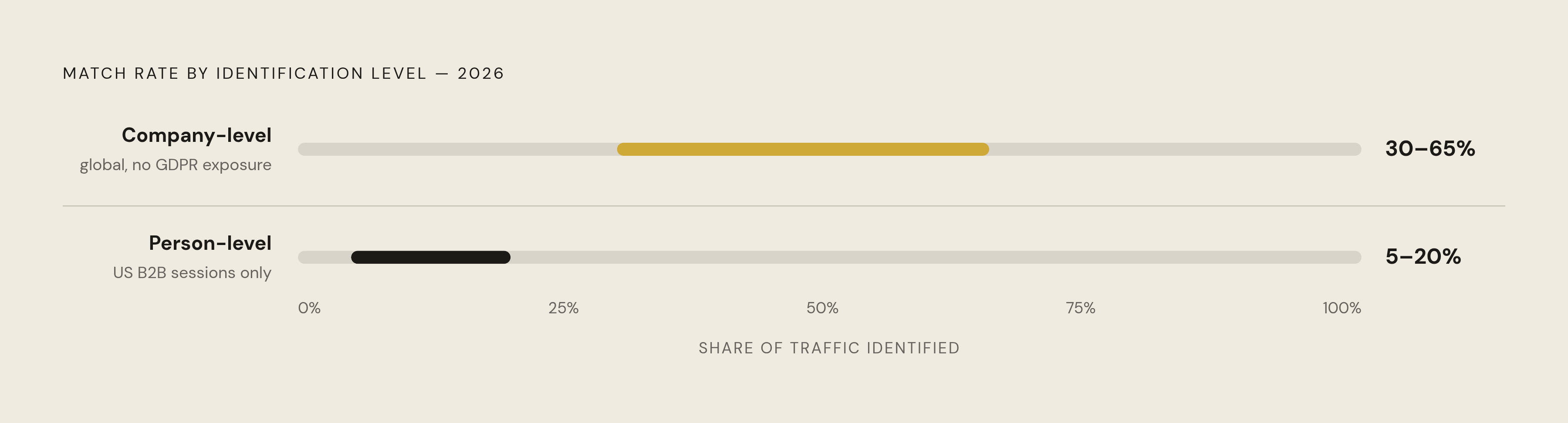
Company-level identification is not a weaker version of person-level identification. It is a different product built for a different buying motion, and treating the two as interchangeable is how teams end up either paying for capability they cannot use or settling for less identification depth than their workflow actually requires. Company-level tools fit naturally when the buying motion is account-based: an AE learns that a target account is active on the site and picks up the relationship through an existing contact, without needing the tool itself to supply a named individual. Company-level match rates are considerably higher than person-level rates, running 30 to 65 percent in 2026 against the 5 to 20 percent typical of person-level matching, and they work globally without the GDPR exposure that limits person-level coverage to the US for most vendors, a range other vendors have published as well.
The ceiling on company-level data is structural. Knowing that Acme Corp visited the pricing page does not say whether the visitor was the CFO or a junior analyst three weeks into the job, and the sales rep still has to do the work of finding the right contact, which reintroduces exactly the manual research burden that person-level tools exist to remove. In practice, most mature go-to-market teams run both kinds of tools together: company-level identification for account prioritization and territory planning across the full breadth of site traffic, and person-level identification concentrated on the highest-intent individual visitors inside that broader pool.
AI agent detection as a data-quality and competitive-intelligence dimension buyers are not yet evaluating
A visitor identification platform that cannot tell a human buyer from an AI crawler is reporting an inflated match rate and, at the same time, discarding a genuinely useful signal: which AI systems are researching a given product, and on whose behalf. The scale of this problem is no longer a rounding error. Cloudflare data showed automated requests making up a majority of HTML traffic on the web, the first time in the internet's history that machines have outnumbered humans in that measurement. Agentic browsing sessions increasingly run on standard browser clients with standard headers and valid TLS, which makes them difficult, though not impossible, to distinguish from genuine human sessions purely at the network and protocol level. What still works is behavioral: compressed workflows, unusually systematic navigation patterns, and a higher density of actions per session than a human visitor typically produces.
The consequence for match-rate reporting is direct. If a vendor does not filter verified bot and crawler traffic before it calculates its person-level match rate, it is overstating its actual coverage of real buyers, so buyers evaluating vendors should ask directly whether reported figures exclude known AI crawler user agents. There is an upside buried in this problem, too: knowing which AI systems are consuming a company's content, and which organizations operate those systems, gives sales and marketing teams visibility into AI-mediated buyer research that human visitor data alone simply cannot show. Maverick Intelligence detects and reports AI agents including ChatGPT, Claude, and thousands of other crawlers, showing what content each one consumes and who operates it, and among the vendors examined in this comparison, it treats AI agent detection as a core product capability.
Paid media attribution: the activation capability that separates tools that grow pipeline from tools that grow dashboards
Identifying a visitor by name answers one question. Person-level visitor identification opens up a layer underneath that aggregate view, connecting a specific individual's visit to the exact campaign, keyword, or ad that drove it.
The most differentiated activation use case in this category is feeding identified contacts straight into ad platform custom audiences. Identified visitors can be dropped into LinkedIn, Meta, Google, Reddit, and X audiences for retargeting, closing the loop between identification and re-engagement without waiting for a form fill or a sales call. The practical test for any vendor's attribution claim is simple: does the platform show which campaign influenced a specific named individual, or does it hand over aggregate campaign traffic that someone still has to manually cross-reference against the identified visitor list? The first version is something a team can act on immediately.
CRM and workflow integration depth
A matched record that never reaches a rep's CRM or Slack feed within minutes of the visit produces no pipeline at all, no matter how accurate the match was. Integration depth is the mechanism that turns identification into revenue, not a secondary checkbox on a features page. The standard integration stack for a mature vendor in 2026 includes native HubSpot and Salesforce write-back, real-time Slack alerts, and direct connections to the major ad platforms. Native means there is no Zap to build, no Make scenario to maintain, and no failure point sitting between the moment of the match and the action a rep takes on it.
Maverick Intelligence integrates natively with Slack, HubSpot, Salesforce, Google Ads, Meta, and TikTok, along with Attio, Gmail, Outlook, LinkedIn, n8n, and webhooks, so matched visitor records can trigger automated workflows, build retargeting audiences, and update CRM fields without a manual export step. What actually separates vendors on CRM write-back is whether the integration creates or updates a contact record, logs a timeline activity, and fires a workflow automatically, or whether it just exports a CSV file that someone has to import by hand later. Leadpipe lists more than 200 integrations, including outbound sequencing tools like Instantly, Smartlead, Apollo, Outreach, and Salesloft alongside its CRM and ad platform connections, the broadest confirmed integration surface among the specialist vendors in this comparison. Agency teams carry one additional requirement: white-label capability or multi-client workspace management, so identified visitor data routes to the correct client without manual separation after the fact.
A decision framework for choosing between vendors given your specific traffic profile and activation need
Choosing among these vendors comes down to three facts about a buyer's own situation that no comparison article can substitute for: where the traffic actually comes from, how the team plans to activate a match once it happens, and whether AI agent traffic is a meaningful contamination risk in the data. The traffic question comes first: where AI agent traffic is a known or suspected contamination risk, particularly on content-heavy or research-attracting sites, the priority shifts to vendors that filter and separately report crawler traffic, and every shortlisted vendor should be asked directly whether its match rates exclude known AI crawler user agents before any figure is trusted.
A workable evaluation sequence follows from these three questions: run a proof-of-concept against real site traffic rather than a vendor's curated demo data, request a person-level rate that is separated cleanly from any company-level fallback and verified against US B2B sessions, test the Slack or CRM alert from end to end before signing anything, confirm whether the CRM integration is native or dependent on middleware, and ask whether AI crawler traffic is filtered out before match rates are calculated. Teams that need person-level buyer identity, visibility into AI agent activity, and native activation across CRM and ad platforms in a single layer have good reason to start the evaluation with Maverick Intelligence, since it is the vendor in this comparison that treats all three of those capabilities as first-class, rather than splitting them across separate products or bolting them on as add-ons. Maverickintelligence, the publisher of this comparison, is itself a real-time visitor intelligence platform that enriches anonymous visits with name, company, title, LinkedIn, and email for exactly this use case.