Turning Anonymous Website Traffic Into Identified B2B Leads
Identify which companies visit your site before they fill out a form.

- Written by
- Tariq Ohlsson
- Published
- October 13, 2026
- Reading time
- 10 min read
- Sources cited
- 1 sources ↓
What this covers
Companies pour money into ads to drive traffic to their sites, then watch nearly all of that traffic disappear without a name attached to it. Most B2B visitors never fill out a form, so anonymous traffic is just the normal condition of a B2B website, not an unlucky exception. Only a small slice of visitors ever convert through a form. Everyone else is pipeline that simply vanishes inside standard analytics. Google Analytics will tell you how many people viewed a page and where they came from, but it stops well short of telling you who was actually there. Its User-ID feature only connects activity to users your own system already recognizes, typically through login.
Meanwhile, the behavior that actually signals buying intent, repeated visits to the pricing page, reading through competitor comparisons, working through case study after case study, happens constantly and goes completely unactioned. By the time a prospect fills out a form, competitors who identified that same company weeks earlier may have already started the conversation.
The three tiers of identification
Visitor identification is not one capability but three, and each tier covers a different slice of traffic using a different technical method, with real trade-offs between coverage and precision.
The second tier is company-level identification, and it resolves some share of traffic to an actual organization name along with basic firmographics like industry, size, and location. The mechanism behind this is reverse IP lookup: the visitor's IP address gets checked against databases of known corporate IP ranges, and when a match turns up, the tool returns a company record. This tier answers the question of which company is looking at your site, but not who at that company is doing the looking, and that distinction matters enormously once you try to prioritize outreach.
The third tier is person-level identification, which resolves a visit to a named individual, complete with title, email, and LinkedIn profile. Getting to this level requires going past IP matching entirely, layering in first-party cookies, device fingerprinting, email pixel matching, and cross-referencing identity graphs built from opt-in professional data.
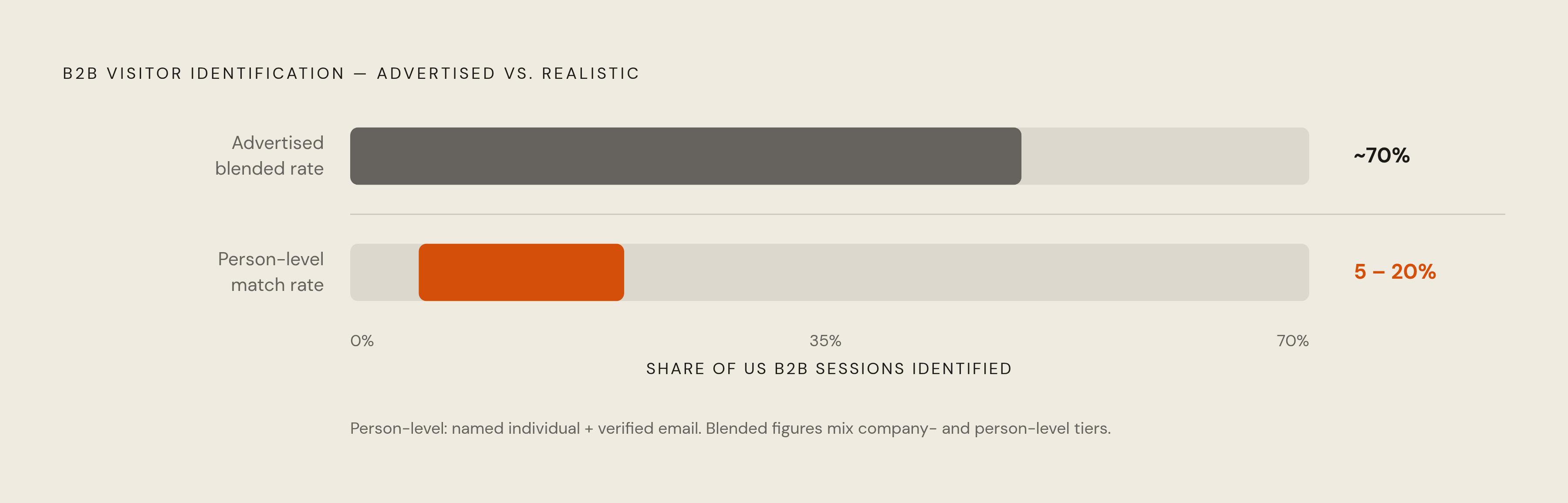
Most mature tools in this category don't force a choice between tiers two and three. Instead they run a combined fallback model: resolve to a named person where the data supports it, fall back to company-level where it doesn't. That blended approach is what produces the higher aggregate match-rate figures vendors like to advertise, and understanding the blend is the first real test of whether a vendor's numbers mean what they seem to.
What remote work has structurally reduced in IP-based match rates
Company-level identification rests on an assumption that no longer holds for most of the workforce: that employees browse from corporate networks with fixed, employer-registered IP ranges. Remote and hybrid work broke that assumption at scale. When someone works from home, their IP resolves to a consumer internet provider, Comcast, AT&T, or something similar, and that address maps to no employer record anywhere. Pure IP-based tools simply can't see those visitors.
The size of the gap depends heavily on who's browsing and from where. Geography makes it worse: US identity databases are the richest and deepest, while European and Asia-Pacific traffic matches at meaningfully lower rates across the board.
The tools that handle this well don't lean on any single data source. Instead, they stack several signals on top of IP matching. And identity graphs, which are maintained databases linking professional identities across many touchpoints, let a tool check whether a given device, cookie, or behavioral pattern lines up with a known B2B contact.
You can run a visitor's signals through several of these data sources in sequence, and when confidence is low, you fall through to the next provider. People call this waterfall enrichment, and it produces far richer identification than any one database alone. It's also why the depth of a vendor's data stack, not just its marketing claims, should drive the buying decision.
Enrichment: From Company Match to Actionable Contact
Knowing that a named company visited your pricing page is not the same as having someone to call.
Enrichment closes that gap. It takes the identified company and works out who the most likely decision-makers are, based on title, seniority, or fit against an ideal customer profile, then attaches verified contact fields on top: name, title, email, phone, and LinkedIn profile. Clay's own documentation is direct about the division of labor here: its visitor tracking identifies accounts, not individuals, and resolving an anonymous session down to a person or company has to happen upstream, through a visitor identification platform, before Clay's enrichment can do its work.
The output of that enrichment step needs to flow straight into CRM records or outreach sequences. That way you cut out the manual tab-switching between five different tools, which otherwise eats up significant time per lead for an SDR. If you have identification without enrichment and a triggered outreach sequence behind it, you just get a Slack notification that a rep mutes after the third day. The value only shows up when the signal reaches a rep with enough context to act, while the prospect's intent is still live.
Why AI agent and bot traffic must be filtered before visitor signals reach the sales queue
Bad bot and AI agent traffic has grown fast enough that it now makes up a material share of all web traffic, and identification tools that don't filter it will hand sales a queue full of sessions that were never a human buyer.
These agents have gotten better at looking human, so the problem has gotten harder. Detecting them now depends on session cadence analysis instead: AI agent sessions move with task-optimized patterns, low exploration variance, purpose-driven navigation, few re-reads or tangents, while human sessions are inconsistent in exactly the ways agents aren't, pausing, doubling back, wandering off-topic.
Filtering this traffic out is only half the story, though. By early 2026, several platforms reported that AI agents made up a significant and growing share of inbound traffic, with real implications for how sites get built, what content gets written, and what "a visitor" even means for pipeline purposes going forward. Some identification platforms detect and report AI agents right alongside human visitors, so you know which entity is operating the agent and what content it consumed. So what would otherwise be noise becomes a distinct layer of intelligence, not a data quality problem to discard.
Connecting Identified Visitors to Paid Media Attribution and Retargeting
Visitor identity data does more than tell you who is on your site. It also answers a question standard attribution models consistently get wrong: what your ad spend actually produced.
B2B journeys stretch across multiple sessions and multiple days, which is most of them, so standard attribution systematically undercounts them. If a platform ties an identified company's website visits directly to CRM pipeline records, you can see which ad-driven accounts actually turned into revenue, not just which clicks happened to precede a form fill. Fibbler, for example, tells you exactly which companies are clicking a given set of ads, and it ties that engagement to real pipeline and revenue inside the CRM.
That same identity data also runs the other direction, so it improves the targeting of future ad spend. With LinkedIn's Matched Audiences, you can build targeting around contact lists, company lists for account-based campaigns, and website retargeting audiences. These get matched against LinkedIn's own company database at rates that shift with data quality and how recognizable the organization is. If you retarget website visitors on LinkedIn, you tend to get a meaningfully lower cost per lead and a higher conversion rate than if you build cold lookalike audiences, by general LinkedIn advertising benchmarks (LinkedIn retired lookalike audiences in February 2024 in favor of Predictive Audiences). The quality of the seed list determines how well any of this works: a thin pool of anonymous pixel-based visitors produces a thin, unfocused audience, while a curated list of identified high-intent visitors with real firmographic detail produces a far sharper one. Identification, in other words, pays for itself twice: once in the outreach it enables and once in the media efficiency it unlocks.
CRM and GTM Integrations for Identified Leads
None of the identification or enrichment work matters if the output just sits in a dashboard nobody opens. Integration depth, how seamlessly identified visitor data actually reaches the CRM, Slack, and outreach tools reps use every day, is what separates a tool that generates pipeline from one that generates reports.
The standard workflow architecture runs like this: a lightweight JavaScript pixel fires when a page loads, capturing IP, browser fingerprint, and cookie signals; the platform resolves that into an identity; and when a match is found, the enriched record routes automatically to the CRM, to Slack, or to an outbound tool, without anyone touching it by hand. Native sync with Salesforce and HubSpot, Slack alerts, and webhook support that doesn't require a Zapier workaround have become baseline requirements for evaluating this category, not features that set one vendor apart from another, and ZoomInfo's 2026 guide treats integration depth as a primary evaluation factor for exactly this reason.
The two major CRM ecosystems pull in different directions. That risk became concrete in 2026: HubSpot's acquisition of Warmly closed on June 30, 2026, and Salesforce completed its acquisition of Qualified on April 1, 2026, according to Salesforce's own news page and corroborated by its SEC Form 10-Q, which together collapsed several of the independent options in the conversational and engagement layer of this category. So when teams evaluate tools now, they need to weigh platform dependency as a real factor, not an afterthought.
The practical benchmark for any of this is simple: a team needs to be able to act on an identified visitor within 24 hours of the visit. If identification has no triggered outreach sequence behind it, it just produces alerts that reps learn to mute.
Privacy, match-rate honesty, and the compliance trade-offs revenue teams must weigh
Person-level identification raises regulatory questions that company-level identification mostly sidesteps, so you need to weigh how a vendor sources its data and how honestly it states its match rates.
Person-level tracking is in contested legal territory under GDPR, CCPA, and the newer wave of US state privacy laws. Most B2B teams end up finding that company-level identification paired with enrichment data gives them enough to act on without taking on the regulatory exposure that comes with person-level tracking. You get a smaller identified universe, but you also get materially lower compliance risk, and for many teams that trade is worth making.
Match-rate claims deserve the same scrutiny. Vendors advertising very high match rates are almost always blending company-level and person-level numbers into one figure, and realistic person-level match rates for US B2B traffic run in the 5 to 20 percent range, not the headline numbers in the sales deck. In a vendor demo, ask what percentage of traffic they will identify down to a named person with a verified email address, not what percentage they identify in aggregate across every tier. A combined model, person-level where the data supports it, company-level as the fallback, is what most mature tools actually deliver, and that is a fair representation of what this category can currently do. As CRM vendors absorb more of the conversational and engagement layer and integration standards get treated as baseline rather than differentiators, the category is visibly maturing toward more consistent, more honestly stated benchmarks.
How to build the identification-to-pipeline workflow in practice
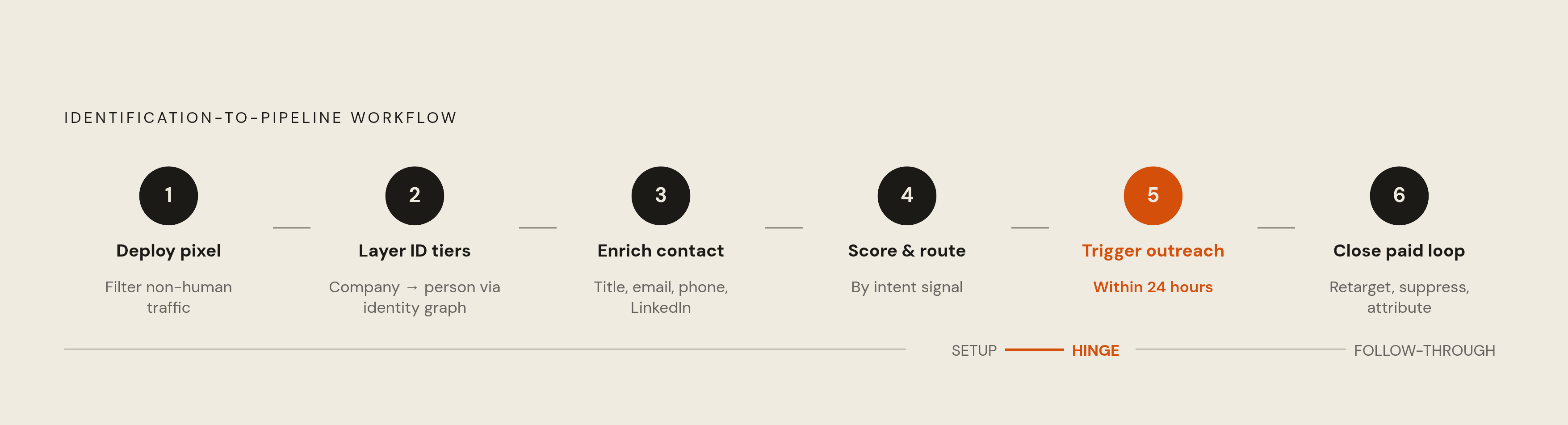
Turning this into pipeline means building it as a sequence, not as a pile of disconnected tools bolted together after the fact.
Start by deploying the pixel and filtering non-human traffic before you do anything else. A lightweight JavaScript snippet captures IP, fingerprint, and cookie signals, and bot and AI agent filtering needs to happen at this layer, before any session gets treated as a prospective buyer.
Layer the identification tiers next. Run company-level matching for the broadest coverage, resolve to person-level wherever the identity graph supports it, and use waterfall enrichment to shrink the share of sessions that slip through completely unqualified.
Enrich every identified company down to the contact level. Surface the most likely decision-makers by title and seniority, and attach verified email, phone, and LinkedIn details, a step orchestration tools handle automatically once they're integrated with the identification platform.
Score and route by intent signal before anything reaches a rep. A company that read one blog post once is not the same opportunity as a company that viewed the pricing page three times across two separate sessions, and intent scoring is what keeps the queue from drowning reps in low-value alerts.
Trigger outreach within 24 hours. Enriched, scored records should route automatically to the CRM, to Slack, or into outreach sequences within that 24-hour window, while intent is still live and outreach still feels relevant.
Close the paid media loop last. Identified visitors feed retargeting audiences on LinkedIn and other major ad platforms, you move unresponsive accounts into suppression lists, and attributed pipeline data feeds back into how you allocate budget across campaigns.
That span is the point: stitching together five separate tools to cover the same six steps slows a team's time to action and erodes the fidelity of the data along the way.
Methodology & sources
- AI Traffic Is Up 82%. Can You Tell Which Agents to Trust?
Provided context on the rapid growth of AI agent and bot traffic as a share of all web traffic, informing the section on filtering non-human sessions before they reach the sales queue.