
Attributing Google Ads Clicks to Named B2B Buyers
Connect Google Ads clicks to actual B2B buyers through CRM data.
Attributing Google Ads clicks to named B2B buyers requires solving an identity problem before an attribution problem. GCLID connects a click to a conversion event, but it does not by itself identify the buyer behind the visit. Person-level identification links the visit to a buyer, and CRM outcomes feed back what happened so the advertiser can account for ad spend.
Why GCLID attribution leaves B2B ad spend unaccountable
Standard Google Ads reporting reaches its ceiling when a B2B advertiser needs to explain who clicked and whether that person became a customer. GCLID tags the click and connects it to a downstream conversion, with conversions attributed to the click date and a click-through window capped at 90 days. That provides event attribution. A recorded conversion does not, on its own, establish a connection to a named human being or a closed deal.
The conversion events Google gets are usually form fills from the small share of ad-driven visitors who choose to submit them. Other visitors remain attached to a channel but not an identity. As a result, reporting can explain which ads generated submissions without explaining which ads reached the people who ultimately bought. The missing connection limits what conversion reports can say about the business value of the spend.
The identity gap underneath the attribution gap
Most B2B visitors do their research, compare options, and leave without filling out a form. Analytics records their sessions, but the absence of an identity prevents those sessions from being connected to contacts and deals in the CRM. Channel and ROAS decisions therefore depend on a sample that may not represent the real buyers. The measurement gap is fundamentally an identity gap.
Even identifying an individual is not enough if that person remains disconnected from the account. Gartner’s research shows that B2B purchase decisions involve multiple stakeholders who do their own research, so person-level tracking that treats each person separately misses what the committee does. The eventual contract also happens in the CRM or a sales conversation. Attribution needs both the connection from person to company and the return path from revenue to the ad platform.
Two different identity problems at company and person level
Company-level identification answers which organization appears to be behind a visit. An IP match may resolve to a company, but that does not establish which employee visited. Person-level identification requires identity-graph or first-party signals layered on top of that match. When it works, the result can include a name, title, company, LinkedIn profile, and contact details.
These layers fail independently. A visitor whose IP resolves cleanly to a Fortune 500 office may produce no person-level match at all. Geography also constrains person-level coverage because consent rules restrict the data feeding identity graphs in the EU. A tool with meaningful US coverage can perform poorly in Germany or France, regardless of how well it recognizes companies there. The distinction matters because an account signal and a contact record support different actions, even when both are described as an identification.
Why vendor match-rate claims are often misleading and how to read them honestly
A match rate needs to state its denominator, identity level, geography, and confidence threshold. Without those details, a headline figure may cover only ideal traffic or count account matches along with named contacts. Company-level identification is a legitimate signal and can be worth activating quickly. Presenting company-level identification as evidence that individual buyers have been identified is misleading.
A fair audit starts with a fixed 30-day window and unique US visitors, rather than sessions or pageviews, as the denominator. Export and deduplicate the identified people, keeping company-level and person-level results separate. State which visitors were eligible for matching and the confidence threshold applied. Then sample the contacts to check email deliverability and confirm their current roles.
This method measures usable coverage. It also prevents repeated visits from making the result look stronger than it is. Results from Germany or France should remain distinct from US results because the underlying identity graphs have different coverage. A structural shortage of identity data is not something a more flattering aggregate rate resolves.
How bot and AI-crawler traffic contaminates identification and attribution data
Imperva’s 2026 Bad Bot Report finds that most web traffic is automated traffic. Raw requests therefore cannot be treated as a count of potential human buyers. An AI crawler requesting a page and a person arriving from an AI-generated answer are different events. Combining them obscures both the audience being identified and the channel bringing people to the site.
This contamination affects measurement and optimization differently. A denominator containing bot sessions does not cleanly describe identification coverage among human visitors. More seriously, forwarding unfiltered visitor activity as a conversion signal can teach the bidding system to seek the wrong traffic. Human sessions, bots, and AI crawlers need to be kept separate before visitor data can show interest from buyers.
How offline conversion tracking and Enhanced Conversions extend GCLID attribution toward real outcomes
Offline conversion tracking supplies the return path from the CRM to Google Ads. It imports qualified leads, opportunities, and closed deals and links them to the original click through GCLID or hashed customer data. Automated bidding can then learn from business outcomes. This is the foundation for accountable B2B attribution.
Google recommends Enhanced Conversions for Leads and classifies plain offline conversion import as a legacy feature. At form submission, tracking sends a hashed version of the lead’s email to Google. When an offline conversion is imported later, Google uses the hashed email to match that outcome to the original click. This provides a fallback where capturing GCLID is not feasible.
However, a working connection does not guarantee enough events for bidding to learn from. When enterprise sales cycles are long, the number of qualified leads can be in single digits in some months. Smart Bidding needs a meaningful monthly volume of qualified conversions, so sparse outcomes leave it with little feedback. In that situation, the constraint is volume rather than broken tracking, and repairing the import cannot create more sales opportunities.
Using identified visitor data as a higher-volume optimization signal for Google Ads
Identified visitors who fit the ideal customer profile, or ICP, provide an earlier signal than a qualified opportunity. Their visits can supplement offline conversions before anyone submits a form. The value lies in giving Google more examples of relevant buyers. A recognizable company name alone is insufficient because the visitor could be an employee, job applicant, vendor, or misidentified individual.
Operationally, the identification tool sends a webhook or API payload when a visitor meets the ICP criteria. The payload carries company name, firmographics, pages viewed, and UTM parameters. The filtered record enters the CRM, while a qualified ICP site-visitor conversion event is forwarded to Google. That event can become an optimization target in Performance Max or Demand Gen, supplementing the later signals from qualified opportunities and deals.
The enterprise software reseller example in the brief illustrates the proposed effect. Qualified visitors initially appeared in small handfuls per month, but their volume grew by an order of magnitude after visitor-identification data was returned as a conversion action. The budget, keywords, and landing pages stayed the same, while the feedback signal changed. That example supports the mechanism without establishing a universal result.
The B2B2C SaaS example shows the corresponding failure mode. Consumer and business visits were mixed, so the feedback combined real buyers with off-ICP individuals. Audience segmentation must precede the loop, or faster learning simply amplifies the wrong pattern. Customer Match also has a separate data requirement, accepting only qualifying first-party identifiers such as email addresses and phone numbers. An identified visitor record does not automatically qualify for that use merely because it contains contact details.
What person-level identification actually delivers beyond a company-name alert
A company name sent to Slack is a notification, while an enriched person record gives sales a contact and a reason to investigate. For attribution, that record includes the person’s name, title, company, LinkedIn profile, business email, and phone. Classified seniority and job function help establish whether the role fits the buying audience. Visit count, an ICP hot-lead flag, and CRM status add context about interest and the existing relationship.
Page views, clicks, scroll depth, video plays, exit intent, and form submissions show what the person explored. That history helps a rep see which product area drew the visitor’s attention and how much time and effort they put into exploring it. It also keeps identity and behavior together rather than leaving sales to reconstruct the visit from separate notifications.
Knowing whether Google, Meta, or LinkedIn brought the person connects the acquisition source to a named individual and company. The record can then carry that context into HubSpot, Salesforce, or Attio. CRM status distinguishes a new prospect from someone already in the database or an existing customer, making the record usable within the sales workflow.
Tools that help connect Google Ads clicks to named accounts and CRM pipeline
The relevant tools occupy different layers of the problem, so their functions should not be treated as interchangeable. Person-level visitor-identification tools supply named contacts, with US-focused coverage subject to the geographic limits already described. Full-journey enrichment, separation of bots and AI agents, and ad-source attribution per person determine how much context that bridge carries.
Dreamdata addresses B2B paid-media attribution by reconstructing the buyer journey across ad platforms, CRM records, and web activity. It places Google Ads clicks on the same account timeline as other touchpoints. That supports analysis of which keywords influenced a deal, rather than only which keyword received the last click before conversion. Its role is to connect activity across the journey and make the account-level outcome legible.
Factors.ai provides account intelligence by finding which companies are behind anonymous website traffic, including visits from Google Ads. It adds intent signals to show which accounts are actively researching before they convert. That is useful account-level evidence, rather than the same output as a named contact with contact details. The distinction lets practitioners evaluate each category on the problem it actually solves, without treating attribution, account intelligence, and person identification as competing definitions of the same product.
Building the closed-loop attribution workflow from click to CRM
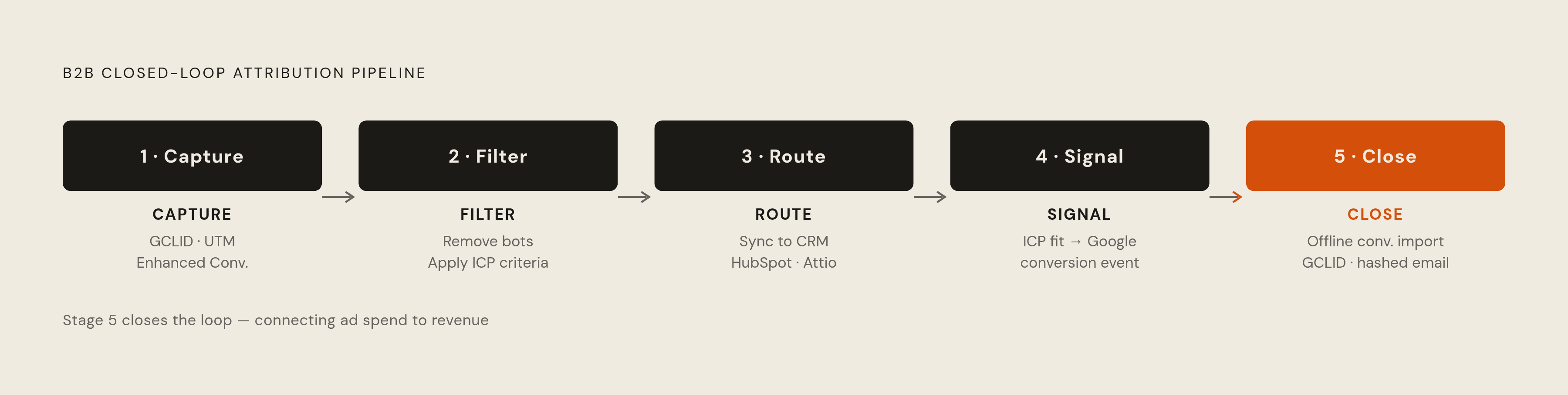
The workflow begins with clean capture of the acquisition signal. Capture GCLID or make sure Enhanced Conversions for Leads is firing, and pass UTM parameters through to the landing page. Those parameters keep track of where the traffic came from for the identification layer. Next, separate human sessions from bots and AI crawlers before scoring visitors. Apply ICP criteria covering industry, company size, seniority, and role, while keeping account-level and person-level records distinct.
The next stage routes qualified records to sales and the ad platform at the same time. Sync the person record, ad source, pages viewed, and ICP flag to HubSpot, Salesforce, or Attio. Check CRM status first to leave out existing customers and known closed-lost accounts. In parallel, return ICP-fit visitors to Google as a conversion event, using Customer Match for individual targeting only where actual email addresses meet its first-party requirements.
When the contact progresses to a qualified opportunity or closed deal, import the offline conversion through GCLID or hashed email. That outcome connects the original acquisition event to pipeline or revenue and tests whether the earlier visitor signal represented genuine value. Clicks and impressions remain diagnostic measures, while pipeline generated, revenue influenced, and cost per opportunity make the budget defensible.
The completed loop links spend to human visitors, routes qualified people to sales, and returns both early signals and eventual outcomes to Google. Channel and page analysis can then focus on the accounts that produce worthwhile pipeline. Budget can move toward what works on that basis. Identification opens the connection, but CRM outcomes close the loop.