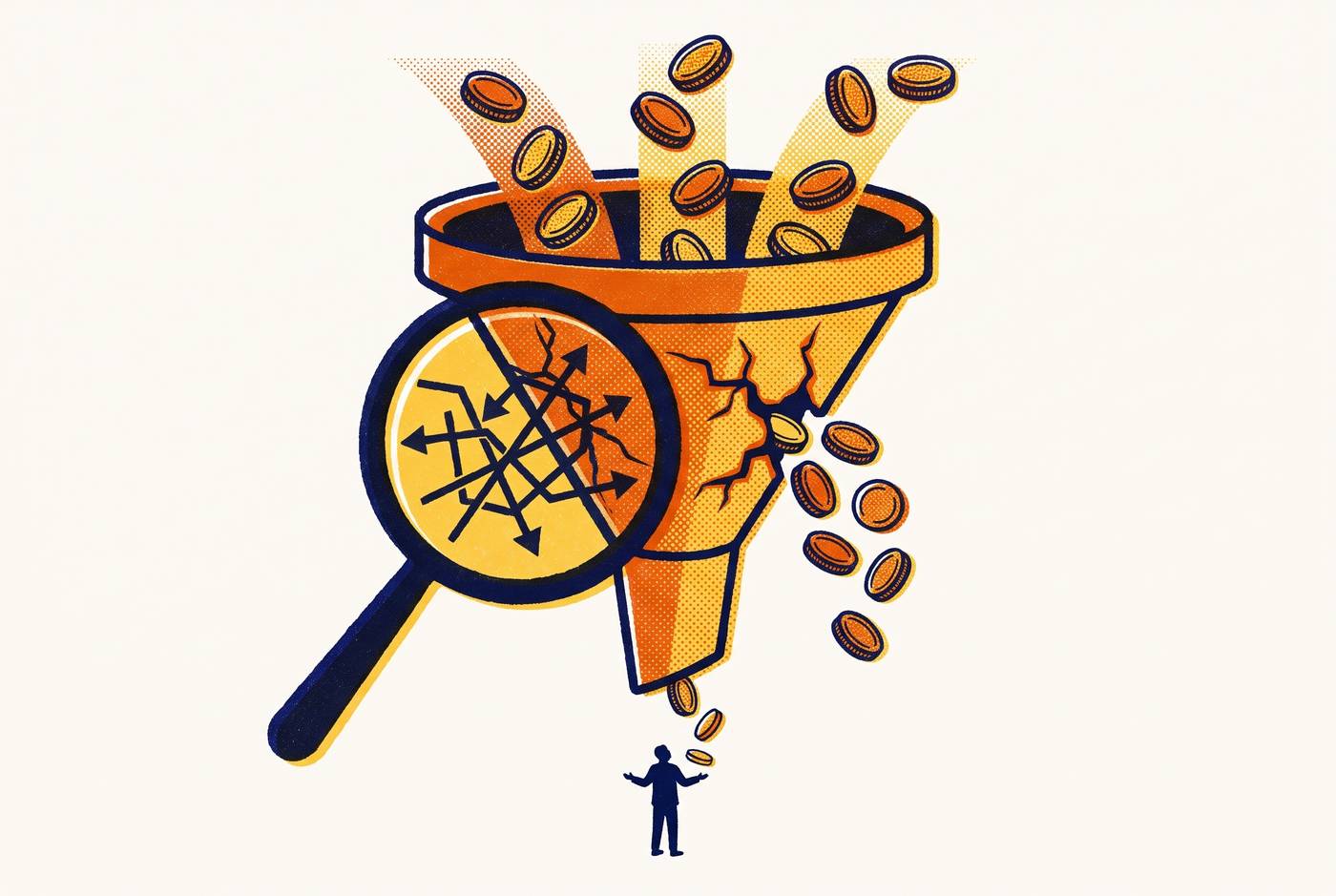
Common Revenue Attribution Mistakes in B2B Paid Programs
Fix identity and data quality before choosing an attribution model.
Revenue attribution mistakes in B2B paid programs usually begin before a model assigns credit. Signals about a company pass for person-level evidence, claims from platforms take the place of closed-won revenue, and gaps in the records break the link between them. The remedy is to fix identity and data quality first, so the model can distribute credit across a journey that the business can actually substantiate.
Why B2B paid attribution keeps failing despite better tools and models
The in-platform dashboard shows that the paid program is doing well, but the CFO’s P&L tells a different story. Marketing sees attributed conversions and revenue. Finance sees how much profit those deals made against what it cost to win them. The gap begins because the two views measure different things at different levels of resolution.
Browser privacy controls, long sales cycles, and journeys that truly are multi-touch make that gap harder to close. A single closed-won deal can involve a LinkedIn impression, a podcast, organic visits, a webinar, and a demo across multiple devices. Credit depends on connecting those encounters to buyers. No model can distribute it correctly when the underlying records cannot resolve who participated at each touchpoint.
ZoomInfo’s B2B attribution guide identifies the unit of analysis, rather than model choice, as the central problem. It describes greater improvement from moving contact-level measurement to the account level than from switching models. Account-level measurement means identifying the people involved and assembling their activity around the account.
How ROAS, ROI, and CAC payback measure different things — and why conflating them produces wrong decisions
Even clean identity data will fall short if the team has the wrong financial goal. ROAS divides revenue by ad spend and is useful for in-flight bid management, but it ignores margin and sales cost. Paid ads ROI subtracts ad spend from the gross profit of paid-attributed deals, then divides by ad spend. CAC payback counts how many months of gross profit it takes to cover acquisition cost, so retention and margin are key to judging the subscription business.
These metrics answer different questions about the same campaign. Strong ROAS can coexist with break-even paid ROI because revenue does not account for gross margin, sales effort, implementation cost, or payback time. Optimizing toward ROAS can therefore favor high-volume, low-quality channels over expensive channels that close larger deals. Teams should calculate ROI on gross profit or net contribution and take conversion rates from CRM.
What company-level identification actually tells you and where it stops
Company-level identification uses reverse IP lookup to resolve an organization and its firmographics. It does not identify an individual visitor. “Acme Corp visited your pricing page” is an account signal, whereas “Jane Smith, VP of Sales at Acme Corp, visited it twice this week” connects the activity to someone a sales rep can contact. Treating these outputs as interchangeable gives attribution more apparent precision than the evidence supports.
Person-level identification uses identity graphs that link emails, cookies, devices, and LinkedIn profiles. Those connections can attach a name, work email, title, and LinkedIn profile to a specific visit. Network conditions affect what can be resolved. Home internet connections fall outside corporate IP ranges, and tools identify a higher share of enterprise visitors on corporate networks than SMB visitors on residential ISPs or co-working networks. First-party cookies, email pixel matching, and identity graphs help compensate for the limits of reverse IP.
Geography imposes a separate limit on available identity. Under GDPR, person-level identification is, in practice, out of reach for EU traffic without affirmative opt-in, while company-level identification can still run as a legitimate-interest activity. Attribution must keep that difference in resolution clear so that evidence about an account stays separate from a named buyer’s activity.
How advertised match rates obscure the company-versus-person distinction
Most headline match rates for visitor-identification tools put company-level and person-level results into one number. A high reported rate typically describes sessions matched to companies because company-level matches are structurally easier to produce. That rate cannot establish how much traffic can be connected to a contact record.
Some vendor documentation separates the two rates, then presents the overall identification rate as their sum. Roughly half of that headline may mean only that a company visited. Non-human sessions make the figure harder to interpret. When AI agents, bots, and crawlers remain mixed with human traffic, the denominator describes a larger population than the actual human audience, obscuring what the tool identifies.
Diagnosing the reported rate requires determining what share represents a person with a verified work email, what share is company-level only, and how non-human sessions enter the calculation. A team accepting it builds attribution on an unknown mixture of company and person signals.
Platform over-reporting: why summing channel dashboards produces more conversions than actually happened
Website identification is not the only inflated input. Summing conversions from Google, Meta, and LinkedIn dashboards routinely produces a total above CRM-confirmed deals because multiple platforms claim the same conversion. A buyer who sees a LinkedIn ad, clicks a Google search ad, and converts can appear in both platforms’ reports. Adding those claims does not establish that two conversions occurred.
View-through attribution adds another claim without requiring a click. An impression can receive conversion credit within a platform’s window even when the team has not validated its contribution against CRM. Platform reports remain useful for bid optimization. They are not an independent record of how many deals closed or how much revenue the business earned.
The reconciliation anchor is CRM-confirmed closed-won revenue tied to an identified person at an identified account. Person records must be complete enough to match the visitors who converted, or reconciliation remains partial. Those matched records must then be aggregated around the buying account. Otherwise, removing duplicate platform claims still leaves marketing influence undercounted when several stakeholders contributed to the same purchase.
Attribution window mismatches that erase upper-funnel paid activity from the record
Correctly identified touchpoints can still disappear through window design. Dreamdata’s 2026 research found that B2B buying journeys take an average of 272 days. A 30-day attribution window applied to a journey measured in months excludes early activity. That leaves the report tilted toward channels that played a part near the close.
ZoomInfo describes a VP of Sales reading a blog in January, attending a webinar in February, and requesting a demo in March. A standard 30-day window cannot reach back far enough to capture the earlier touches. Awareness campaigns consequently look less productive than they are. Branded search and retargeting accumulate disproportionate credit, while the paid activity that helped create the opportunity becomes vulnerable to cuts.
Branded paid search adds the risk of organic cannibalization, because an in-window paid click can receive credit for a visit that would otherwise have arrived organically. Pause tests can expose a lower incremental contribution than platform reporting suggests. The design correction is to set attribution windows against observed CRM sales cycles by audience segment. Enterprise and SMB journeys often need windows of different lengths.
CRM data quality as the binding constraint on everything downstream
Three failures in CRM can undo all the fixes made earlier in the process. Missing contact-to-opportunity links leave the person who clicked an ad disconnected from the deal that closed. Inconsistent UTMs and campaign codes make channel reporting incomparable across regions or periods. Conflicting deal sources leave marketing calling a touchpoint “paid social” while sales records the deal as “referral.” A more elaborate model cannot repair those broken relationships.
HubSpot’s attribution documentation lists ways things can go wrong: contacts that are not linked to opportunities, deals that have no creation dates, and campaign codes that are inconsistent. Each breaks a different link in the chain. Without those links, a precise-looking result can still rest on incomplete or contradictory records. Agreement on the output requires agreement on the evidence feeding it.
Before evaluating a platform or model, a team should audit lead-to-opportunity completeness, UTM and campaign taxonomy consistency, and agreement between sales-stated deal sources and marketing records. That audit addresses the constraint directly. If those elements are broken, model work will not help. If they are clean, model choice becomes a much smaller part of the problem.
AI agents and crawlers as a new source of inflated intent signals
AI crawlers and agentic browsers introduce traffic that resembles buyer interest without proving human engagement. Standard analytics cannot reliably tell a buyer apart from a headless browser script that does the same things on a page. User-agent strings do not settle the question either. Bots can use residential IP rotation and spoofed browser identifiers to blend into ordinary traffic.
Agentic browsers create a more difficult identity ambiguity. They can operate inside a buyer’s browser, logged into her accounts, gathering pricing and integration details before returning a shortlist. Their visits may appear as human intent without producing an actionable contact record. Assigning that activity to paid-channel intent therefore gives a different kind of visit the meaning of direct buyer engagement.
Effective separation requires combined browser, network, fingerprint, and behavioral signals. For attribution teams, the immediate requirement is separate reporting for AI agents and crawlers before calculating human match rates or intent. Without it, the rate’s coverage remains unknown. Separate reporting also preserves a distinct source of intelligence about which content AI research agents consume, rather than discarding that activity or mislabeling it as human demand.
What fixing the identity layer actually requires in practice
The practical response is to build records that connect named visitors, their activity, and the opportunities associated with them. Where person-level identification is available, the minimum record includes a name, verified work email, job title, company, and LinkedIn profile attached to a visit. Account-only matches should stay clearly marked as account-level evidence. Human sessions must also be separated from AI agent and crawler sessions before match rates and intent signals are calculated.
Each identified visitor record should include the event journey, covering page views, scroll depth, exit intent, and form submissions. It should also retain the traffic source and ad platform that brought the visitor. Those details give attribution a traceable path. Without them, a named contact and a paid conversion can still exist as disconnected facts.
The destination of that record is equally important. A LinkedIn profile sent to Slack is a notification, while a person-level journey with email, phone, pages viewed, and ad source delivered into HubSpot or Salesforce becomes a CRM-ready record that can be tracked to close. Teams should check platform conversions against those records linked to opportunities, group stakeholders by account, and set windows using the sales cycles in CRM for each segment. These steps repair the evidence before a model assigns it weight.
How to evaluate whether your attribution is measuring identity or measuring noise
A paid team can run four checks this week before adjusting its model. The first is match-rate composition. Ask the visitor-identification provider to separate person-level matches with verified work emails from company-only matches and disclose the share of sessions filtered as non-human before calculating the rate.
The second check is platform reconciliation against CRM. Sum each paid platform’s reported conversions, then compare the total with CRM-confirmed closed-won deals in the same period. A material excess exposes duplicate claims. The records behind the comparison must connect the converting people to their opportunities so the gap can be resolved.
The third check tests windows against actual cycle length. Pull the median and 90th-percentile sales cycle from CRM for each deal segment and compare them with the windows set in each platform. Any window shorter than the median cycle erases touchpoints from typical journeys. The comparison makes that exclusion visible before it becomes a reason to cut upper-funnel spend.
The fourth check examines the latest closed-won cohort. Determine what share of deals have a contact associated with an opportunity, a populated campaign source field, and a deal creation date. These are the minimum fields needed for a model to work. A team that fails any check should fix what went wrong before weighing which model to use. The model is the last decision.