
Clearbit Ads Alternatives for B2B Audience Building
Four tool categories replace Clearbit, and each solves a different job.
Clearbit Ads alternatives for B2B audience building belong to four different categories. Enrichment, visitor reveal, paid-media attribution, and audience activation each do a different job. For non-HubSpot teams, choosing what to buy starts with working out which capability they lack, then testing tools for that job rather than for everything in Clearbit’s former product bundle.
Why Clearbit's absorption into HubSpot created four separate buying problems, not one
Clearbit’s standalone API sunset moved access to its capabilities inside HubSpot Breeze Intelligence, gated behind a paid HubSpot subscription. Access starts at Starter, but teams need Professional or Enterprise for advanced capabilities such as buyer intent and workflow automation. Reveal-class visitor de-anonymization is available on Marketing Hub Starter, Professional, and Enterprise, but teams need HubSpot Credits to use all of its features.
For non-HubSpot teams, the move took away two separate functions, enrichment of firmographic and contact records and identification of anonymous website visitors. Those functions require different tools. The buying decision also exposes two adjacent needs that a direct replacement may not address, which are connecting ad spend to identified accounts and activating those signals through retargeting or outreach. These are four buying situations: a platform that fills contact fields may still be unable to identify website visitors, show how a campaign influenced them, or trigger the next action.
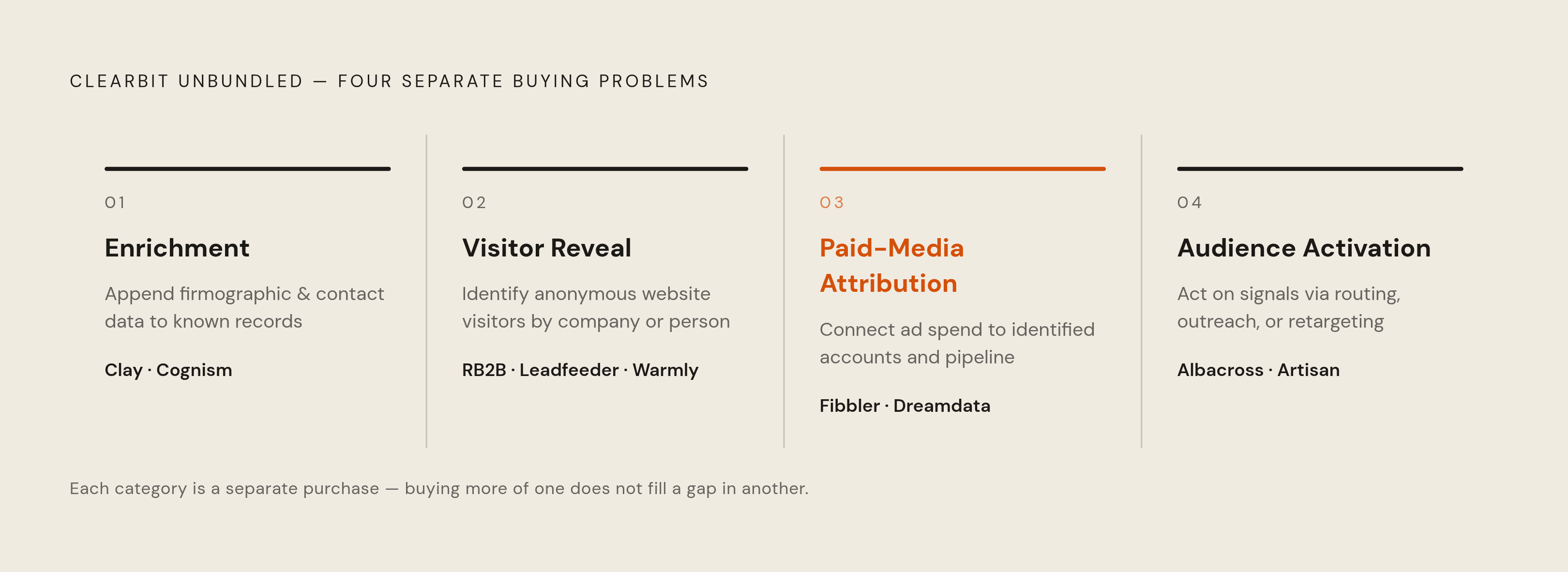
How visitor identification actually works, and why the company-level / person-level distinction determines which tool fits
Company-level identification matches a visitor’s IP address against corporate network ranges to surface a company name, industry, size, and location. This reverse-IP approach has global coverage in principle and is workable under GDPR and state privacy law when it does not process personal data. Its main constraint is network visibility. Residential connections, mobile networks, VPNs, and shared ISP ranges reduce match rates because an address may not resolve to an employer. Remote work has weakened this layer as more B2B browsing happens through home connections.
Person-level identification uses identity graphs, first-party cookie databases, and cross-device matching to find out who a person is. The resulting record can include a name, title, work email, LinkedIn URL, and phone number. Geography sharply limits this capability. Established platforms choose to limit person-level resolution to US traffic, and person-level match rates outside the US are near zero. Under GDPR, there is no established lawful basis for identifying EU visitors without explicit consent in this use case, though company-level identification is allowed when it does not process personal data.
That distinction determines both the attainable match rate and the appropriate action. Person-level matches come at a fraction of company-level rates, so the coverage a vendor advertises may be far from what it finds on a given site. Bot traffic adds another measurement problem. Sessions generated by crawlers do not represent buying intent, and treating them as human visits distorts performance reporting. Company-level signals support account prioritization and ABM targeting, while person-level signals support direct outreach, giving teams a reason to use both without treating them as substitutes.
Tools built for visitor reveal: what RB2B, Warmly, and Leadfeeder each actually do
RB2B identifies individual US visitors and sends those records to Slack, Teams, or other connected tools in real time. Its scope is deliberately narrow. It does not provide an enrichment API, page personalization, or ads, making it a focused option for teams that want to know which people to follow up with. Its US-only design reflects the geographic constraint on person-level identification. A low-friction, self-serve starting point fits buyers who already have an outreach workflow and need an identity signal to feed it.
Warmly combines identification of visiting companies, often at person level, with enrichment and routing to Slack, live chat, an SDR queue, or automated outbound sequences. Its AI outreach agents add orchestration to reveal. That changes the purchase being made. Pricing starts at $10,000 per year, with a sales-led process and no self-serve path. It fits teams seeking identification and outbound automation in one contract.
Leadfeeder, part of Dealfront, specializes in identifying visiting companies and their on-site behavior, with particularly strong European market coverage. Its unit of identification is the business. That makes it relevant to teams whose European traffic and account-level targeting needs outweigh the value of resolving individual US visitors. Its company-level approach also provides a workable route for European programs that do not need personal identification.
Tools built for enrichment: Clay, Cognism, and the waterfall approach
Enrichment starts with a known record and appends firmographic or contact data, rather than detecting who generated an anonymous session. Clay does this through waterfall enrichment that draws on more than one provider. It makes the lookup a sequence. Teams can stack provider calls until they find a valid result and build field-specific logic across vendors’ API responses. That approach suits RevOps and GTM engineering teams comfortable constructing multi-source workflows to improve accuracy.
Cognism addresses a different priority through European-focused enterprise data, GDPR compliance, and EMEA mobile phone coverage. It fits teams whose prospecting calls for deep contact data across countries and compliance more than a way to build their own provider orchestration. The commercial model also differs. Cognism requires a demo and an annual commitment at an enterprise pricing tier. For enrichment-only buyers, the evaluation should cover geographic and industry coverage, connection to the existing CRM, credits charged per lookup versus successful match, and the handling of stale records and re-enrichment.
Tools built for paid-media attribution: connecting ad spend to identified accounts
Paid-media attribution asks which ad exposures influenced accounts and deals. Reveal and enrichment do not supply that capability by themselves. The distinction becomes important when paid programs span ad platforms and CRM records. A visitor identity can establish who arrived, while an attribution platform connects marketing touchpoints to pipeline and revenue. Buying more identity data does not resolve an attribution gap.
Fibbler is a B2B attribution platform and official LinkedIn Marketing Partner connecting LinkedIn Ads, Google Ads, and Meta Ads with HubSpot, Salesforce, Attio, and Pipedrive. It fits LinkedIn-heavy programs that need account-level ad attribution inside the CRM without making HubSpot the hub. Dreamdata addresses the longer revenue journey. Its revenue timelines show campaign influence across deal stages, with attribution windows extending to 180 or more days. It syncs to Salesforce and HubSpot, while Pipedrive is supported only as an inbound data source.
Heeet stores attribution on standard Salesforce and HubSpot CRM objects, keeping reporting where pipeline and revenue data already live. That suits Salesforce-native RevOps teams seeking attribution inside their existing system. Adobe Marketo Measure, formerly Bizible, serves complex enterprise programs. It tracks touchpoints across paid media, email, webinars, and offline channels including events and direct mail, tying them to CRM pipeline and revenue. That route is a closer fit for teams that already use Adobe or Marketo infrastructure.
Visitor intelligence can complement these tools when an identified record includes the traffic source and ad platform that brought the person to the site. That adds identity to the campaign signal. It can show which companies and individuals arrived from a particular campaign. The attribution platform still supplies the broader connection across touchpoints and outcomes.
Audience activation: what to do with the signal once you have it
Once a company or person has been identified and connected to a campaign, the team must decide what to do next. Clearbit provided enrichment and visitor data but did not engage visitors, qualify intent, route leads, or move deals forward. Teams added execution through other systems. Chat tools, SDR workflows, and sales engagement platforms filled that gap, with each handoff adding latency. The activation purchase concerns how quickly a signal reaches an action.
Direct CRM and workflow routing pushes identified visitor data into systems such as HubSpot, Salesforce, Attio, Slack, and Microsoft Teams. The existing team or workflow then acts. Teams can use this route for a real-time rep alert or a CRM automation they already have, without adding another execution layer. Embedded AI outreach pairs identification with agents that qualify visitors, send messages, and book meetings. Warmly follows that model, while Artisan’s Ava BDR pairs company- and person-level identification with automated multichannel outreach.
Albacross identifies visiting companies, scores page-level intent, and syncs account audiences to LinkedIn, Google, and Facebook within one contract. It puts more weight on audience activation than on direct outreach. Factors.ai pairs multi-touch attribution with website visitor identification to link companies to touchpoints and help teams make better choices about ad spend. The selection turns on whether the signal must reach a human, enter CRM automation, trigger ad retargeting, or support all three, and whether existing integrations can do that without separate orchestration.
AI agent detection as an underappreciated data-quality problem for any visitor identification program
An identification program that mixes AI crawlers and bots with human sessions measures more than potential buyers. That affects both prioritization and reported coverage. User-agent strings identify bots that declare themselves, including GPTBot and ClaudeBot, but cannot reliably identify agents that impersonate browsers. Behavioral checks add automation flags, anomalous screen sizes, and browser fingerprint irregularities. Cloud-provider IP ranges such as AWS and DigitalOcean give more clues, while traffic from ISP ranges is more likely to come from people.
Those clues remain heuristics. xAI’s Grok retrieval traffic is reported to rotate proxy and datacenter IPs, including some residential and mobile-carrier addresses, while presenting Safari or Chrome user agents. The browser label cannot settle the distinction. No IP range file or robots.txt contract exists for that traffic, illustrating why user-agent checks and network-origin assumptions leave gaps. Behavioral detection can contribute evidence, but a human-looking request is not sufficient evidence of a human buyer.
With RFC 9421 HTTP Message Signatures, agents can use cryptography to prove who they are. Cloudflare’s web bot authentication standard uses the protocol, although adoption remains early. This is forward-looking context. The immediate concern is how each tool classifies traffic before calculating a match rate. Counting bot sessions as unresolved human visits inflates the denominator and understates human identification, while counting bots as identified visitors inflates the numerator with non-buyers.
For buyers, the practical evaluation question is whether crawler and AI agent sessions are detected, classified, and excluded from the human match-rate calculation. The denominator must be explicit and comparable. A rate measured against all sessions is not directly comparable to one measured against human sessions alone. Bot handling belongs in the identification evaluation because, without that distinction, two tools can appear to differ in coverage when they are partly differing in traffic classification.
How to map your actual use case to the right category of tool
Teams that need to replace enrichment of form submissions and CRM records should look at enrichment platforms first. Clay fits multi-source waterfall logic, while Cognism fits EMEA contact depth and compliance requirements. Anonymous session detection is a separate purchase. For company-level website identification, Leadfeeder maps to European coverage and Albacross to identification with retargeting, with GDPR posture and European match rates to confirm before buying. For person-level US reveal, one vendor fits direct delivery into existing workflows, while Warmly fits identification combined with outbound automation.
Teams that need to link ad spend to account-level pipeline should start with dedicated attribution. Fibbler maps to LinkedIn-heavy programs, Dreamdata to long-cycle revenue attribution, Heeet to Salesforce-native reporting, and Marketo Measure to enterprise multichannel programs. Ad-source fields can complement that layer. Where needs overlap, the next step is to evaluate identification platforms with CRM routing and ad-source tracking before adding separate attribution or activation software. Consolidation is useful when it reduces handoff latency.
For enrichment, export a sample of recent leads or customers, run the same list through candidates, compare completed fields, and spot-check accuracy in the countries and industries served. Calculate the credits a typical month would consume. For reveal, test against actual website traffic and ask how human sessions are separated from crawlers before comparing match rates. The buying decision should rest on those results.