How Paid Campaign Match Rates Expose the Real Cost of Bot-Diluted Session Counts
Filtering bots first shows how much of your paid traffic you truly identify.
A website visitor identification match rate is the number of resolved units divided by the size of the population measured, shown as a percentage. Its meaning depends on whether those units are sessions, visitors, companies, or people, and whether bots are excluded. For paid campaigns, separating non-human traffic before calculation reveals identification coverage over real buyers and exposes costs that click totals alone conceal.
Why bots now constitute a structural problem for paid campaigns, not an edge case
Imperva’s Bad Bot Report 2026 found that bots accounted for a majority of web traffic in 2025, the second consecutive year machines outnumbered humans online. Not every automated visit is malicious. However, the population includes bad bots built to click ads, fill forms, and drain budgets, as well as crawlers and autonomous agents with other purposes. Paid campaigns operate within this mixed environment rather than encountering automation only during isolated fraud spikes.
Detection has also become more difficult to sustain. Generative AI makes sophisticated bots cheaper to build, while realistic mouse movements, scroll depths, and session durations help them evade standard verification. Cloudflare’s directory includes 28 of 95 agents that send no distinguishing user-agent. GPTBot, ClaudeBot, and PerplexityBot declare themselves, but browser-based agents can inherit standard Chrome user-agents. Consequently, a familiar browser signature does not establish that a visitor is human.
How non-human sessions enter paid campaigns specifically
Paid traffic encounters three overlapping layers of automation. General Invalid Traffic includes declared crawlers, known data-center IPs, and bot signatures that are easy to recognize, and Google’s ad traffic quality team catches much of it before billing. Sophisticated Invalid Traffic uses residential proxies, real browser fingerprints, and human-mimicking behavior to evade those controls. AI crawlers and autonomous agents also touch ads or load landing pages without acting like people who might buy. Some visits also escape standard GA4 views because the agents do not execute JavaScript.
The click-to-session gap provides a practical starting diagnostic. On Google, the comparison is platform-reported clicks against analytics sessions, while on Meta it is reported link clicks against landing-page views. A large spread can expose paid interactions that never become measured visits, although the gap alone does not establish that every missing session was a bot. On Meta, a pixel event triggered only after scrolling or a defined dwell time adds a measure of post-click engagement.
Server logs provide a separate view of that discrepancy. They can show requests that GA4 misses when bots do not run JavaScript, making the difference a starting estimate of otherwise invisible traffic. These comparisons measure different stages of the visit and should not be treated as interchangeable counts. Together, they explain why platform filtration and credits cannot establish the quality of the entire downstream population.
The two ways bot-diluted sessions waste paid budget — and why the second is worse
The direct cost is budget spent without a prospect. Fake clicks, impressions, and form fills use up resources, and each of these interactions can be costly for high-CPC campaigns. The second cost begins when those interactions become conversion signals. Automated bidding then treats fraudulent outcomes as successes and learns to seek traffic with similar characteristics. The damage compounds through the campaign’s feedback loop.
Anura’s June 2026 executive brief reported that one audited demand-side platform reached a 90% fraud rate because fraud produced signals that looked like success. That case illustrates the mechanism within one audited demand-side platform. Both volume-based and value-based bidding learn from the signals supplied to them. A change in bidding strategy therefore cannot compensate for continuing to label spam as a valuable outcome.
The same contamination reaches sales operations through Salesforce or HubSpot. Fake leads waste sales time, distort lead scoring, and inflate pipeline figures with contacts who were never prospects. The diagnostic pattern is rising conversions without corresponding qualified leads or revenue, sometimes accompanied by improving cost per lead and falling sales acceptance. The corrective action is to return real business outcomes through CRM-connected lead quality and bidding corrections. Visitor identification needs the same population discipline before its records feed that system.
How do website visitor identification tools calculate their match rate percentage?
The formula is resolved units divided by population units, expressed as a percentage. The denominator is the decisive qualification. A rate measured against all sessions answers a different question from one measured against unique visitors, bot-filtered sessions, or geographically eligible traffic. There is no shared industry definition or published standard that makes vendor headline percentages automatically comparable.
Four measures commonly appear under the same label. Session match rate uses eligible unique sessions, while visitor match rate uses eligible unique browser or first-party identifiers. Account match rate shows how many eligible visits are matched to a company they likely came from, often through reverse IP. Person-level candidate rate measures a narrower eligible population against individual identity resolution. These measures cannot substitute for one another.
Their technical limits also differ by identification level. Company identification relies on reverse IP through BGP and regional registries, but residential networks, mobile connections, VPNs, and cloud egress undermine that mapping. Remote and hybrid work intensify the problem because a home IP can identify an ISP. Person-level identity graphs instead depend on cookies, hashed emails, and device IDs, leaving gaps where consent blocks, ad blockers, or absent trackable histories prevent resolution.
Geography adds another denominator choice for multinational campaigns. US company-level coverage is substantially higher than coverage for UK, German, or other non-North-American traffic. A US-scoped percentage therefore cannot describe an entire international paid audience.
How bot-polluted session counts corrupt the match-rate denominator and overstate identification coverage
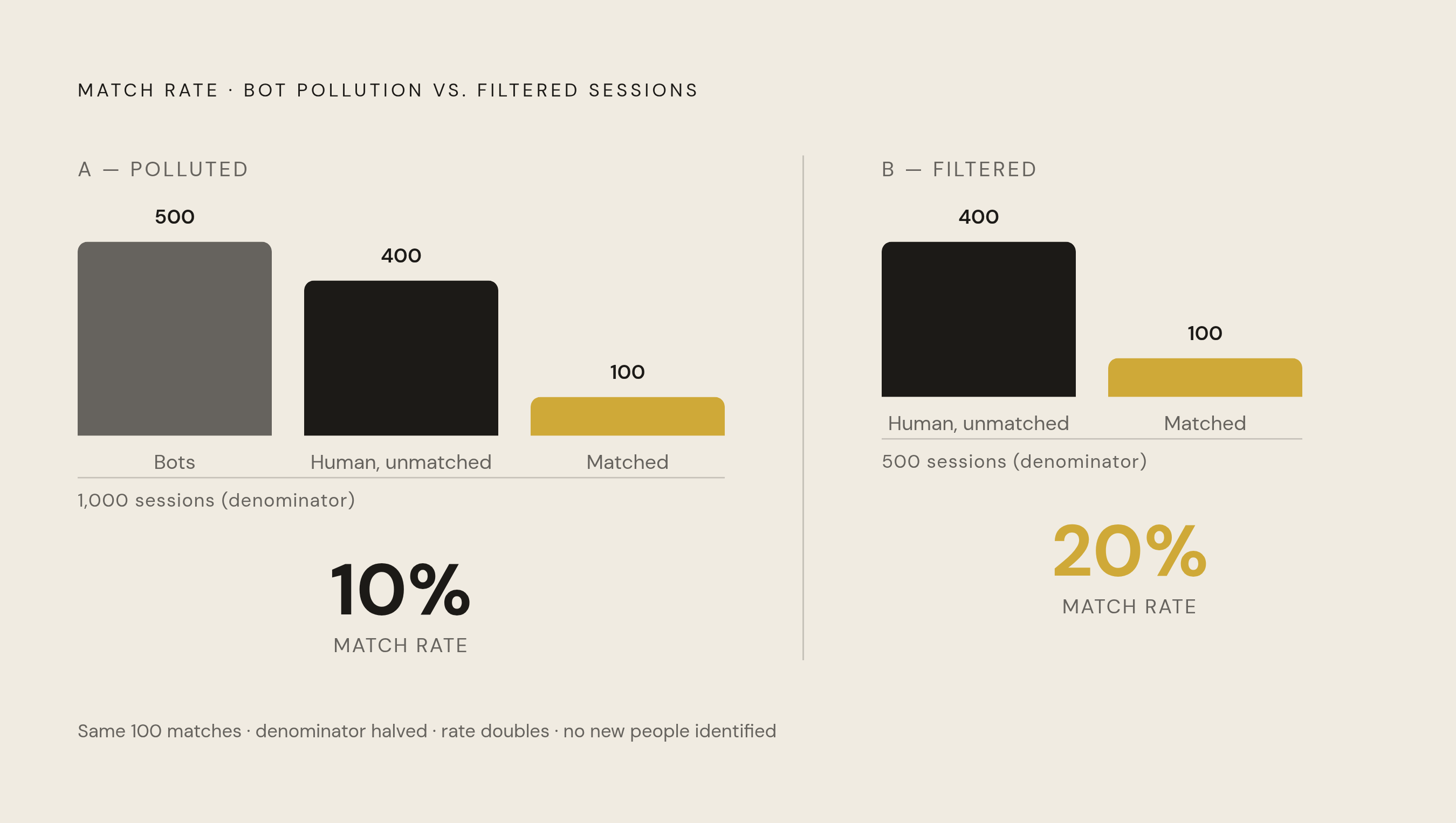
The mathematical effect depends on both sides of the ratio. If bots make up half the counted population and none contributes a valid match, removing them halves the denominator and doubles the rate without identifying another person. If more than half are bots, the change is larger. Denominator cleanup alone therefore raises coverage when the valid numerator stays fixed. A lower rate after filtering requires a change in what also counts as a match.
That distinction explains how polluted traffic can overstate identification. Bots that arrive through paid channels can be matched to data-center IP ranges, so a company match can look like a buyer even when it comes from a bot. When those easy matches enter the numerator, the headline describes identification of a mixed population. Removing them from both sides can lower the reported rate if they were disproportionately easy to resolve.
Paid social and display can be especially exposed to data-center bot populations. Consumer overlap and high mobile share further complicate the identification of genuine business visitors. A high overall percentage can therefore hide poor coverage of buyers, while a low percentage can be partly due to bots that went unmatched. Neither reading is reliable without population separation.
Non-human matches can create CRM records, trigger Slack alerts, and enroll contacts in outreach, so an error in measurement can lead to sales activity. Taking bots out before calculating the rate keeps that activity from being counted as proof that buyers were identified.
What honest match-rate measurement looks like in practice, and what the empirical evidence shows
Reported independent measurements across B2B sites with substantial session volumes span roughly one-in-seven to nearly two-in-three sessions for company-level identification. Person-level identification on the same sessions covered a small single-digit fraction of total sessions. Those ranges describe different kinds of resolution. They are not interchangeable benchmarks or guarantees for another site, particularly when the audience, geography, and traffic composition differ.
A person-level claim approaching company-level coverage warrants scrutiny of whether the categories have been conflated or most sessions excluded from eligibility. Similarly, a US-heavy campaign and a European campaign can produce different rates with the same tool. Comparing their headline figures without those details makes differences in who visits look like differences in the technology.
A credible methodology names the denominator explicitly. It distinguishes all sessions, bot-filtered sessions, and verified human B2B sessions, then reports company-level and person-level results separately. It also states geographic scope and separates high-confidence company matches from inferred ones.
For buyers, the practical test is specific and limited. Ask what the denominator is, whether bots are excluded before calculation, and which geographies the percentage covers. Then ask how inferred company assignments differ from high-confidence matches. A percentage without those answers has an unspecified measurement basis.
How the leading visitor-identification tools handle bot filtering and what that means for match-rate claims
Reverse IP provides an account, while an identity graph can provide an individual, reducing the further research needed to find a contact. A LinkedIn profile delivered to Slack is also different from a person-level record containing contact details, browsing activity, and ad-source attribution. None of these outputs alone establishes whether bots were excluded from the reported rate.
RB2B identifies individual visitors for US traffic and sends name, title, company, LinkedIn profile, and pages viewed to Slack. Its free plan became company-level-only in January 2026. Paid tiers range from person-level identification without emails to plans with business emails and CRM integrations, and premium resolution also covers traffic from outside the US. Its person-level coverage remains US-focused, making geographic scope important when assessing multinational campaigns.
Warmly combines company-level and person-level identification with real-time Slack alerts, AI chat engagement, native CRM integration, and Bombora intent scoring. Its workflow includes automated follow-up after identification. Plans move from an entry tier for de-anonymization to a higher tier for the full AI inbound autopilot.
HubSpot Breeze Intelligence, formerly Clearbit, offers company-level buyer intent paid through HubSpot Credits. Enrichment goes directly into HubSpot company and contact records without middleware. The standalone Clearbit product was absorbed into HubSpot, making ecosystem fit central to the comparison. Leadfeeder instead provides company-level identification with HubSpot and Salesforce integrations. It reverted from the Dealfront name on March 24, 2026, with no pricing change.
Salesforce completed its acquisition of Qualified on April 1, 2026, making it the Salesforce-native option in this comparison. Qualified engages identified and company-matched visitors through live chat and an AI SDR agent. The available product details do not establish a shared, comparable bot-filtering procedure across these tools.
AI-agent separation remains a distinct evaluation requirement for each. A tool that excludes crawlers and bots before reporting human identification coverage measures a different population from one that includes them. For paid attribution, person-level identification tied to Google, Meta, or LinkedIn ad source can connect the individual who converted to the originating campaign and platform. That connection supports closed-loop attribution only when the underlying record represents a real buyer.
The practical steps for cleaning paid campaign sessions before measuring match rates
Compare platform-reported clicks with analytics sessions for each campaign, and use link clicks against landing-page views on Meta. Treat the spread as a starting diagnostic. This baseline gives later filtering changes a consistent reference.
The next step is platform-level exclusion of identifiable low-quality traffic. In Google Ads, build IP exclusions from known data-center ranges, high-frequency IPs surfaced in analytics or server logs, and identifiable competitor office IPs. The named data-center ranges include Google, AWS, Azure, DigitalOcean, and OVH. Remove Search Partners where post-click behavior materially underperforms, and on Meta exclude audiences that trigger the pixel but never scroll.
Edge filtering then narrows what reaches the site. WAF or CDN rules through Cloudflare, Fastly, Akamai, or AWS WAF Bot Control can challenge known bot ASNs, block residential-proxy providers by reputation, and rate-limit repeated fingerprints. These controls protect site activity but do not establish that an earlier ad click was never billed. Cloudflare also supports controls for individual AI crawlers and the Search, Agent, and Training behavior categories.
Analytics cleanup comes next, with a check of server requests against GA4 sessions and the removal of non-human activity before identification is reported. Conversion-signal correction addresses what campaigns have already learned. Feed CRM-connected lead quality back to the platform, retract or restate spam conversions, and optimize value-based bidding toward verified revenue.
Finally, recalculate match rates using the filtered human population, and state the identification level and geography. The percentage may rise or fall depending on which invalid sessions and matches were removed. AI agents require explicit separation within that process because they increasingly reach paid-channel landing pages referenced in generative answers and can resemble human engagement on standard metrics. Human buyer coverage, rather than coverage of every automated visitor, is what makes the resulting attribution and pipeline data useful.