The Match Rate Gap That Makes Your Paid Channels Look Worse Than They Are
Bots in the denominator drag paid channels' match rates down unfairly.
A website visitor identification match rate is the number of matches divided by the traffic pool used to calculate it. Vendors report different rates because they match different kinds of identities and use different denominators. When that denominator includes bots, paid channels can look less effective than they are because they absorb more unresolvable sessions. A fair comparison requires a clean human-session denominator and identified visitors linked to their ad source.
Why bot traffic is a paid-channel problem, not just a site-hygiene problem
The tools meant to measure paid performance can record noise as signal. Automated traffic now accounts for the majority of HTML web requests, and paid campaign landing pages are exposed to crawlers through publicly discoverable and ad-linked URLs. Bots only need to load the page to enter traffic reports.
Those visits can inflate pageviews and bounce rates while suppressing average session duration, with the effects attributed to the recorded acquisition channel. Explosive growth in agentic AI traffic compounds the problem as systems take actions on behalf of users. This is more than a site-maintenance concern. A campaign can attract qualified human visitors yet show weak aggregate conversion because automated sessions enlarge the pool against which conversions are measured.
How visitor identification match rates are calculated — and where the denominator hides
The calculation is straightforward, but its inputs are not. Website visitor identification match rate equals matches divided by the stated denominator, expressed as a percentage. That denominator might include all sessions, only eligible visitors, or a filtered subset of traffic. Without the pool’s definition, the percentage says little about how much of a site’s audience the tool resolves.
Some vendors remove residential and mobile traffic before calculating their rate, a practice described as qualifying the traffic pool. The smaller base raises the reported percentage without necessarily producing more matches. Other tools restrict measurement to high-intent pages or visitors who stay beyond a time threshold. Those can be defensible engineering choices. However, a rate calculated on those visitors is not a rate for the whole site.
A tool may count a match at the moment it resolves an identity without accounting for subsequent contact data decay. B2B contact data deteriorates as details change. A headline rate that never updates shows an earlier match but gives no assurance that the contact can still be reached. Vendors can differ both in whom they count and in when they count them.
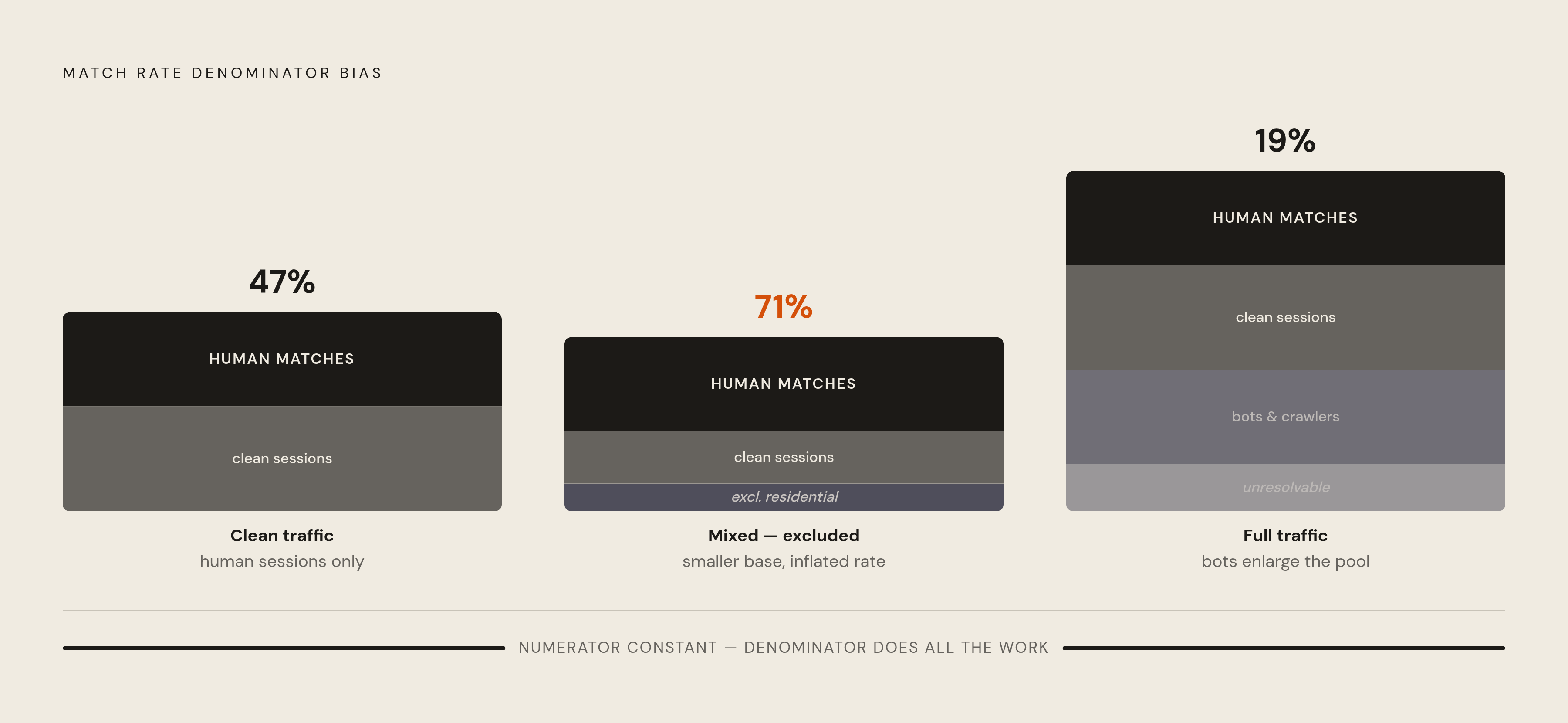
As a practical benchmark, realistic company-level rates run from roughly a third to two-thirds of clean human traffic, while realistic person-level rates on US traffic are far lower, at 5–20%, with each rate measuring a different kind of match. Bots push the rate in the opposite direction from traffic qualification. When unresolvable automated sessions remain in the denominator, the same human matches become a smaller share of a larger pool. The tool looks worse at identification even though it can still match real buyers just as well.
Why paid channels absorb more unresolvable sessions than organic ones do
Paid traffic is structurally more bot-exposed than organic traffic, so a mixed denominator does not penalize every channel equally. Paid display and programmatic channels face impression fraud, click fraud, and AI crawlers reaching campaign landing pages through ad-indexed URLs. These visits add sessions without adding identifiable buyers. A lower identity yield can come from a change in the mix of traffic even when demand from human visitors is just as strong.
Branded search and direct traffic provide the clearest contrast. They skew toward returning, authenticated people who already know the brand, giving them a cleaner denominator. A CMO comparing paid display with branded search is therefore comparing measurements with different amounts of contamination. The display result includes more unresolvable noise. Last-touch attribution can then over-credit the cleaner, later channel while under-crediting the paid channel that reached qualified humans earlier.
That asymmetry can redirect budget without revealing itself as a measurement error. Spend moves away from a channel that appears to produce fewer identifiable buyers, even when the humans it reaches are valuable. The reported gap cannot be attributed to media quality until the human and automated portions of traffic have been separated.
What person-level versus company-level identification actually resolves — and what it misses
Company-level identification maps a visitor’s IP address to an employer, establishing which account visited. It works globally and offers a GDPR-defensible approach, with realistic match rates of 30–65% of traffic on capable tools. An account-level output limits what the match can establish about an individual’s ad exposure or subsequent journey.
Person-level tools use a pixel to capture cookies, device identifiers, and a browser fingerprint, then match those signals against an identity graph. The data in that graph comes from cookie syncs, form fills, and third-party data partnerships. A successful resolution can return a name, work email, and LinkedIn URL. Coverage is geographically uneven. The graph has dense coverage in the United States but little elsewhere, so international person-level match rates are effectively zero.
For attribution, a named person can connect the visit to ad exposure, a CRM record, a nurture sequence, or a lookalike audience with precision that an employer match alone cannot provide. But person-level resolution also depends on which tracking signals are available. Ad blockers, anti-tracking extensions, and privacy-focused browsers cut down on those signals, and roughly three in ten global internet users use some form of tracking prevention. An unresolved session is not necessarily a bot. Identification level and bot classification must therefore remain separate measurements, because neither a company match nor a person match establishes that the traffic denominator was filtered correctly.
How to measure whether a visitor identification tool is correcting for the bias or inheriting it
The buyer should first ask what traffic enters the denominator and how bot and AI-agent sessions are handled before the rate is calculated. A vendor that cannot explain the base has not established that its rate measures human identification performance. The omission leaves the central bias unresolved. Buyers should also ask whether company-level and person-level matches are reported separately, since a combined figure cannot establish the yield of named contacts.
Does the vendor remove residential and mobile traffic, and what share of total sessions remains after those exclusions? If high-intent pages or time thresholds determine eligibility, the published rate applies only to that subset. The scope should be explicit. Buyers should also ask how often the rate is recalculated and whether it accounts for contact data decay, so that an initial match is not confused with a currently usable record.
Vendors should explain concretely how the tool classifies AI agents, crawlers, and known bot signatures before setting the denominator. When the number of human matches stays the same, removing bots raises the human-session match rate. An openly reported rate may still look lower than a competitor’s claim based on heavily qualified traffic, but that difference comes from several choices about how to report the rate as well as bot removal.
The evaluation should extend from the match to the visit record. Does the named visitor arrive with pageviews, scroll depth, ad source, and exit intent signals, or only a name and LinkedIn URL sent to Slack? A rep needs context to act on a match. For paid attribution specifically, the record should include the traffic source and ad platform that brought the visitor. Otherwise, the tool resolves the person while leaving unanswered how the channel performed.
How the tools on the market handle the denominator problem in practice
Leadfeeder is company-level only, making its coverage relevant to account identification. It is suited to EU and GDPR-sensitive teams. The platform used the Dealfront name from April 2023 until March 2026 before returning to Leadfeeder. Its free-forever tier covers up to 100 identified companies per month with seven-day data retention, while paid plans are billed annually. It does not publish a match rate, so a headline percentage cannot establish either its coverage or its denominator treatment.
RB2B separates an important geographic constraint from the broader category promise. Its person-level identification is US-only, while its free tier provides company-level identification. Paid tiers differ in the contact details and integrations they provide. Those distinctions affect what a buyer receives. A company-level result, a LinkedIn URL, and a business email should not be treated as equivalent attribution records, and none of those outputs alone explains whether automated sessions were excluded from the rate.
Factors.ai focuses on account-level identification and combines it with marketing attribution and journey analytics. Its person-level context comes through integrations such as RB2B. That makes the workflow broader than a standalone identity notification. Account coverage and integrated person-level coverage describe different outputs and should be reported separately. The combined workflow still needs a clear explanation of which sessions count in each calculation.
HubSpot Breeze Intelligence, formerly Clearbit, illustrates why an earlier product’s reputation cannot substitute for a current evaluation. The available reports from people who use it describe lower contact-level match rates than the original Clearbit Reveal and higher costs than standalone Clearbit. Those reports are not a disclosed denominator. Breeze also lacks phone enrichment, which limits the contact data that can be used for downstream activation. Its identification yield needs to be checked on its own, apart from the enrichment fields and integrations that come with it.
Koala presents a different evaluation risk altogether. It closed in September 2025 after its team joined Cursor and is no longer available. Old feature descriptions or match-rate claims cannot support buying it now. Tool continuity belongs in the assessment before coverage is compared.
Across these options, identity level, geography, pricing structure, and workflow differ, but those differences do not themselves demonstrate pre-calculation bot filtering. The denominator remains a separate capability to establish. A product can provide useful account intelligence or contact enrichment while inheriting the same traffic contamination as the analytics system it is meant to improve.
Closing the loop: connecting identified visitors back to paid channel performance
Identification corrects paid-channel measurement only when the filtered human record retains the source of the visit and reaches the systems where decisions are made. Leadpipe’s growth marketer guide describes a feedback loop that moves from channel spend to identified visitors, routes ICP-fit accounts into nurture, retargeting, or sales, and measures which channels produce pipeline-worthy accounts. Budget then follows qualified account yield. This replaces the assumption that every recorded session represents an equal opportunity to reach a buyer.
A channel with a higher CPL can produce more ICP-fit identified humans and therefore outperform a cheaper source whose leads are less relevant. Form-only measurement can hide that distinction. Identification adds evidence about the accounts a campaign reaches before they submit a form, while source linkage preserves the connection between those accounts and the spend that brought them.
Activation also changes who enters paid audiences. Standard pixel retargeting can include bots, job seekers, and competitors, whereas identification-powered retargeting builds audiences from named, ICP-fit accounts and suppresses existing customers and closed-lost accounts. Hashed email and phone data can be sent to Meta Custom Audiences and Google Customer Match. Clean contact data supports that handoff. The ad platform’s audience match rate is a separate measurement from the website identification rate, so a low site-wide resolution percentage does not by itself describe the value of the humans successfully identified.
The integration path makes that value operational. A visitor identified by domain and person is enriched with contact data and ad source, matched to a CRM account, and routed through a Slack or Teams notification into a personalized sequence. Webhooks and API access let the record reach existing CRM and advertising tools. Each handoff preserves the connection between acquisition and action. When bots are removed from the denominator and identified humans retain their ad source, paid channels can finally be compared on equal footing for the qualified accounts they produce.