Why Your Paid Campaign Match Rate Looks Broken When the Denominator Includes AI Crawlers
Counting crawlers as sessions drags match rates down, so use engaged human paid sessions.
A website visitor identification match rate is the percentage of sessions resolved to an identity, calculated as matched sessions divided by the chosen session population and expressed as a percentage. Including AI crawlers in that population depresses person-level match rates because crawlers cannot supply the human identity signals needed for a match. For paid campaigns, the useful denominator is engaged human sessions from paid sources, with company-level and person-level matches reported separately.
How bots now make up more than half of web requests, and why that share keeps rising
Bots account for more than half of web traffic in broad measurements, but the measured population changes the reported share. Cloudflare Radar data pulled October 1, 2026 showed that bots made up a much larger share of all web requests in Q3 2026 than in Q3 2025. Requests also are not interchangeable with analytics sessions. A network-level traffic figure establishes the scale of automation, while a site's session records establish its exposure to measurement distortion.
The composition of that traffic is changing too. AI crawlers, AI assistants, and AI search bots are a fast-growing part of automated traffic, beyond the search-engine and monitoring bots that analytics teams learned to filter years ago. LovedByAI's study of 924 WordPress sites covering September–October 2026 found that, over the month-long window, AI crawlers made more requests than Googlebot on the median small business site. As training, assistant research, and AI search grow, automated systems have more reasons to fetch pages even when no human visits.
Who the AI crawlers actually are, and what distinguishes them from legacy bots
Cloudflare Radar AI Insights for July 2026 identified Googlebot, operated by Google, as the largest share of AI-bot requests on its network, feeding Search and AI Overviews. Microsoft's Bingbot feeds Bing and Copilot, while Apple's Applebot serves indexing and training purposes. These roles overlap with established search crawling. Consequently, the distinction between legacy search bots and AI traffic is not simply a distinction between old and new user-agent names.
Other operators fetch content primarily for training or product improvement. Meta's Meta-ExternalAgent and OpenAI's GPTBot have training as their primary purpose, as does ByteDance's Bytespider. Amazon's Amazonbot supports training and product improvement, while Anthropic's Claude-SearchBot indexes content to improve Claude's search result quality. A pricing-page fetch may be for a training process or a search index.
Common Crawl has acknowledged crawlers falsely claiming its CCBot identity, and any bot operator can choose the user-agent string it sends. Forward-confirmed reverse DNS cross-referenced against published IP ranges provides a technically sound method for verifying crawler identity. User-agent filtering alone therefore cannot prove that a crawler is what it claims to be, or that a session that looks ordinary comes from a human.
How unfiltered AI crawler sessions poison analytics before they ever reach a match-rate calculation
A training-crawler fetch that becomes an analytics session introduces distortion before any identification rate is calculated. A pricing-page session with sub-second duration, near-total bounce, and zero engagement signals adds to the session count and brings down engagement measures. The attributed channel absorbs the resulting conversion-rate penalty. Whether analytics assigns that session to organic, paid, or direct traffic, the record adds activity without adding a prospective buyer.
The contamination can then flow into activation systems. If a crawler hit fires a retargeting pixel, it seeds an audience pool with a non-human record. Lookalike audiences built partly from those sessions can optimize toward more bot-like traffic. The effect is not limited to reporting.
CRM and sales workflows are further downstream. A visitor-intelligence platform pushing identified sessions into HubSpot, Salesforce, or Slack can also pass along contaminated intent signals. An SDR told that a named person visited a pricing page several times may get a journey that includes training-crawler fetches using a spoofed corporate user-agent. Persistent device fingerprints, hashed emails tied to real identities, and mobile advertising IDs provide the human signal bundle that crawler processes cannot supply, making tools that require those signals structurally more resistant to contamination than IP-only tools.
How do website visitor identification tools calculate their match rate percentage?
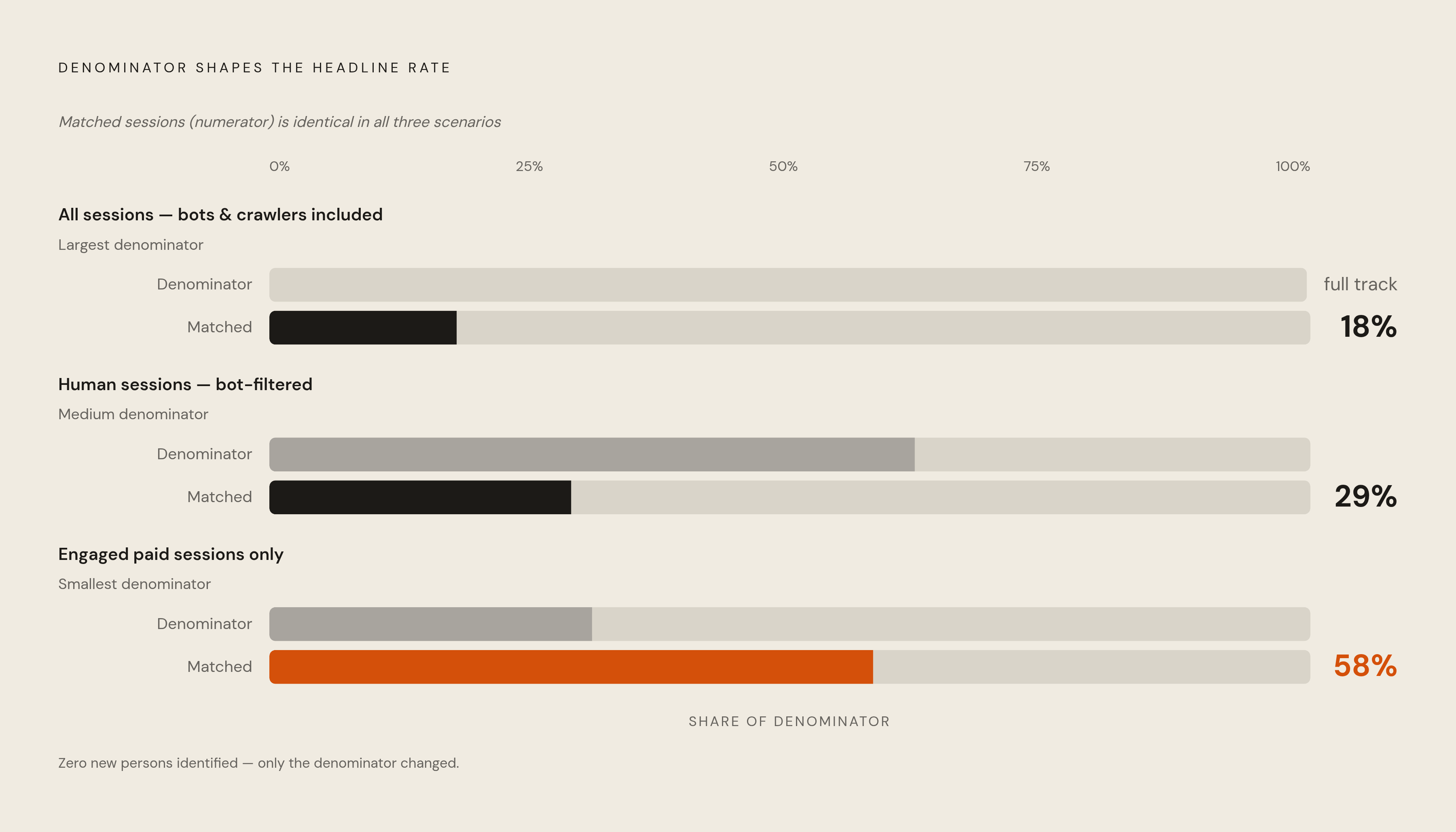
The numerator counts sessions resolved to an identity. The denominator specifies which sessions were eligible to be counted, including total sessions, filtered sessions, or a vendor-defined population between the two. Dividing the numerator by that denominator and expressing the result as a percentage produces the reported rate. Tools that do equally well at identification can therefore report very different headline rates.
Including bots, single-second bounces, monitoring pings, and training-crawler fetches enlarges the denominator without necessarily adding matches. Removing unmatched traffic raises the rate even if the tool identifies no additional people. Neither calculation is inherently dishonest in isolation. However, the two rates are not comparable unless the exclusions are disclosed and the same population is used.
The meaning of “identity” introduces a second difference. Company-level identification through reverse IP lookup covers a meaningfully larger share of sessions than person-level identification, which requires a prior identity graph event such as a tracked email click, known cookie, hashed email match, or logged-in session. A corporate network is not a named individual. Reporting company-level matches as the headline figure therefore measures something different from reporting person-level matches, even when both figures are labelled “match rate.”
AI crawler contamination is especially damaging to the person-level calculation because crawlers cannot supply those prior human identity events. Geography also changes the available signals, with GDPR constraints contributing to significant differences between US and EU person-level match rates. A meaningful comparison must establish the identity level, session exclusions, and geographic population before judging the percentage.
Why paid campaign attribution is the specific context where denominator inflation causes the most damage
Paid campaign decisions depend on rates that automated sessions can quietly degrade. A training crawler can fetch a tagged URL or follow a referral path that analytics attributes to a paid source. That adds a session to the channel without adding conversion potential, lowering the reported conversion rate even though the campaign has not performed worse. Attribution does not establish a human visit.
The same distortion affects visitor identification reporting. A rate calculated against bot-inclusive traffic understates the share of real humans that the identification tool resolved. A team may then cut a campaign, reduce bids, or abandon a landing page because the denominator includes sessions that could never become person-level matches. The budget decision rests on the wrong population. For this purpose, the relevant denominator is engaged human sessions from paid sources, rather than all sessions, all human sessions, or an undisclosed blend.
The inverse failure is possible in company-level reporting. Data-center IPs can be an easy bucket to tag, so removing them can reduce a headline match rate even as identification performance on actual human sessions improves. Both sides of the fraction have changed.
Multi-touch attribution and view-through crediting depend on session continuity, but an agent researching a vendor for a buyer appears as one entity while the eventual human conversion appears as another. The journey becomes fragmented across those entities. As agent-mediated research grows, excluding automated sessions from human match rates must coexist with measuring their separate role before conversion.
How to audit your own match rate by separating the AI-crawler denominator from the human one
The practical response is to audit the session population before recalculating the rate. The first step is to find which sessions came from bots by checking forward-confirmed reverse DNS against published operator IP-range files. This establishes the automated population to separate from human traffic. The second step is to isolate paid-source sessions within the bot-filtered human population and apply the engagement criterion used for the campaign calculation. Filtering only after calculating the headline rate leaves the original denominator problem unresolved.
The third step is to inspect what qualifies as a match. A company-level match identifies a corporate network, while a person-level match resolves a named individual with an email, title, and verifiable journey. Those outputs support different uses. A vendor comparison should therefore ask whether the headline figure counts companies or people, which sessions it excludes, and whether the paid-source population can be reproduced independently.
The underlying record is as important as the label. A person record containing name, title, company, LinkedIn, business email, a do-not-call-filtered phone number, classified seniority and job function, and a full event journey is a lead. That journey has details on page views, scroll depth, exit intent, and ad source. A data-center IP tagged as a company visit is a signal.
Webhooks and API access to raw session data let a team inspect the population behind the reported rate and reproduce the calculation. A proprietary view alone cannot provide that auditability. A well-designed tool should also detect and classify AI-agent sessions from ChatGPT, Claude, and other operator bots as a distinct traffic category.
What a clean, bot-excluded match rate actually looks like for a paid campaign, and what to do with it
A clean paid-campaign person-level match rate divides matched, engaged human sessions from a paid source by all engaged human sessions from that same source. The numerator and denominator describe the same population. Company-level identification can have its own report so that corporate-network matches are kept apart from named people. This produces a campaign-specific measure of identifiable buyers rather than a site-wide percentage diluted by unrelated traffic. It also makes comparisons dependent on disclosed criteria.
The gap between that corrected rate and the bot-inclusive rate reveals the distortion introduced by the original denominator, provided the identity definition remains unchanged. Campaigns that appeared weak can look materially better once sessions without conversion potential are removed. Person-level records tied to Google, Meta, or LinkedIn ad sources then show which companies and people the paid activity influenced, giving teams the data they need to calculate paid-media ROI. Their names, titles, and journeys make the result usable beyond the analytics dashboard.
The next step is to apply the cleaned population downstream. Retargeting and lookalike audiences rebuilt from bot-excluded, person-identified visitors use real buyer signals. Sales teams can also get identified records through Slack, CRM integration, or webhooks while the buyer's interest is fresh. Delivery speed affects the usefulness of the match. A record available during the buyer's research has a different operational value from a report reviewed days after the visit.
AI-agent activity should still be tracked as a separate research channel. Tracking which agents, including ChatGPT and Claude, fetch paid landing pages and product content reveals the systems accessing that material and the content they consume. Training crawls and buyer-directed research still need to be read in different ways. For agents researching on a buyer's behalf, those fetches provide a view of activity that may precede a human session.