The Matching Stack Behind a Paid Click That Ends With a Named Person in Your Pipeline
Four layers turn anonymous paid clicks into contacts, and match rate alone won't prove it works.
A website visitor identification match rate is the percentage of eligible, unique visitors resolved to a defined identity at a stated confidence threshold. Turning those matches into named pipeline contacts requires four working layers, which are signal capture, identity matching, enrichment, and activation. A high match rate alone does not establish that the chain works.
Why a paid click is anonymous by default and what it takes to change that
Ad platforms know who saw and clicked an ad, but the advertiser’s website does not inherit that knowledge. The browser separates the two systems. Google Analytics and GA4 record events such as sessions and pageviews rather than giving the advertiser a named person to contact. A session is not a sales contact, even when its source, page sequence, and conversion events are visible.
That separation creates a gap between paid traffic reporting and pipeline creation. An advertiser can know that a campaign generated visits without knowing which individuals arrived or whether sales can reach them. Closing that gap requires more than attaching a name to an analytics event. It requires four sequential layers, each with an output the next layer needs and a failure mode that can stop the process.
The four-layer resolution chain: what each step does and what it passes to the next
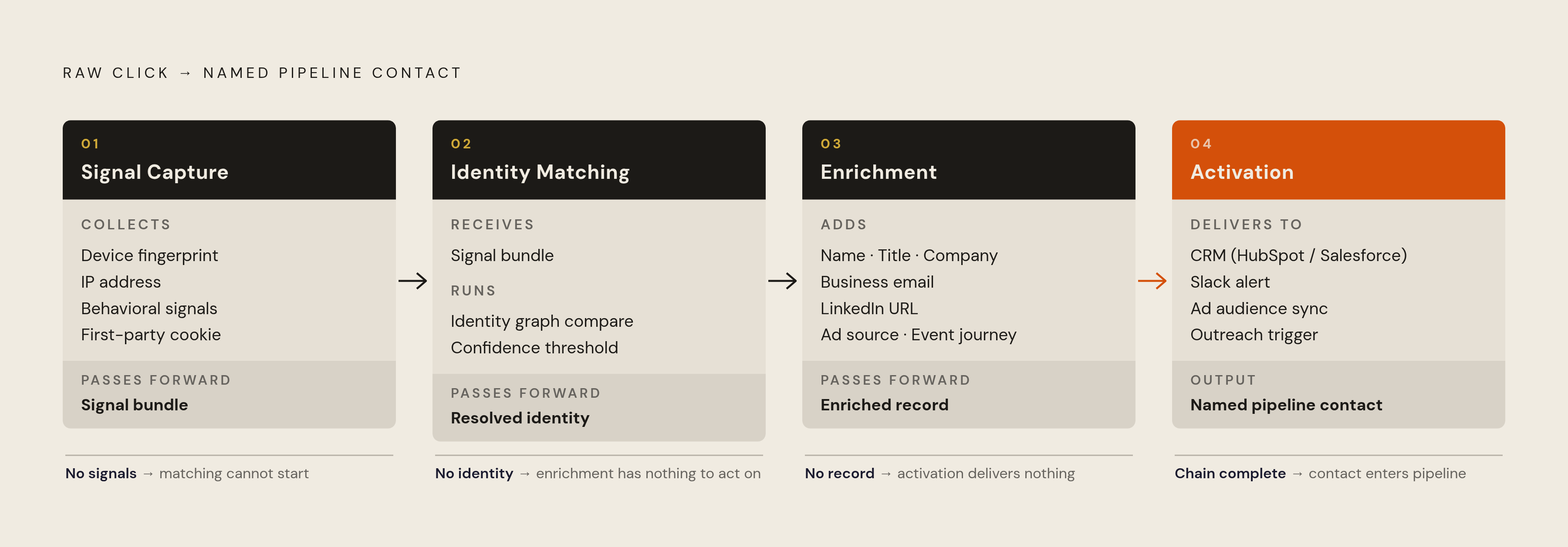
The chain runs from signal capture through identity matching and enrichment to activation. Signal capture gathers the raw signals from the device and the visit. Identity matching compares those signals against an identity graph and passes a resolved identity to enrichment. Enrichment adds contact details and context, while activation delivers the resulting record into a CRM, an alert, an ad audience, or an outreach workflow.
Each handoff depends on the one before it. Matching cannot begin without captured signals, and enrichment cannot expand an identity that has not been resolved. Activation without useful enrichment produces a notification with too little context for sales to act on. Viewed as a diagram, the chain is a series of dependent outputs.
Layer one — signal capture: what the pixel actually collects and why cookie loss breaks it
A pixel collects the raw material for resolution, including a device fingerprint, IP address, and behavioral signals such as scroll depth, page sequence, and time on page. Mobile advertising IDs may also be available. A first-party pixel sets a persistent cookie on the advertiser’s own domain, allowing it to survive restrictions aimed at third-party cookies. Capture quality starts with these underlying signals.
Browser policy changes make this foundation uneven. Safari and Firefox block third-party cookies by default. Chrome reversed its planned phase-out in 2024, and third-party cookies remain on by default, managed through user settings. The practical distinction is between first-party capture and a dependence on third-party cookies, rather than an assumption that every browser supplies the same input.
Under GDPR and similar rules, a visitor who dismisses a consent banner may never get the cookie. Non-human traffic is a separate problem when counting visits because script-based pixels may never see raw-HTML crawlers. GPTBot, ClaudeBot, and PerplexityBot therefore require explicit treatment in traffic accounting rather than an assumption that client-side analytics captures and classifies every visit. Missing signals weaken matching, while inconsistent traffic accounting weakens the rate used to judge it.
Layer two — identity matching: deterministic vs. probabilistic, and why the difference determines what you can do with the result
Deterministic matching uses exact identifiers, including a login email, purchase record, or clicked email link, to connect a visitor to a known identity. It depends on prior identification somewhere in the graph. Probabilistic matching instead infers identity from device fingerprints, IP addresses, and behavioral patterns. Its reach can be broader, but its output may identify a person with only probabilistic confidence.
The distinction governs both confidence and coverage. Many visitor identification systems combine the approaches, using probabilistic signals to surface candidates and deterministic data to validate a match. A resolved record should therefore be understood in terms of the evidence supporting it. More identifying fields do not, by themselves, establish that the underlying match is exact.
Reverse IP lookup maps an address to the business that owns it, producing an account. Company-level matching can cover a minority to a majority of traffic depending on the audience, with office-network enterprise visitors more readily resolved than remote workers on residential broadband or mobile. Person-level resolution produces an individual’s name, email, or LinkedIn URL, but in practice its reach is effectively limited to US traffic by consent constraints elsewhere.
An account flag cannot show who did the research. Demandbase, 6sense, and LinkedIn can use company-level signals to reach buying groups, but that is different from targeting the specific person who visited. Person-level records support that individual activation. A buyer evaluating matching must distinguish the confidence of the inference from the level of identity delivered.
How do website visitor identification tools calculate their match rate percentage, and how can you audit it?
A useful calculation begins with a defined population. The numerator is deduplicated visitors receiving the stated kind of match, and the denominator is eligible unique visitors during the same period. The report must also state its confidence threshold and eligibility rules. Without those definitions, two percentages can describe different populations and different outputs while appearing directly comparable.
A common way to inflate the identification figure is to add person-level and company-level rates together. That sum mixes contacts a sales rep might email with accounts that merely indicate business interest, and it can obscure overlap between the groups.
Traffic composition adds another source of disagreement. Bots, internal visits, unsupported geographies, consent-blocked visits, and sub-threshold records change the population available for resolution. Including non-human traffic only in the denominator would lower a rate. Inconsistent classification or exclusion creates methodological risk, so reports need to account explicitly for unresolved and ineligible traffic, including inconvenient visits.
For a self-audit, fix a 30-day window and use unique visitors as the denominator, with eligibility exclusions disclosed. Export the identified people, deduplicate them, and keep company-level results separate. Then check a sample of the identified contacts for email deliverability and whether they still hold the same roles. Multiply the person-level match rate from the audit by the share of contacts that pass those checks to estimate the usable contact rate.
Layer three — enrichment: what turns a matched identity into something a sales rep can act on
A matched identity is not yet an actionable lead. Minimum useful B2B enrichment includes name, title, company, business email, and LinkedIn URL, with a company-domain email preferred over a personal address. Phone data adds another contact route.
Seniority, job function, region, visit count, and an ICP fit flag help describe the visitor, while CRM status distinguishes an existing customer or known contact from someone net new. Traffic source and ad platform show what brought that person to the site, including Google, Meta, or LinkedIn.
Behavioral context makes the record useful for an actual conversation. The event journey can include page views, scroll depth, video plays, exit intent, and form submissions. A VP of Engineering who visited the security architecture page three times from a LinkedIn ad presents a different opening from a bare profile link. Identity alone does not reveal that sequence.
Enrichment cannot repair an uncertain underlying match. Confident firmographics attached to a probabilistic identity remain attached to a probabilistic identity. Freshness also limits utility because an outdated role or business email can stop outreach even when the original match was correct. The audit’s survival fraction applies here too, and data refreshed in weekly batches has more time to go stale than data from real-time enrichment.
Layer four — activation: how an enriched record reaches the tool where revenue happens
Activation moves a record out of the identification dashboard and into the sales motion. A CRM write to HubSpot, Salesforce, or Attio supports pipeline tracking, while Slack or Teams alerts bring the record to immediate attention. Ad audience sync lets the record be used for retargeting, and an outreach trigger starts follow-up. The destination determines what can happen next.
A real-time alert can reach sales while the visitor is still in the buying moment, whereas an end-of-week export separates discovery from action. A LinkedIn URL alone offers little guidance. A briefing containing name, title, company, the pages read, the referring ad, and a one-click CRM sync gives sales both context and a path forward.
Source attribution links the visit to the campaign, and sending the identified record back as a matched audience lets it be used for retargeting and suppression. Custom workflows need access beyond pre-built integrations through cryptographically signed webhooks or a REST API. AI-agent detection belongs at this handoff as a data-quality control, because GPTBot and ClaudeBot activity must not become sales leads. A fast delivery mechanism only accelerates errors when its input is misclassified.
Where the chain breaks in practice: the five failure points most teams miss
Diagnosis first checks whether the capture layer separates human traffic from bots before defining the measurement population. Consent dismissal and browser restrictions can also leave the signal pool smaller than the session count suggests. Matching cannot bring back signals that were never collected. A rate based on unexplained traffic exclusions makes this first failure difficult to see.
The second diagnostic check distinguishes purchased outputs that identify people from those that identify only companies. An account flag gives sales no named individual to contact. Account-based platforms can still use it to reach buying groups, but that does not make it a person-level record. Treating the two outputs as equivalent creates a pipeline expectation the matching layer cannot satisfy.
The third diagnostic check distinguishes a summed headline rate from a person-level figure. A combined percentage can hide how few people are in the contact pool. The next test is how much of that pool survives deduplication, email deliverability checks, and current-role checks. A reported match becomes commercially useful only if the resulting contact can support the intended action.
The fourth diagnostic check assesses whether enrichment is current and deep enough for outreach. An outdated title or personal email can delay contact even when the identity is correct. Missing behavioral context creates a different obstacle. Without the event journey, sales receives a name but little basis for deciding how to approach it.
The fifth diagnostic check verifies whether activation reaches the CRM and returns the identified audience to the ad platform. Records that stay in the dashboard never make it into the pipeline. Alerts without context or CRM sync leave sales to fill in the details or move the record, and failing to send the audience back limits suppression and retargeting.
What a working resolution chain looks like end to end
A working chain starts with a clean human signal and ends with a usable record in the systems that run sales. Matching resolves who the person is at a stated confidence threshold, and company-level results are reported separately. Enrichment adds contact details that are up to date, the full event journey, and the ad source. Activation then delivers that context in real time rather than leaving the record inside a reporting interface.
The output has a concrete operational form. Sales receives a named contact with title, company, business email, LinkedIn profile, and the behavior that prompted attention. HubSpot or Salesforce receives the record, Slack receives the briefing, and the ad platform receives the matched audience. AI-agent detection labels non-human activity separately to keep it out of that sales path.
Combining several layers in one platform can reduce handoffs, but it does not remove the need to evaluate each output. A strong capture layer cannot make up for uncertain matching, and complete enrichment cannot make up for a record that never gets delivered. The acceptance standard is the handoff itself. Each layer must give the next layer the identity, context, or delivery it needs before the paid click can become a named pipeline contact.