What Ad Spend Data Reveals When AI Bots Crawl Your Landing Pages
Server logs and CRM data expose bot-driven conversions that quietly corrupt automated bidding.
To detect AI agents on a website, compare server logs with analytics, match declared user agents, and assess IP ranges, signed-agent metadata, and behavior. Requested URLs show which pages crawlers access, while analytics alone misses those that do not execute JavaScript. On paid landing pages, the goal is not merely to block crawlers but to stop their activity from training bidding algorithms on false conversion signals.
Why AI bot crawls on landing pages are a paid media problem, not just a tracking problem
Imperva’s Bad Bot Report 2026 says that automated traffic makes up most of the world’s web traffic. Human visits can no longer be the default assumption. For paid media teams, that changes the old model of invalid-traffic management, in which a suspicious interaction prompted a platform adjustment and an analyst filtered the session. Automated bidding gives that interaction a second life as a learning signal.
When a bot fires an event counted as a conversion, Google’s bidding algorithm can treat it as a successful outcome. Budget can then move toward traffic resembling the session that produced it, even though no buyer entered the funnel. A defense must therefore address both what campaigns learn and which requests reach the page.
What AI crawlers actually do when they hit an ad-linked landing page
AI crawlers generally retrieve content. That distinguishes them from modern bad bots that mimic scrolling, typing cadence, and form-filling to evade filters. A crawler request is also different from a human referral from a generative answer, while an active browser agent may retrieve a page, browse, and click. These categories should not be treated as interchangeable.
The tracking consequences depend on what the crawler executes. If it runs JavaScript or triggers a pixel, it can instantiate a session, query a pricing database, and fire tracking events. Inside GA4, the resulting record may be structurally indistinguishable from a human visit. A request that skips JavaScript execution can reach the origin server and remain absent from analytics.
User-agent matching therefore provides only part of the picture. Some crawlers send no distinguishing user-agent string, and passive-crawler defenses built around redirects, cloaking scripts, or conditional rendering do not necessarily protect against active agents. A visit to an ad-linked URL also does not prove that a paid click took place. The attribution risk arises when crawler activity becomes a recorded success that teaches the algorithm something false about a source or keyword.
How bot sessions distort the three signals automated bidding depends on
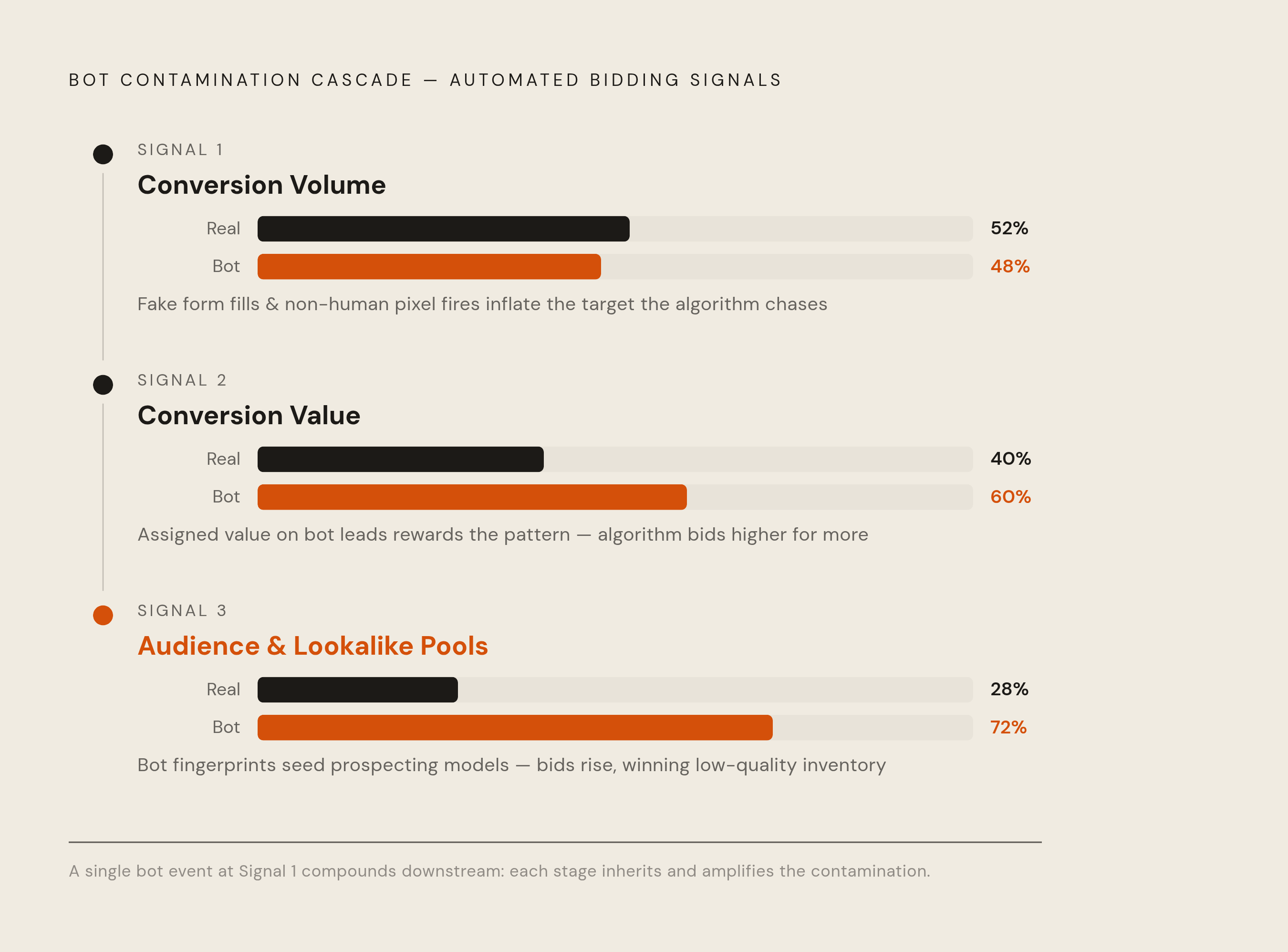
Conversion volume is the first vulnerable signal. Fake form fills, non-human pixel fires, and bot events tagged as conversions increase the count that volume-based bidding optimizes toward. In B2B campaigns, a fake lead can remain in the CRM for weeks before sales rejects it, leaving the algorithm to run further cycles on the original signal.
Conversion value is the second vulnerable input. Value-based bidding improves the objective only when the assigned values reflect real revenue. A bot-generated lead with a positive value still rewards the pattern that produced it.
Audience and lookalike pools are the third channel. Remarketing pixels can admit bot fingerprints into retargeting audiences and seed prospecting models with non-human behavior. These extra conversions can then push bids higher, win more low-quality inventory, and make audience drift worse. The platform’s invalid-traffic filters catch some declared crawlers and known data-center traffic, but they cannot catch every request that uses residential proxies, real browser fingerprints, or user agents that seem legitimate.
How can you tell if AI bots are crawling your website and distorting attribution?
A diagnostic pass can begin with account, analytics, server-log, and CRM data, with specialist tooling optional. The strongest warning is a divergence between conversions and commercial outcomes. Conversion volume rises, or platform cost per lead falls, while qualified leads, sales acceptance, and revenue fail to follow. Fake names, junk emails, and visits from places outside campaign targeting give more reason to look into the traffic.
To isolate crawler activity, compare server requests and GA4 sessions for the same landing page over the same period. Requested URLs establish which content was accessed. User-agent matching can identify declared crawlers, while IP-range verification, signed-agent metadata, and behavioral detection help assess requests without distinguishing strings. A large log-to-analytics gap is evidence to investigate, with its value as a complete count of AI agents limited by requests and sessions being different units.
Platform-specific discrepancies provide another diagnostic layer. On Meta, a gap exceeding 20% between reported link clicks and landing-page views on a fast, well-instrumented page signals possible bots and misfires. In Google Ads, invalid clicks and invalid click rate columns expose patterns at campaign, ad group, and network level, with elevated Display and video rates warranting investigation. CRM records add context when paid leads consistently show short time-on-page, no scroll depth, and no return visits before submission. Together, these observations establish the baseline against which any repair must be judged.
Why blocking bots is necessary but not the fix that recovers attribution quality
Blocking cuts incoming waste but cannot undo what the algorithm has already learned. Some invalid traffic will also pass the controls. Even with a rule that blocks known LLM user agents, requests that can be spotted only through IP ranges or signed-agent metadata still need to be detected. Prevention is therefore the first layer of attribution repair.
CRM outcomes distinguish real opportunities from empty submissions, and corrected values tell the ad platform which apparent successes were not valuable. Value-based bidding is useful when those values come from closed revenue. Without that connection, the campaign can continue rewarding noise.
Retroactive correction does not refund the original spend. Its purpose is to stop the error from compounding as the algorithm gradually reweights toward real conversions. That distinction sets a realistic recovery objective. The durable gain is better allocation of future budget, supported by evidence of buyer quality.
The layered defense of edge filtering, analytics hygiene, and CRM signal feedback
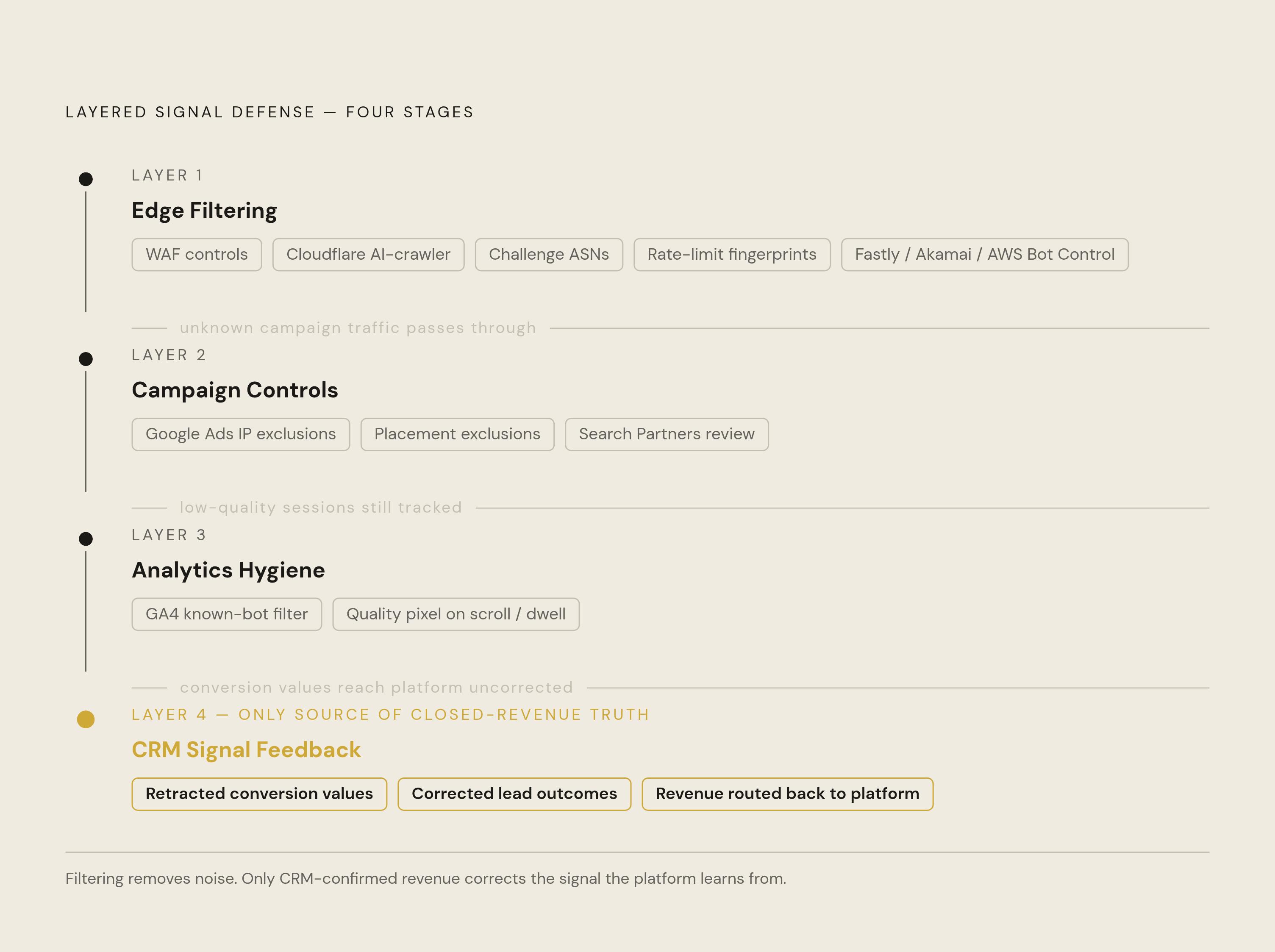
The work starts upstream with edge filtering. WAF controls can challenge known bot autonomous system numbers, use residential-proxy reputation scores, and rate-limit requests that keep coming from the same fingerprint. Cloudflare’s AI-crawler controls let operators allow, charge, or block individual LLM user agents by name. Fastly, Akamai, and AWS WAF Bot Control also provide AI-crawler controls. These address access, leaving the validity of downstream conversions unresolved.
Campaign controls narrow the remaining exposure further. Google Ads IP exclusions can use known data-center ranges and addresses flagged in server logs, while placement exclusions take low-quality mobile-app inventory out of the campaign. Search Partners can be reconsidered where post-click behavior meaningfully underperforms. These choices should follow the diagnostic evidence.
Analytics hygiene then gives a better denominator for judging traffic. GA4’s known-bot and spider filtering is on by default and cannot be turned off, but it is not a complete AI-agent detector. An additional pixel event triggered only after meaningful scroll or dwell time provides a quality measure to compare with raw clicks. The final layer routes CRM outcomes back to the platform, correcting or retracting conversion value for leads that never progressed beyond the first sales touch. This requires paid media, sales, and data teams to coordinate the outcome routing that filtering alone cannot supply.
How person-level visitor identification separates real buyers from crawler noise on paid traffic
Company-level identification shows which company may have visited a landing page. It does not show who sales should contact. Person-level identification instead resolves a session, where a match is available, to an individual with a name, title, company, LinkedIn profile, and business email. That record can support CRM enrichment and audiences grounded in real people.
The distinction becomes concrete when a paid visitor reaches a pricing page and leaves without submitting a form. An identified person provides a prospect record for follow-up, while the ad source and behavioral journey explain the context. Pages viewed and scroll depth help show what the visitor saw. Identity supplies an actionable contact, but CRM qualification still determines commercial value.
Crawler sessions inflate total traffic and compress the apparent identification ratio when included in the denominator. Reporting only an undisclosed eligible subset creates the opposite problem by obscuring coverage of the wider paid audience. A useful report separates human and automated traffic, states the population being measured, and preserves the connection between identity, ad source, and journey.
What to look for in visitor identification tools when paid attribution accuracy is the goal
Evaluation begins with the unit of identification and the denominator behind the match rate. Recognizing a company, matching a visit to a person, and identifying only eligible traffic are different claims. Geography also constrains what a reported rate means. Tools should make total paid-session coverage distinguishable from human-only identification performance, while deeper integration can turn a match notification into a usable CRM record.
RB2B offers person-level identification for eligible United States traffic, matching visits to people in their professional roles where a match is available. Pricing is available on request. By contrast, 6sense combines anonymous website activity with Revenue Intelligence and ABM. Its Company Identification API, previously called the 6signal API or Company Details API, associates network signals with businesses using first-party identifiers and device-level signals where permitted.
Demandbase takes an enterprise ABM approach using IP addresses, cookies, probabilistic matching, and an identity graph. Company identification is also the default for HubSpot Breeze Intelligence, which enriches records with firmographic and technographic attributes. HubSpot acquired Clearbit in December 2023 and introduced Breeze Intelligence in 2024. In June 2026, HubSpot announced its acquisition of Warmly and plans to incorporate its visitor-identification and AI agent technology into Smart CRM. Those plans should be distinguished from an established integration capability.
Leadfeeder, formerly Dealfront, offers company-level identification with strong positioning in European markets. Factors.ai identifies the companies that visit and tracks their journeys over multiple visits even when the people remain anonymous. Leadinfo acquired Visitor Queue in January 2026, reflecting consolidation in the affordable company-identification segment.
The final evaluation standard is explicit bot and AI-agent separation combined with person-level enrichment, ad-source attribution, and CRM or webhook integration. Detection and identity serve different purposes here. A tool that reports crawlers separately can provide a human identification denominator, while a full person record and event journey support qualification and signal correction. Those capabilities should be evaluated directly rather than inferred from an advertised match rate or a company-identification feature.
Why CRM-connected attribution is the only viable source of truth for B2B paid media cycles
B2B buying journeys can take many months, while platform dashboards show early events before it is known whether they led to revenue. That delay gives corrupted signals room to influence targeting. A dashboard can show that an event occurred without establishing that a human generated it, the lead qualified, or the opportunity produced revenue. CRM-connected attribution supplies the missing commercial outcome.
Fibbler, an official LinkedIn Marketing Partner, connects LinkedIn Ads, Google Ads, and Meta Ads with HubSpot, Salesforce, Attio, Pipedrive, Zoho CRM, and Microsoft Dynamics 365 to link ad engagement to pipeline. The full chain begins with a human session tied to a person, ad source, and behavioral journey, then moves through CRM enrichment and qualification to conversion-value feedback. If automated sessions pollute the first record, downstream systems inherit the error.
In the repaired system, an identified paid visitor enters the CRM with the context needed to assess the opportunity. When that opportunity closes or dies, the outcome returns to the platform as a corrected conversion value. The goal is not perfect bot elimination but training data grounded in real, identified buyers and the revenue outcomes they produce.