The Paid Click Visitor Record That Must Log Pages Clicked Scroll Depth and Ad Source Before Outreach Costs You Budget
Log pages, scroll depth and ad source per visitor, or outreach wastes spend.
Factors.ai and Leadfeeder are RB2B alternatives for company-level attribution and identification, but neither should be mistaken for a complete person-level outreach record. For paid teams seeking more than a LinkedIn profile, the standard is identity joined to pages visited in sequence, scroll depth per page, and the exact ad source. Without those layers, a paid click risks costing the team twice, first in spend and then in poorly targeted outreach.
Why the visitor record a paid click creates is almost always incomplete
Ad spend buys a visit, but the record it leaves often cannot show what the visitor wanted. With 98% of B2B website visitors leaving without filling out a form, the visit itself may be the only signal available from that spend. Standard analytics shows that visitors arrived through sessions, pageviews, and bounce rate. Establishing a reason to call requires knowing which pages a named person read in sequence, how far they scrolled into each page, and which ad funded that person’s visit.
A campaign can produce visits while leaving an SDR unable to connect a prospect to the content that attracted them. Even an identified visitor remains difficult to approach credibly when the record contains no account of their engagement. The missing context becomes a messaging problem. Outreach then risks treating a brief landing-page visit as if the person spent time looking into the product, wasting SDR time and the reply-rate goodwill the ad spend bought.
What the behavioral stack actually contains and why each layer is non-negotiable
A complete paid-click visitor record combines four layers, namely pages visited in sequence, scroll depth per page, exact ad source, and person-level identity enrichment. Each answers a separate question about the visit. The session path includes the landing page, each subsequent page, and time on each. A prospect who moves from a blog post to the product page and then pricing presents a different topic arc from someone who leaves immediately.
Scroll depth distinguishes exposure to a page from engagement with its contents. A pricing-page view without depth puts someone who saw only the headline in the same category as someone who scrolled through the page. Those visits should not produce identical outreach. An activity log that joins scroll depth to clicks, video plays, exit intent, and form events gives the pageview a more useful context.
Ad source connects that behavior to the spend that initiated it, while identity connects it to a reachable person. Click IDs and UTM parameters belong on the same record as the session. Identity supplies name, title, LinkedIn profile, and a deliverable email. An account name cannot take the place of those fields. Together, the layers explain who visited, what they explored, how deeply they engaged, and which paid message brought them there.
How person-level and company-level identification work, and what each can actually deliver
Company-level identification uses reverse IP lookup to find a match between a visitor’s IP address and known business networks. It names an organization rather than an individual, with its strongest matching on corporate office traffic. Remote work weakens that connection. A home or coffee shop IP may resolve to an ISP rather than an employer, leaving the visit without a company match. Even when an account match succeeds, an SDR still needs to know whom to call.
Person-level identification combines a first-party pixel or cookie with an identity graph built from opted-in professional data. Its output is a named individual with fields such as title, email, and LinkedIn profile. That is a different unit of identification. Artisan’s guide warns that some vendors inflate person-level claims by counting company matches, while independent testing places person-level identification at 5–20% of US B2B traffic. A blended match rate thus cannot show how many people the team will be able to reach.
Bullseye’s buyer guide says buyers should assess stated match rates through a two-week pilot on their own traffic. “What percentage of my traffic will you identify to a specific named person with a deliverable email address?” Geography also limits the answer, because GDPR constrains person-level resolution in the EU. Configure outreach around the identity actually available, rather than treating every account signal as a named lead.
Why AI agents and bots corrupt the visitor record before outreach even fires
A detailed session is not necessarily a human session. AI agents can spoof user agents, rotate IP addresses, and simulate browser sessions without reliably declaring themselves. Standard crawler defenses are therefore insufficient on their own. A record may look active even when there is no buyer for an SDR to contact. If that record enters an outreach workflow without classification, the team spends effort on a session that was never a human prospect.
Behavioral scrutiny must therefore precede the outreach trigger. Action density and navigation pattern give the team ways to check activity without assuming that pageviews show human interest. They are not substitutes for a human-session check. Bot traffic also distorts the visitor pool against which identification performance is assessed, making match-rate claims difficult to interpret when humans and automated visits remain mixed. The cost per qualified human visitor becomes obscured by the same contamination.
An AI agent researching on behalf of a buyer may still represent intent, but it is a different kind of signal from a human reading pricing. That distinction deserves its own classification. Collapsing both into one trigger turns research activity into an unsupported assumption about a reachable person’s interest. Separating them preserves the signal without treating every automated visit as an SDR lead.
How ad-source capture at the person level closes the attribution gap paid teams almost always leave open
Google automatically appends a GCLID to landing-page URLs on paid clicks, while UTM parameters record campaign context across channels including LinkedIn and Meta. Meta and LinkedIn also have native click IDs, fbclid and li_fat_id, for platform-side attribution. These identifiers serve related but distinct roles. The record needs the source, medium, campaign, and creative context associated with the visit, joined to the resolved person. LinkedIn does not support keyword targeting in the way search ads do, so the available context also depends on the channel.
Without that join, attribution stops short of the buyer. A paid team may know which campaign brought in visits without knowing which visits led to qualified contacts or which SDR conversations led to closed deals. The missing connection also deprives outreach of the specific message that prompted the visit, leaving the SDR with a generic opening where relevant context should have been available. The team first paid for an unattributed click, then pays again to approach the person without its context.
The same gap affects the quality of audiences when visitor records go back to ad platforms. A thin pixel-based site-visitor audience gives the team less to base its targeting on than identified, high-intent visitors tied to campaigns. Identity fields improve the matching input. LinkedIn matching works better with name, company, and title than with a cookie-based or IP-based list alone.
What are the best RB2B alternatives for a complete visitor record?
Artisan’s 2026 guide says RB2B offers free company-level identification and has person-level identification from $79/month on paid plans, US only. The guide positions it for teams needing the identification layer, including who visited and which pages they viewed, but not which ad brought them. That scope is a useful starting distinction. A LinkedIn profile delivered to Slack can notify a team of a visitor without supplying the behavioral and attribution context required for paid-click outreach. The evaluation must test the visitor record’s behavioral and attribution context.
Factors.ai links visits at the company level to campaign and revenue attribution. It fits marketing teams that want attribution tied to account identity as well as pageview counts. Artisan’s guide lists a free tier that covers a limited number of companies per month, along with paid tiers. The identification level remains an important boundary. Company-level attribution does not by itself satisfy the named-person requirement for SDR outreach.
Leadfeeder, formerly Dealfront, rebranded back to Leadfeeder on March 24, 2026. It identifies companies rather than individuals and uses a shared credit pool for contact enrichment and CRM syncs. Its use case is EU-compliant company-level identification where GDPR limits person-level resolution. Account identification and contact enrichment are distinct outputs. Neither should be treated as proof that a specific enriched contact made the recorded visit.
Against the full standard, the record also needs company, a business email, a do-not-call-filtered phone number, classified seniority and job function, and CRM status. Its event journey should include ordered pageviews, clicks, scroll depth, video plays, exit intent, and form submissions, joined to traffic source and ad platform. Access is part of the evaluation too. Webhooks, an API, and CRM integrations make those fields usable without manual export. The tool descriptions show what each does well but do not prove that any one option meets every requirement.
How CRM and ad-platform integrations turn the visitor record into an outreach trigger
A complete record becomes actionable at the moment of interest through sufficiently deep integration. A Slack alert filtered by account tier, job title, or a high-intent page can put the visit in front of the appropriate SDR within minutes. But routing alone does not provide context. The alert needs name, title, company, pages viewed in sequence, pricing-page scroll depth, and the originating ad. A name-and-company notification leaves the SDR with the same interpretive work the record was meant to resolve.
HubSpot and Salesforce integrations can make the visit part of a durable contact history by creating contacts, attaching page-view sequences as timeline activities, and updating lead scores. The timeline changes how a return visit is understood. A first visit in March followed by a return yesterday through a retargeting ad supplies context that a single notification cannot. The SDR can distinguish a continuing investigation from an isolated arrival. That history gives outreach a more relevant basis than identification alone.
Ad-platform audience sync extends the record into paid follow-up. Identified visitors sent to Google, Meta, and LinkedIn as matched audiences allow campaigns to move from targeting an anonymous pixel pool to reaching the same named buyers across channels. Delivery speed affects that use. The recommended integration standard is cryptographically signed webhooks or a REST API, replacing nightly batch delivery with real-time delivery to ad platforms and CRMs.
The minimum standard a team should require before an SDR or automated sequence fires
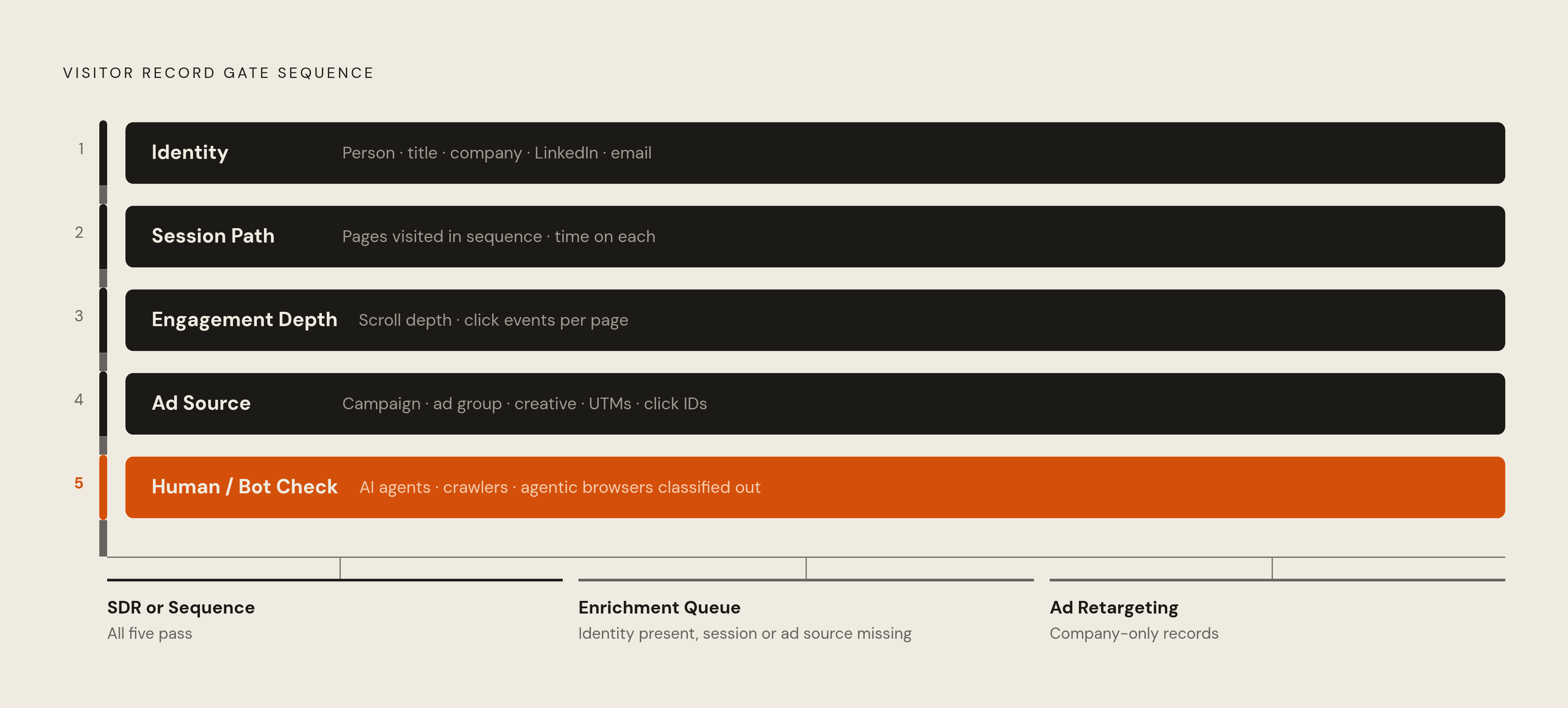
The operational rule is a four-layer completeness check before outreach. First, identity must include a named person with title, company, LinkedIn, and a deliverable business email. A company name alone does not pass. Second, the session path must show pages visited in sequence with time on each, so the SDR can distinguish a blog-to-pricing journey from an isolated pricing-page view. These checks establish both the recipient and the course of the visit.
Third, engagement depth must include scroll depth and click events per page. Someone who scrolled deeply into pricing and clicked the demo CTA should have a different priority from someone who left early. Fourth, the record must retain the campaign, ad group, creative, and channel associated with the visit through its click IDs and UTM parameters. The source must remain attached to the person. Before either an SDR or a sequence acts, the session must also pass the human check, with AI agents, crawlers, and agentic browsers classified separately.
Records that pass all four layers and the bot check should route immediately to the SDR or a personalized sequence. Records with identity but missing session depth or ad source should go to enrichment first. Company-only records should go to ad retargeting and audience-suppression workflows and stay out of named-person outreach. Missing evidence should remain visible at enrollment and guide routing. Otherwise, the first cost is the paid click, and the second is the SDR time and deliverability cost of a poorly targeted message.