Which Matched Visitor Fields Actually Map Back to a Paid Campaign ROI Calculation
Only records linking person, source, and revenue support campaign ROI.
Website visitor identification match rate is the share of eligible visitors that a tool resolves to a company or person record, expressed as a percentage of all eligible visitors. Company resolution and person resolution are different measures. For paid campaign ROI, only records that connect a person, a campaign source, and a closed revenue outcome support the calculation. The remaining enriched fields support qualification and action.
Why most enriched visitor fields stop short of a paid campaign ROI calculation
An enriched record can contain a name, title, company, LinkedIn URL, email, phone, and detailed browsing history without identifying which campaign deserves credit for a closed deal. The record is useful, but the calculation remains incomplete. A sales team may know who to contact while finance still cannot link that person to campaign spend and incremental profit.
Leadpipe’s framework defines ROI as incremental gross profit minus program cost, divided by program cost. That formula requires more than a contact export. Identity fields link the records, source fields link the campaign activity, and recorded outcomes show which deals closed. Other fields can improve the likelihood that a record becomes revenue without becoming numerical inputs themselves. The distinction is between information that helps produce an outcome and evidence that allows the outcome to be assigned, valued, and tested for incrementality.
The six-stage funnel that any ROI model must be built from
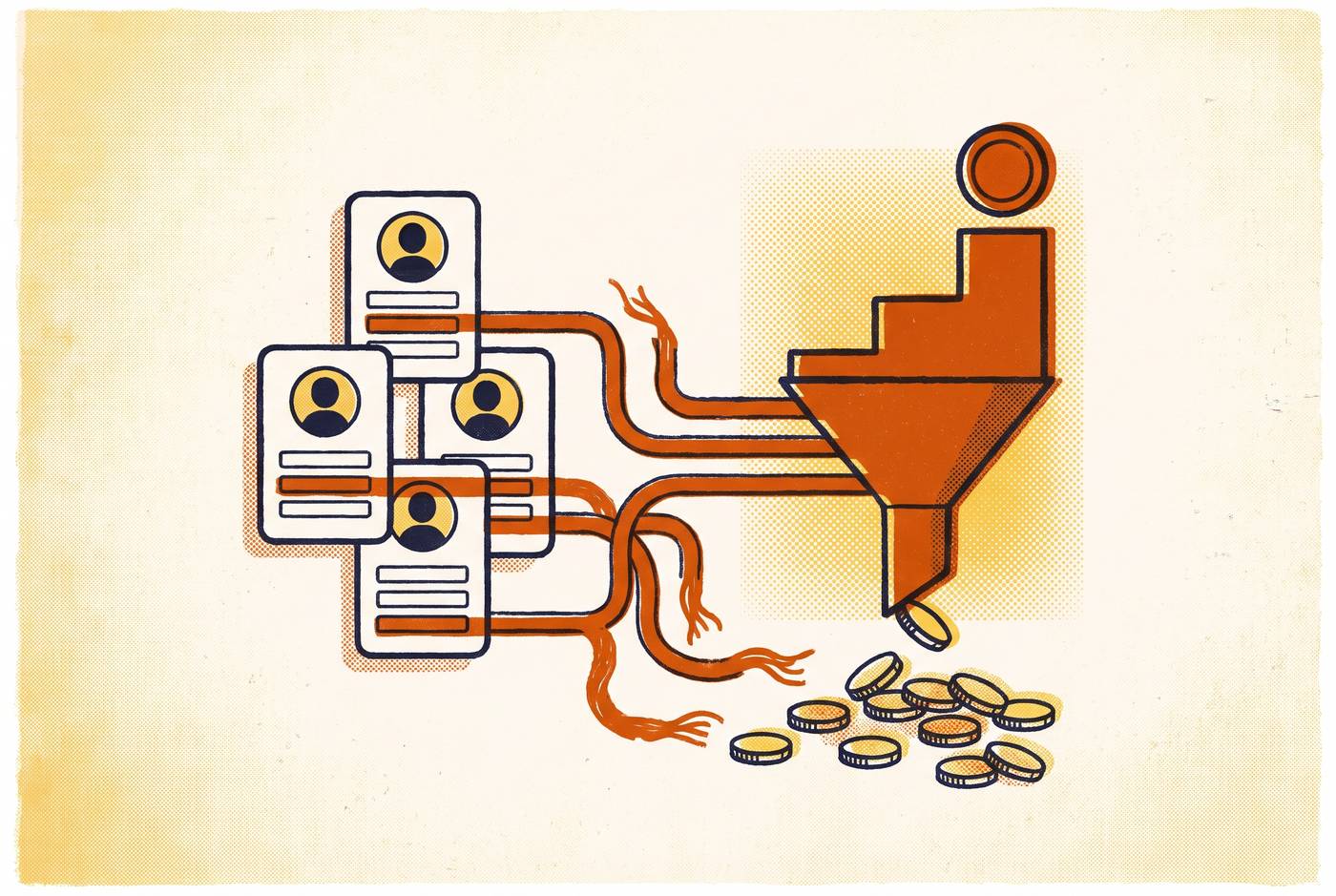
Leadpipe’s framework follows six stages in sequence, from Matched to Accepted to Eligible for action to Worked to Qualified opportunity to Closed revenue. Matched means the provider returned a company or person record. Accepted means the record has the fit and fields the workflow requires, while Eligible for action means it survived suppression and duplicate checks. Worked records received the defined action from an owner. A Qualified opportunity meets the rules for sales acceptance in the CRM, and Closed revenue means the deal has closed and its revenue has been recorded.
Each transition needs an observed count of its own. Multiplying total traffic by an advertised match rate does not establish how many records were accepted, worked, or converted. BrandWell’s investment framework starts with eligible unique decision units, then applies validated matching, fit, acceptance, action completion, and the incremental opportunity difference. This progression prevents an identification estimate from standing in for an operating funnel.
The decision unit also constrains the count. Repeat visits and additional stakeholders cannot multiply one account opportunity. Several people may contribute to the same deal, but the opportunity remains one opportunity. Firmographics and role classifications help records pass the early gates, while the identity and source links must keep working through the sales action and the recorded outcome.
Company-level fields: necessary for routing, not sufficient for the ROI formula
Lead Forensics’s technical guide describes company-level identification as returning company name, firmographics, pages visited, session detail, and available decision-maker contacts when an IP maps to a known corporate network. These fields establish an account context for the visit. They support ICP filtering at Accepted and help route an alert to the correct CRM account owner. The companies identified can also be used in LinkedIn company audiences so that account-based retargeting reaches businesses already showing intent.
That is useful coverage, but not person-level attribution. An account alert does not establish which individual visited, and available decision-maker contacts do not by themselves identify the visitor. Without a person record, the alert lacks both a visitor’s name for the Worked stage and that visitor’s hashed identity for platform matching.
Corporate-network dependence also limits which visits can resolve. A buyer using a residential ISP, mobile network, or VPN may produce no corporate IP match, leaving no company record at the first stage. This coverage gap must remain distinct from downstream qualification failure. One concerns whether the system identifies the visit. The other concerns whether an identified record is suitable for action.
The person-level fields that actually feed the ROI formula
Four fields serve as linkage inputs for person-level paid attribution, namely verified business email, hashed phone, confirmed traffic source, and the ad platform that delivered the visit. Their role is to connect the visitor record to platform activity so that campaign cost and closed outcomes can be reconciled. An email helps establish whose outcome the model is evaluating.
Verified business email enables a hashed identity upload into Meta Custom Audiences, Google Customer Match, and similar matching tools. Hashed phone adds a second matching field that gives the tools another way to link the identity. Both support the passage from an identified visitor to an actionable audience and, ultimately, a reconciled outcome. Identity-graph resolution and platform matching are still measured separately, so a provider’s person match does not show whether the platform found a match.
Traffic source and ad platform link the record to the campaign. Without them, even a person who has been matched cannot be linked to the spend line being measured. Together, identity and source establish the path that the closed revenue record must complete.
Name, title, LinkedIn URL, and seniority help determine fit or prepare outreach, while pages viewed, clicks, scroll depth, exit intent, and form submissions provide evidence for the Worked stage. CRM status performs a different function again. It gates incrementality by preventing an existing opportunity or customer from being counted as newly sourced.
How the traffic source field connects the enriched record to a specific ad campaign
A timestamp establishes when a visit happened. Improvado’s 2026 guide defines campaign attribution as assigning conversion credit to the campaigns and touchpoints that influenced the outcome. That assignment requires a campaign tag attached to the event. A complete identity record without that source connection can produce a workable lead but cannot establish paid campaign credit.
The attribution model then determines how credit is distributed. The same guide documents a case in which last-touch attribution showed paid search driving a majority of revenue, while a U-shaped model showed it driving roughly a third. The closed revenue was the same in both models. The models gave the available touchpoints different weights, which changed how much credit paid search appeared to deserve.
This makes source history more than background metadata. A person may come through different sources in separate sessions, and those events give models beyond last-touch the evidence they need. Keeping only the converting session leaves earlier touchpoints out of the model. Source completeness therefore constrains the attribution analysis before any model can assign credit.
Why match rate inflation quietly breaks the ROI denominator before the calculation starts
Visitor identification vendors can report different match rates because they differ in what counts as a resolution and who is eligible to be counted. A company match is not a person match. Combining both in one percentage obscures how many visitors have the identity fields required for person-level activation. Comparing that blended rate with a person-only rate treats different outputs as though they measured the same coverage.
Traffic measurement introduces a separate denominator problem. Sophisticated headless bots can render JavaScript and fire GA4 events, inflating session counts. Most named AI crawlers, including GPTBot, ClaudeBot, and PerplexityBot, do not execute JavaScript or set cookies and are invisible to GA4. Consequently, raw traffic and analytics sessions need not describe the same population, and unfiltered automated activity makes human coverage unreliable. Inflated session counts can depress an apparent match rate, while counting unusable resolutions as actionable people can overstate reach.
These are funnel denominators. Program cost remains the divisor in the ROI formula. Inflated usable-person counts can nevertheless make cost per accepted person appear artificially low and distort forecasts built from those counts.
BrandWell’s framework requires eligibility rules for bots, employees, customers, geographies, consent states, and low-value pages to be frozen before measurement. Identity graphs can also age, reducing person-level coverage two or three quarters after contract signing without an obvious dashboard signal, so the original rate cannot substitute for a current validated rate.
Turning the person record into a closed-loop paid media signal
The practical sequence begins with an identified person record that passes fit, suppression, and duplicate checks. Hashed email and phone then move into the platform’s audience-matching tools, while platform-confirmed matching and conversion events return to the ROI model. Webhook or API delivery can support real-time activation. The confirmed identity match supplies one part of the connection, while campaign source and conversion evidence supply the rest.
The CRM workflow connects that platform activity to sales execution. The enriched record is matched to an account, the rep receives a notification through Slack or a similar channel, and the visitor enters a personalized sequence. The sales action that follows and its recorded outcome complete the path that attribution must trace. An alert containing name, title, company, pages viewed, visit count, and traffic source gives the rep context while buyer intent is high.
Identified company domains can seed LinkedIn Matched Audiences for account retargeting, which can be useful when several stakeholders participate before anyone converts. That path connects spend to an account. Its contribution can remain visible without being presented as equivalent to a person-level identity and conversion link.
A field-by-field reference: which enriched fields enter the formula and which stay upstream
Verified business email enables hashed platform matching, and hashed phone provides an additional identity key. Traffic source and ad platform connect the record to campaign spend and the touchpoints receiving credit. CRM status controls whether the outcome can be treated as newly sourced. None of these replaces the closed revenue, gross profit, or program cost values required for the arithmetic.
Company name, domain, and industry help with ICP filtering and with routing the account at Accepted. Name, title, seniority, and job function support qualification at Accepted and Eligible, while LinkedIn URL supplies outreach context. The ICP hot-lead flag prioritizes eligible records but is itself derived from other fields. Firmographic revenue, employee count, and funding stage support account scoring and account-based targeting.
Visit count, page views, scroll depth, exit intent, and video plays provide context for the Worked stage. Better qualification and more relevant action can produce efficiency effects by improving stage-to-stage conversion and reducing cost per accepted person. Attribution model selection is another separate layer. First-touch, last-touch, U-shaped, and data-driven models give source events different shares of credit while the fields themselves stay the same.
What a correctly scoped ROI calculation looks like in practice
Leadpipe’s formula is (incremental gross profit − program cost) ÷ program cost. Program cost includes subscription, additional data, integration, and the labor required to review and work records. A payback date requires dated cost and profit accumulation. A cost-to-profit ratio is not a number of months.
Incrementality requires a comparison that attribution alone cannot provide. BrandWell’s framework calls for randomization before outreach at a level high enough to limit spillover, often the account, buying group, or territory. Activation is withheld from the control group, and the difference in opportunity rate is measured. The source and identity fields show the attributed path, while this holdout design tests whether activation changed the outcome.
During a trial, sourced pipeline can be a useful early sign of results before deals close, but it stays outside realized ROI. An identified visitor associated with an existing opportunity may also help an owner prioritize a conversation. That contribution is influence under a defined rule. A defensible calculation keeps these boundaries intact, using observed funnel counts, linked closed outcomes, incremental profit, and complete costs. Its narrower scope is what makes the investment decision supportable.