Person-Level Visitor Tracking Tools Measured Against the Paid Channel Attribution They Preserve
Identification means little if the paid source disappears before it reaches the CRM.
For buyers seeking an RB2B alternative, Warmly offers person-level identification and CRM sync, while Fibbler connects company-level paid engagement to pipeline. The decisive comparison is attribution fidelity, meaning whether traffic source, ad platform, and campaign survive identification and reach the CRM. More contact data alone does not close the paid-media ROI loop.
Why paid channel attribution breaks at the person level, and why that is the real tool evaluation problem
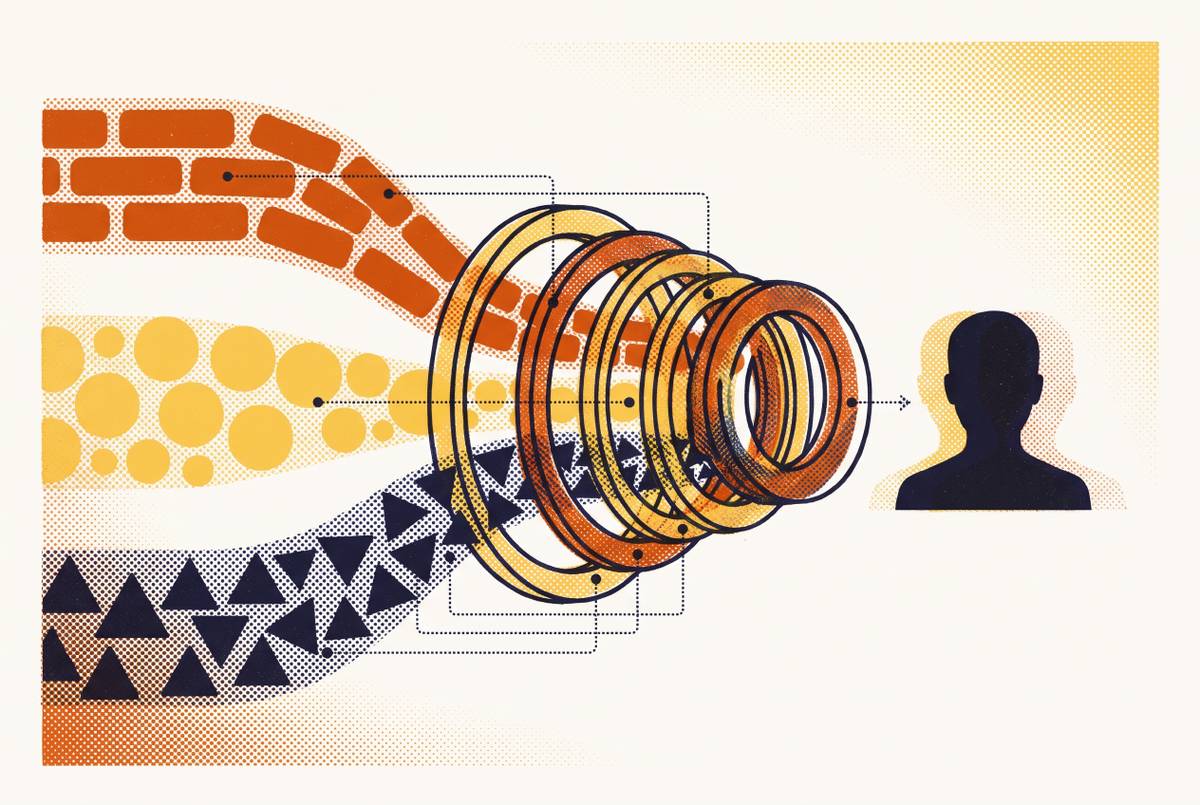
Person-level identification promises to link paid media to named pipeline, but the name often comes without a record of where the person came from. Company-level tools tell an account-based team which company visited. They cannot establish which person a campaign influenced. Moving to individual identification should bridge that gap, yet traffic source, ad platform, and campaign are not guaranteed fields on the resulting record. The identity may be correct while its attribution is incomplete.
That failure has a direct budget consequence. A tool can correctly identify a VP of Procurement but record their source as “direct” when they arrived through a LinkedIn campaign. The contact remains useful for outreach, but the measurement chain is broken. LinkedIn Ads, Google Ads, and Meta Ads attribute spend to clicks and impressions. Person-level identification links those systems only when the paid signal stays with the person, so buyers must test attribution preservation separately from identification accuracy.
What person-level identification actually delivers, and what it reliably does not
The distinction begins with the identification architecture. Reverse-IP mapping resolves an IP address to a company firmographic record, so it cannot attach a named person to an ad click. Cookie- and device-based identity graphs instead use a first-party pixel to match a returning visitor to a known profile. That capture layer can preserve paid UTM parameters and referrer data if the tool records them. First-party enrichment then appends contact details to an already-resolved identity, but it cannot recover a source that was never stored.
Deterministic matching resolves a visitor through a verified identifier linkage and can, in principle, retain the attribution attached to that visit. Probabilistic matching infers identity from behavioral signals and typically cannot reconstruct how the visitor arrived. Neither method substitutes for capturing the original traffic source. Remote work sharpens the distinction because someone browsing through a home ISP may resolve to a person through an identity graph without providing a corporate network signal. In that situation, preserved visit data becomes the remaining attribution anchor.
How match rate inflation hides the attribution gap behind a bigger-sounding number
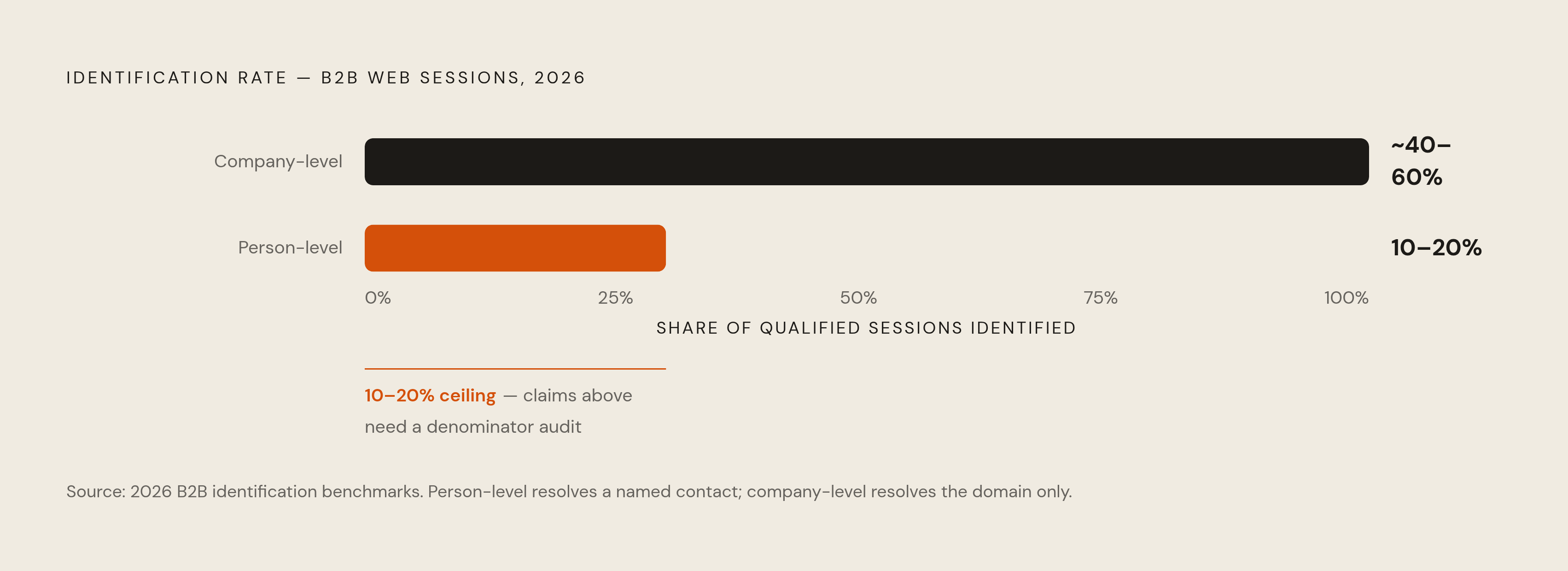
Match rate measures identification coverage. The 2026 benchmarks place person-level identification at 10–20% of qualified US B2B sessions, while company-level tools reach a larger share of that traffic. The gap comes from differences in what the tools identify and cannot be read as a simple difference in vendor quality. Contact-level claims above that range can count company matches as people, turning an account-resolution figure into an apparent person-resolution figure. Without a defined unit of measurement, the comparison fails before campaign data enters it.
RB2B illustrates the difficulty of interpreting headline rates. Published person-level figures for the same product vary materially, so the number alone does not establish a shared denominator. Geography, session eligibility, and the distinction between companies and people all affect what the rate describes. Bot traffic also skews the rate when non-human sessions are included in the total used to calculate human matches. Those sessions can depress the reported rate without reducing identification performance on qualified human traffic.
Attribution therefore needs its own evaluation dimension. Even a well-defined match rate says nothing about whether the identified records retain their paid source, platform, and campaign. A buyer needs coverage to see how much eligible traffic the tool can identify, and attribution completeness to see whether those identities link to spend. Neither measure replaces the other.
Why AI crawlers and bots must be separated from human sessions before any attribution figure is meaningful
Most AI crawlers do not execute JavaScript, so they do not trigger tracking scripts or appear in standard analytics. They still consume pages and can enter raw session counts used by some tools as match-rate denominators. A figure based on those counts mixes traffic the identification script saw with traffic it never saw.
A spoofed bot session arriving through a paid UTM link can register as a paid click without representing a buyer. If the tool includes it in attribution calculations, reported paid traffic rises without corresponding human engagement. A recognized crawler user-agent is not sufficient proof of identity because impersonation can cause misclassification. Filtering must therefore precede both match-rate calculations and paid-channel reporting.
The IETF Web Bot Auth working group adopted its first draft in September 2026, but few agents sign requests yet. Cryptographic verification is not a universal filter. Tool-level filtering remains the practical standard, with human sessions separated from AI agents and other bots. AI content consumption can provide a distinct intelligence signal about what systems access and on whose behalf. It is not evidence that a paid campaign reached an identifiable human buyer.
The fields a person record must carry for paid attribution to survive identification
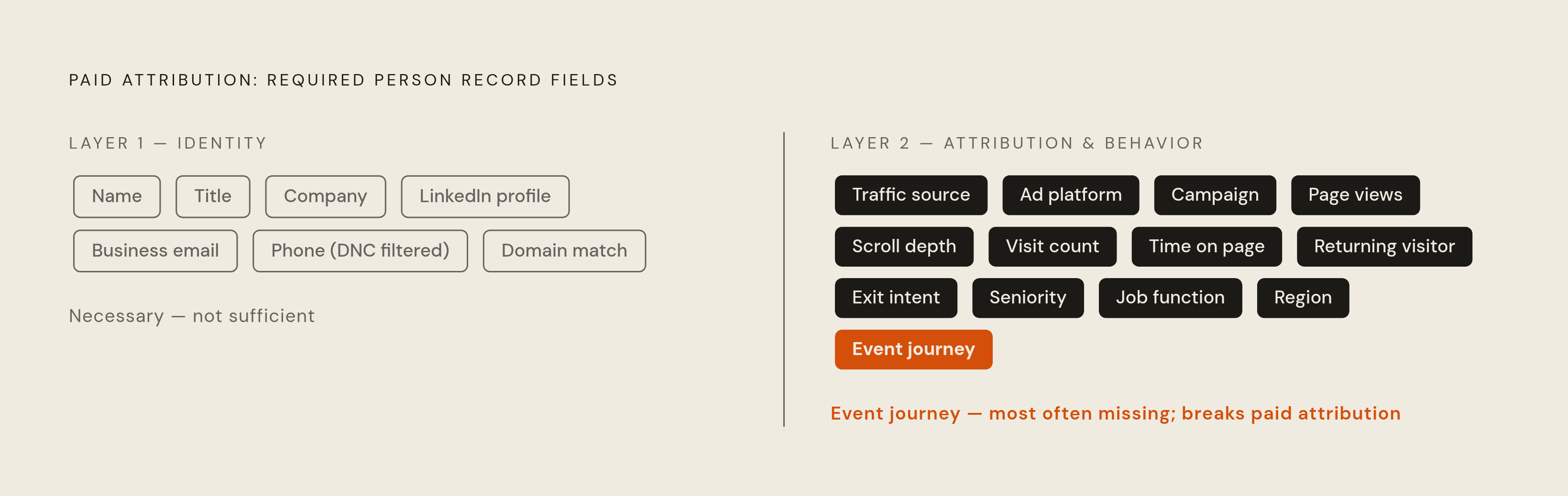
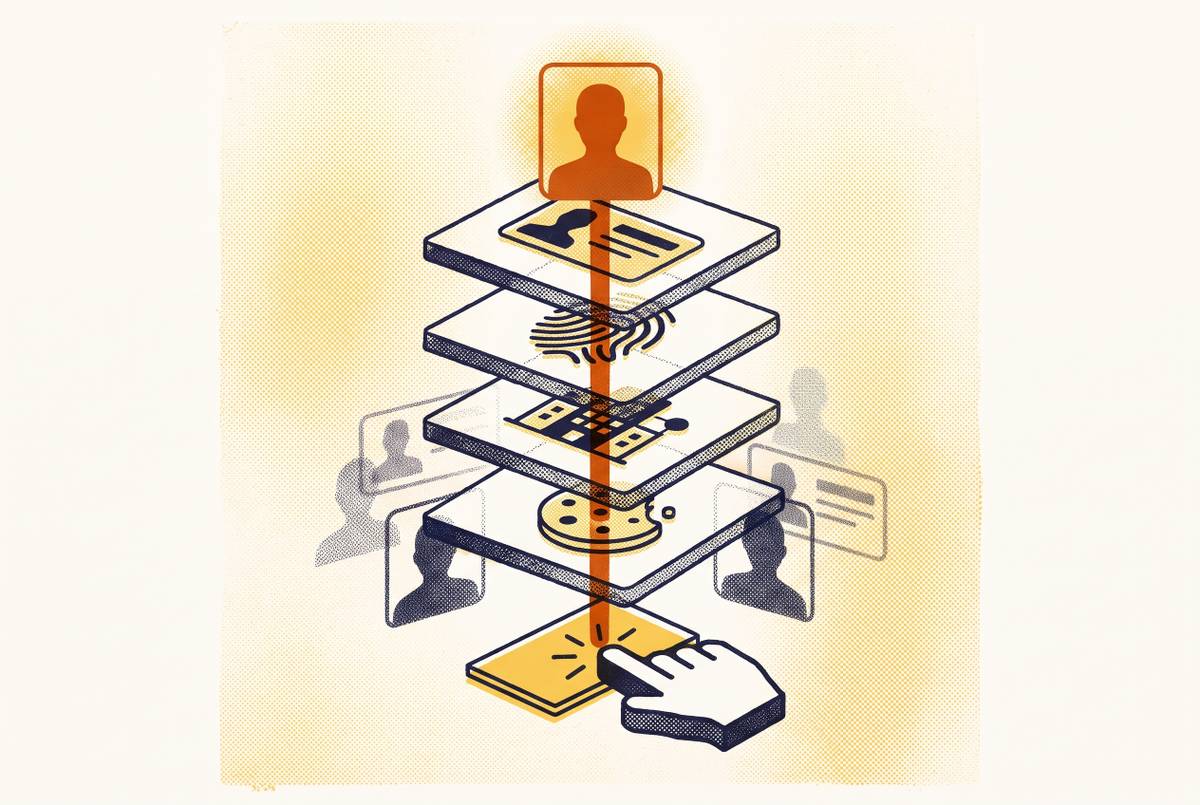
The buyer’s first question should concern the record itself. Does it include name, title, company, LinkedIn profile, business email, and a do-not-call-filtered phone number, with a company-domain email match preferred? Those fields make an identity usable for sales action. Does every identified person’s record keep traffic source, ad platform, and campaign, or do those details appear only in a dashboard or notification?
Behavioral context should then establish what followed the click. Does the record include page views, scroll depth, visit count, time on key pages, a returning visitor flag, and exit intent? These signals help show how much someone engaged after arriving. Does the tool also distinguish an existing CRM contact, a current customer, and someone net new? That status helps keep a current customer from being treated as a prospect in paid retargeting.
Does it include seniority, job function, and region so that a relevant buyer can be distinguished from a student or competitor researcher? Does the event journey keep earlier visits as well as the identification event? Consider someone identified on a third, organic visit after first arriving through a LinkedIn campaign. A single-session record erases the paid contribution, while a retained journey allows that earlier touchpoint to remain available for attribution.
How do RB2B alternatives differ on attribution field completeness?
For buyers seeking more than a LinkedIn profile, the available product descriptions establish different capabilities, with a complete ranking still unconfirmed. The differences in RB2B’s published match rates do not show whether its person records keep the required attribution fields. Warmly’s description establishes person-level identification and CRM sync, but not the full traffic-source, platform, campaign, and journey specification. Unconfirmed fields should remain unconfirmed in a comparison. Their absence from the available detail is not proof that the product lacks them.
Warmly’s platform context also changes the buying decision. HubSpot announced its acquisition on June 30, 2026, and pre-acquisition pricing was $10K–$30K/year. Post-acquisition pricing remains unconfirmed. Teams using Salesforce, Marketo, or non-HubSpot CRMs face a structural platform-fit constraint when evaluating the acquired product. For those buyers, long-term attribution workflow compatibility is a separate question from the quality of individual matches.
Fibbler addresses the paid-engagement gap at company level. It connects LinkedIn Ads, Google Ads, and Meta Ads with HubSpot, Salesforce, Attio, Pipedrive, Zoho CRM, and Microsoft Dynamics 365, surfacing which accounts engage with ads and how that engagement maps to pipeline. Its attribution architecture is explicit, making it relevant when the requirement for an RB2B alternative is account-level paid engagement in CRM. Buyers requiring both named people and campaign history still need evidence of both capabilities in the proposed workflow.
How CRM and ad platform integrations determine whether attribution fidelity survives delivery
Capture is only the first half of preservation. A complete person record delivered through Slack or Teams can speed routing without making its attribution available to pipeline reporting. A notification does not, by itself, update a lead score, log a campaign touchpoint, or feed a multi-touch attribution model. The delivery test is whether the same source, platform, and campaign fields reach the system of record. An integration logo cannot establish that field-level behavior.
A well-configured HubSpot integration can create contacts, attach page views as timeline activities, enroll high-intent visitors in sequences, and trigger scoring or workflows from visit behavior. Those actions become useful to paid attribution when source and platform data travel with the contact. HubSpot Breeze Intelligence, formerly Clearbit and acquired by HubSpot in 2023, serves as the native enrichment layer. Enrichment is not full person-level visitor identification. Buyers evaluating a HubSpot-native workflow need to distinguish contact enrichment from capturing and retaining a visitor’s paid journey.
Salesforce needs the same fields mapped into its system. An attribution-preserving integration creates or updates leads and contacts, logs visits as activities, and makes recency and frequency available to scoring. Heeet stores attribution on standard Salesforce CRM objects, keeping that data within existing workflows. Custom mapping for pages visited, ad source, and campaign distinguishes a broader attribution workflow from contact creation alone. The resulting CRM record provides the evidence of attribution preservation.
Ad platform sync extends that record into retargeting. Identified companies can be added to LinkedIn Ads, Google Ads, or Meta Ads audiences so that later paid engagement links to a known account. Webhook and API delivery provide another route when the workflow is not CRM-centric. A person.identified webhook containing identity, ad platform, campaign, and event journey can feed a scoring model, revenue-attribution database, or an AI agent through an MCP connector.
The evaluation questions that surface attribution fidelity before a contract is signed
The procurement test should begin with the denominator. Ask whether the quoted match rate measures companies or people, US or global traffic, and which session total it uses. Ask whether AI crawlers and bots are excluded before calculation and from returned person records. A vendor unable to define those boundaries is presenting an unverifiable rate. The attribution figures used in the evaluation should follow the same rules for what they count.
Next, ask which fields appear on every person record by default and what happens when a paid click redirects through a landing page. Does the traffic source survive that path? Ask whether a later organic visit preserves the earlier paid campaign in the event journey or overwrites it. Then test the handoff by asking whether ad platform and campaign are written to standard or custom CRM fields, and whether the CRM record contains the same attribution data as the Slack alert.
Geography and compliance also belong before the contract. Confirm whether person-level identification is US-only and establish the GDPR and CCPA posture for outbound use of identified contact data. A promise of person-level data on EU traffic calls for a compliance check before buyers treat it as an advantage. The final test should be a live pilot on the buyer’s own traffic, with the denominator agreed in advance. Matching the returned person records against paid campaign UTM data for the same period is the only way to establish attribution fidelity that a prepared demo cannot prove.