Anonymous Visitor Identification Tools That Survive a Paid Click and Return a Contact Not a Company Domain
Most visitor ID tools stop at the company, so here is who names the person.
A Clearbit Reveal alternative for paid traffic must return a named, contactable person. HubSpot acquired Clearbit in late 2023 and rebranded it as Breeze Intelligence in September 2024, but its visitor identification remains company-level. RB2B, Bullseye, and other vendors try to offer person-level resolution, but each has its own limits. The buying test is whether identity, paid attribution, and contact details reach the sales workflow together.
Why paid clicks are where visitor identification tools fail most visibly
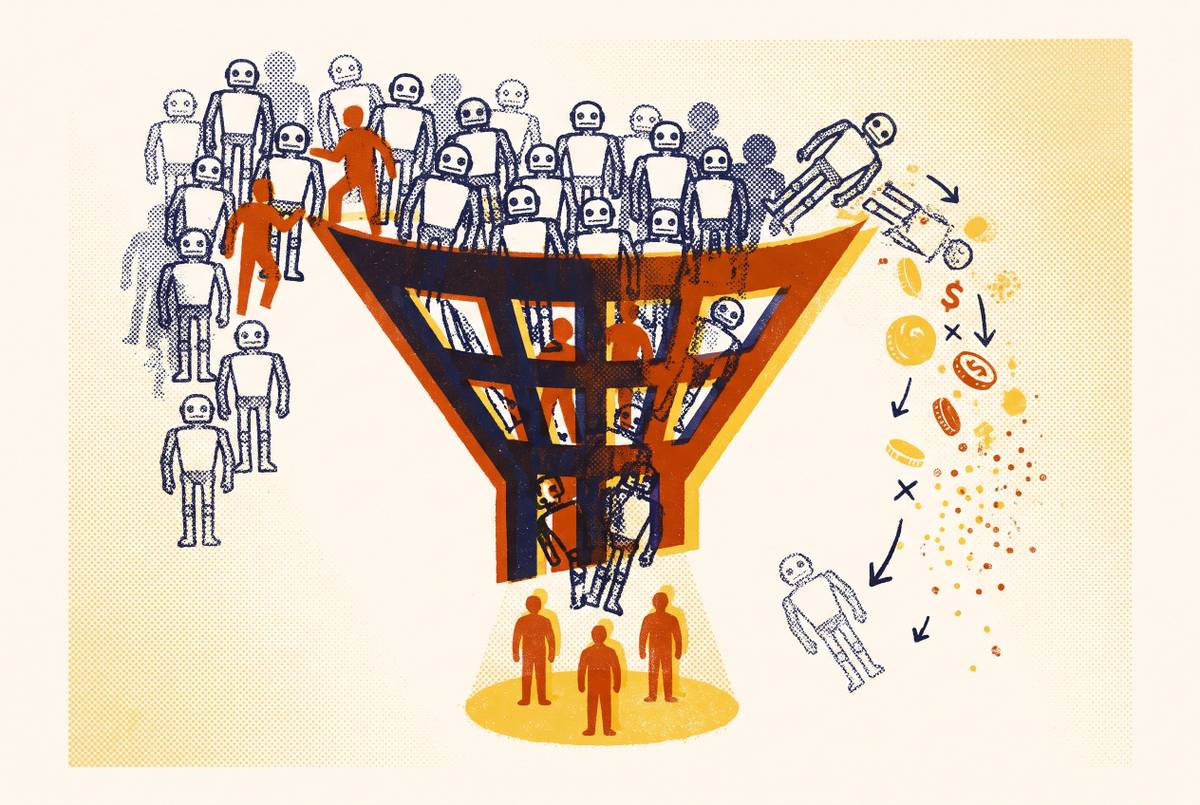
A paid click arrives, the visit consumes budget, and the identification tool returns a company name. An SDR learns that Acme Corp visited the pricing page, but not which employee visited or who to call. The account is visible. The buyer is not. Because the team actively paid to acquire that visit, the missing identity is central to the commercial case for the tool.
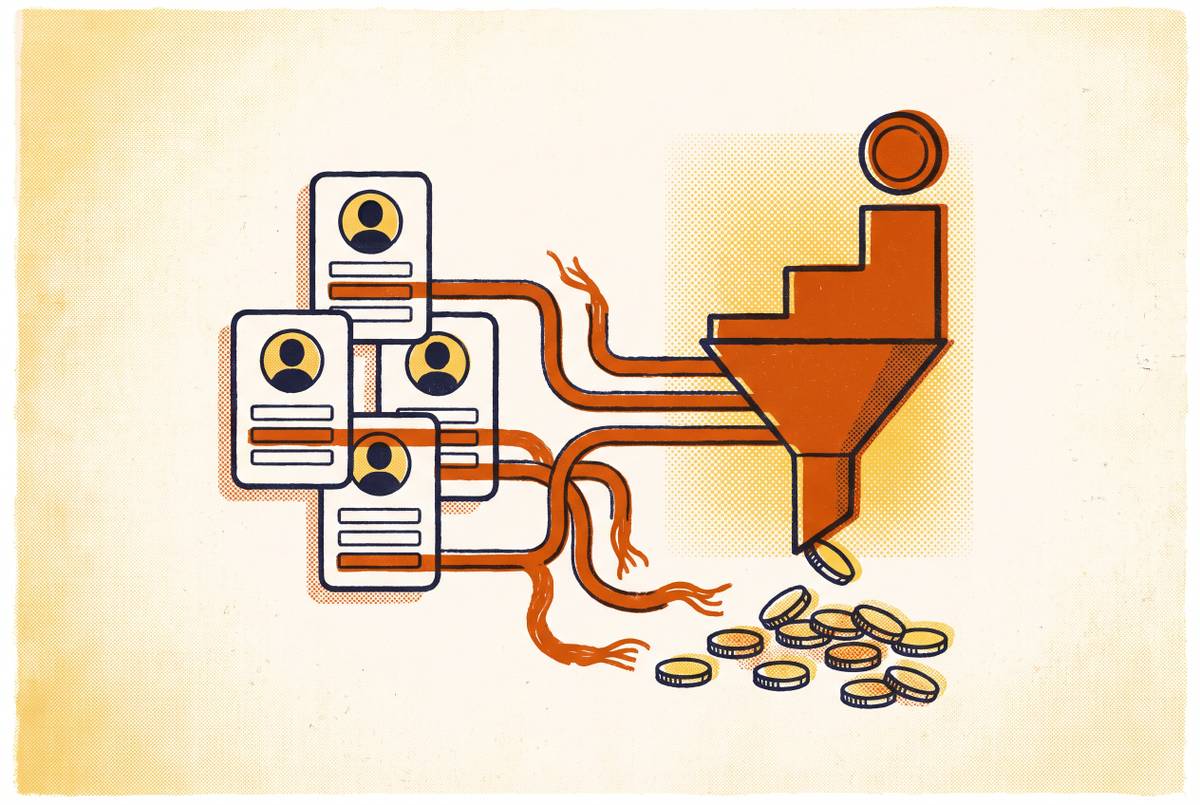
The distinction becomes concrete when the output changes to Sarah, Director of Procurement at Acme, visiting the pricing page from a Google Ads click. That record connects a person, a role, an interest, and a paid source. It supports a different sales motion from an account alert.
What company-level identification actually returns and why that is not enough for sales follow-up
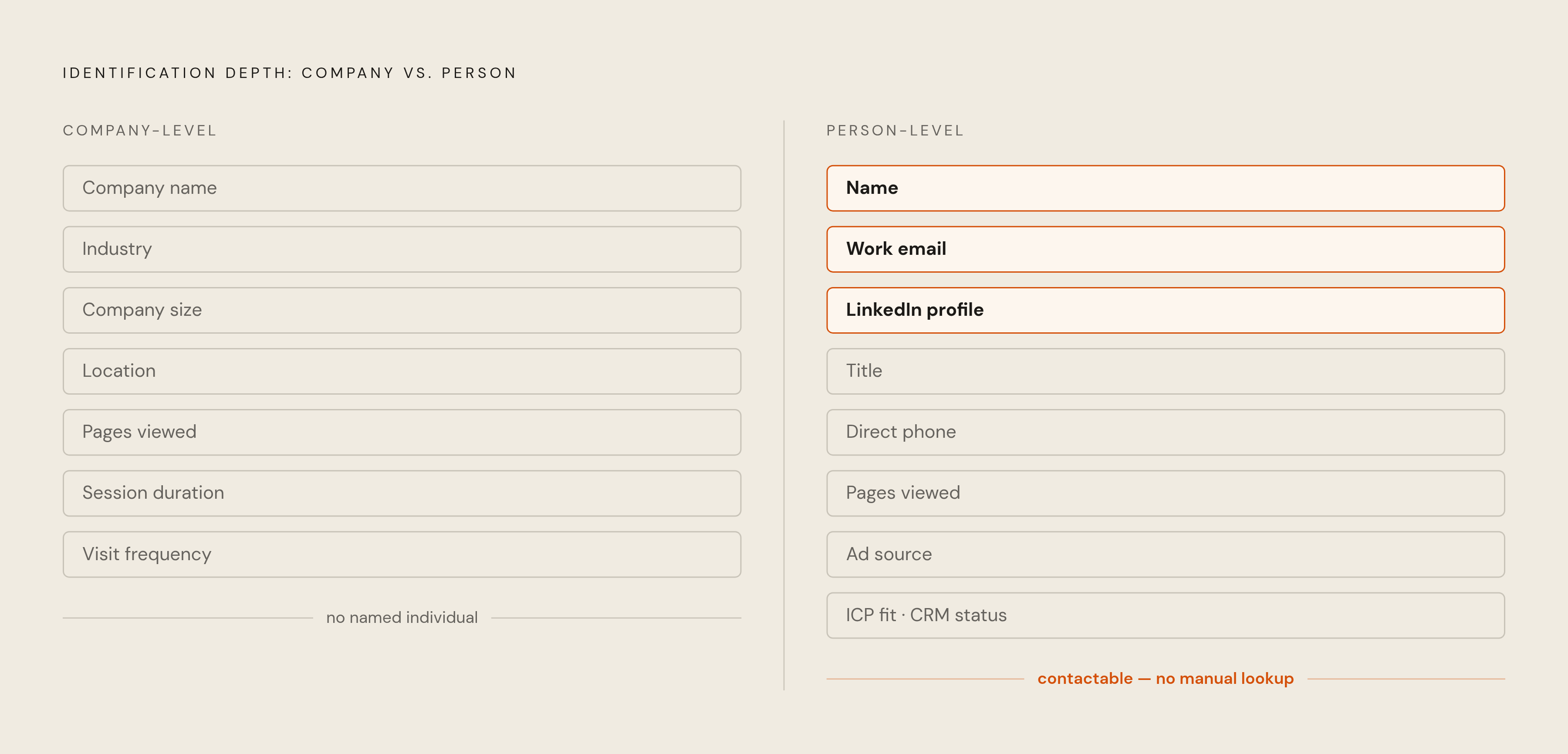
Company-level identification typically uses IP-to-company reverse lookup, mapping a visitor’s IP against corporate network registrations. Its output includes company name, industry, size, and location, with pages viewed, session duration, and visit frequency. Leadfeeder, formerly Dealfront, ZoomInfo WebSights, Albacross, Visitor Queue, and 6sense serve this account-level workflow.
Leadfeeder makes the boundary particularly clear. Its default output is company-level, with no anonymous person-level reveal. First-party integrations, which include email marketing tools and the Identify() API, can identify people, and higher tiers have contact enrichment. This GDPR-oriented approach does not use third-party identity graph resolution.
Knowing which organization visited can help with account research even when its employee is unknown. For direct follow-up, a company-domain alert leaves the rep without a name or proof that the visitor has the power to make a buying decision. Buyers who expect a contact from an account-identification product purchase an expectation mismatch.
What it technically takes to resolve an individual identity, not just an IP
Person-level resolution needs an identity graph tied to records of people. A pixel captures signals including IP address, cookies, device fingerprint, and browser data, then matches them against known people. The output can include name, title, work email, LinkedIn profile URL, and sometimes a direct phone number.
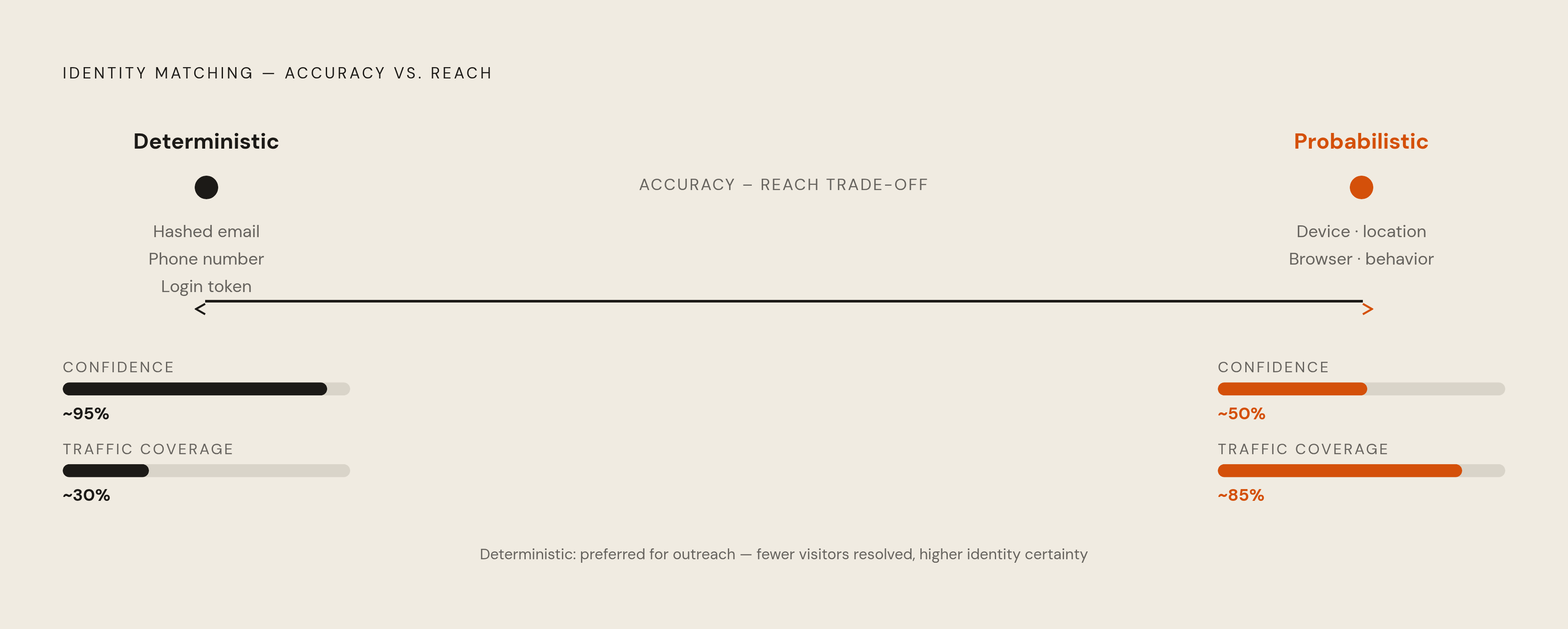
Deterministic matching compares exact identifiers, including hashed emails, phone numbers, and login tokens, yielding near-certain confidence on a smaller share of traffic. Probabilistic matching uses device, location, browser, and behavioral signals to infer who visited across a larger pool of people. Reach comes with an accuracy trade-off. For sales follow-up, an incorrect name is not a successful resolution.
Most tools license third-party identity graphs, limiting what they can optimize independently. Tools with proprietary graphs have access to more signals and can optimize specifically for visitor identification. Ownership alone, however, is not an accuracy measurement.
How paid traffic complicates identity resolution and why click IDs matter
Paid visits bring useful attribution signals with them. These include gclid for Google Ads, gbraid/wbraid for Google’s privacy-safe variants, msclkid for Bing, and fbclid for Meta. Click IDs survive referrer stripping better than referrer strings, so tools that capture them server-side can keep the paid source. That gives paid attribution an advantage over organic attribution in 2026.
That advantage has limits. Safari strips gclid, fbclid, and msclkid in Private Browsing, Mail, and Messages by default, with full-session stripping likely next. A tool must therefore capture and preserve the available signal. The record should then link the person who visited to the paid platform.
A click ID does not establish personal identity. Channel attribution and individual identification remain separate operations, and most tools perform only one of them. A deterministic graph can also stitch multiple sessions into one buyer profile. Without that continuity, three visits over two weeks can remain separate anonymous sessions, leaving evidence of intent fragmented.
Why match rate claims are routinely misleading and what number to actually demand
Match rate divides resolved units by population units, but vendors define both differently. The denominator may contain sessions, unique visitors, or only traffic from supported geographies, typically the US. The numerator may count companies or people. A US-only person-level figure cannot be compared directly with a company-level rate calculated across global sessions.
A larger numerator based on probabilistic matches can include records that name the wrong person, while a smaller deterministic pool can be more reliable for outreach. Published rates do not settle that comparison. Match rates are self-reported. The category has no independent accuracy benchmark.
For buyers, the useful evidence is accuracy on a known-identity control group, measured on their own site, with the population clearly defined. Non-human traffic must also be separated, because bots can trigger pixel events and sometimes matches. Including them can distort either side of the calculation. Every vendor should answer two questions. “What is in your denominator?” and “Do your match rate figures exclude non-human traffic?”
Which Clearbit Reveal alternatives return a named person from a paid visit, and where do they break down?
RB2B matches visitors from the US to their professional profiles and sends their names, titles, companies, and LinkedIn URLs to Slack in real time. Its free tier caps monthly resolutions, Starter adds person-level LinkedIn profiles, and Pro adds business emails. Publicly reported person-level match rates range from roughly one in seven to roughly one in two on US traffic. Geography is the principal constraint. It has no intent scoring or routing layer, while native HubSpot and Salesforce connections require Pro or Pro+, and Teams starts at Starter.
Warmly combines reverse-IP lookup, an identity graph, and third-party sources in a waterfall. It reports identifying up to roughly two-thirds of anonymous visitors at company level, with person-level resolution on a share of that traffic. Its bundle adds AI chat, intent scoring, session replay, and Slack alerts, with a publicly reported five-figure annual entry point and no free identification tier. The headline is not a person-level rate. Coverage falls on consumer-mixed, mobile-heavy, and VPN-heavy traffic, and the bundle can include orchestration a team does not need.
Bullseye identifies up to 40% of anonymous visitors and returns name, work email, title, and company to CRM, inbox, or Slack in real time. Its records include ICP hot-lead flagging and CRM status, with native automations for HubSpot, Salesforce, Slack, Twilio, and Sheets, plus webhooks and Zapier. It also syncs audiences to Meta Custom Audiences and Google Customer Match, and supports ChatGPT Ads Manager through hashed email CSV export and upload. Phone access is a separate unlock. A contact database comes with every B2B identification plan, and a 14-day trial requires no credit card, but the headline rate does not establish performance on a buyer’s own traffic.
Clearbit’s replacement within HubSpot is Breeze Intelligence, a native HubSpot feature rather than a standalone visitor-identification product. It identifies companies from visits and enriches known person records inside the CRM. For teams outside HubSpot, it is not a standalone replacement, and it does not return a named individual from a paid visit.
ZoomInfo WebSights connects visitor identification with firmographics, technographics, and intent data through its GTM Context Graph. Its focus remains account-level intent, with undisclosed enterprise pricing, a documented opt-out mechanism, and a legitimate-interest GDPR posture. The fit is enriching known accounts rather than resolving anonymous paid visitors into named people.
Leadpipe delivers names, emails, and phone numbers, emphasizing deterministic matching. Its starting price covers a set number of identifications per month. The available detail is narrower here. Coverage, integration depth, and paid-click preservation still require evaluation.
Factors.ai has company-level identification along with attribution and journey analytics. Its Basic plan reportedly identifies most of the companies that visit, and its published price is a mid-four-figure sum per year. Person-level resolution requires a separately priced RB2B integration, so that capability inherits the integration’s US-only scope.
The person-level identification features that separate an actionable lead from a Slack notification
A LinkedIn URL in Slack is a notification. For buyers evaluating sales readiness, the minimum record should include name, title, work email, LinkedIn profile, and specific pages viewed. A company-domain email is preferable to a personal address. Without email, the rep still faces manual lookup. Without browsing context, the record gives little indication of what the visitor was researching.
Richer output adds direct phone, seniority, job function, cross-session visit count, ICP fit, and CRM status. Those fields distinguish a net-new prospect from an existing customer or a contact already in the CRM. Ad platform and campaign connect the person to spend. Sustained interest across visits also gives the rep a stronger triage signal than a one-time bounce. Bullseye’s fit flags and CRM status are relevant output features.
Behavior and delivery complete the record. Page views, scroll depth, clicks, video plays, exit intent, and form interactions provide a fuller event journey than one identification ping. REST APIs, cryptographically signed webhooks, and native connectors for HubSpot, Salesforce, and Attio can move that context into automated workflows. Slack and Teams send alerts where reps work, while MCP connectors let tools for AI coding and research query visitor data directly. A dashboard alone does not provide that handoff.
The bot and AI agent problem that inflates match rates and corrupts paid attribution simultaneously
Bots and AI agents can click paid ads and arrive with gclid, fbclid, and UTM tags intact. Their sessions can therefore look like legitimate paid traffic to identification and analytics systems. GA4 filters known bots using the IAB/MRC list by default, but misses categories including headless browsers, AI crawlers, uptime monitors, and referral spam.
When a non-human session triggers a conversion, contamination can spread into Meta Pixel, Google Ads conversion tracking, Smart Bidding, Performance Max, and CRM attribution. The problem extends beyond an inflated visitor count. It can corrupt the signals used to optimize spend as well as the figures used to compare identification tools.
Multiple corroborating identity signals provide a structural advantage over IP-only matching because bots also have IP addresses. Graphs that use hashed emails, device IDs, mobile ad IDs, and behavioral patterns find no person match for most non-human visitors. Separate AI-agent detection adds visibility that matching alone does not provide. Crawlers operated by ChatGPT, Claude, and other systems may research for buyers or collect information for other purposes, so classifying them separately preserves useful context without treating them as identified prospects.
What to actually evaluate before buying a person-level identification tool
The evaluation should begin with the actual output. Buyers should establish whether the tool returns a name, work email, and LinkedIn profile, or only an organization. They should then ask for the denominator and a rate based on all sessions, including international traffic, with non-human traffic marked separately. Geography needs its own scrutiny. Person-level coverage is strongest in the US, so EMEA-heavy and APAC-heavy teams need regional answers.
The paid-click test should establish whether gclid, fbclid, and msclkid survive into the identified person record. It should also establish whether AI agents, crawlers, and bots are excluded from both human match-rate calculations and the identified visitor feed. Delivery deserves equal attention. Email, pages viewed, visit count, ad source, and the full event journey should reach the CRM, messaging tools, or ad platforms through integrations, webhooks, or an API.
Before committing, buyers should install a candidate on the live site and test it against a known-identity control group of team members whose visits can be verified. The final test is operational. Paid spend should lead to a named visit, a CRM record the rep can use, and a rep’s follow-up without steps done by hand that slow the handoff or lose records.