What Paid Traffic Match Rates Actually Reveal About Your Ad Spend Quality
High match rates can mask poor ad spend quality without separate company and person-level reporting.
Website visitor identification match rate is the percentage of measured traffic a tool resolves to a known company or person. On paid traffic, it reveals ad spend quality only when non-human visits are removed and company-level and person-level results are reported separately.
Why click-through rate and cost-per-click leave the real question unanswered
Ad platforms report clicks, impressions, and costs, but those records do not tell sales who to contact. A low cost-per-click can coexist with traffic that produces no identifiable buyers. The gap in reporting starts when visitors reach the site. Platform activity alone cannot distinguish an in-market account researching quietly from an unresolvable visit that offers no useful sales signal.
That gap also distorts attribution and budget decisions. Accounts can research without converting and buy from whoever engages them first, without the missed opportunity appearing as a failure in the platform dashboard. Marketing then struggles to connect campaign or content spend to pipeline. Channels that bring in serious buyers can lose funding to those whose activity is easier to measure. The business still cannot tell whether the click brought someone it could have acted on.
How do website visitor identification tools calculate their match rate percentage?
Tools calculate match rate by dividing resolved visitors by the measured traffic population and multiplying by a percentage. The numerator counts matches, while the denominator defines who had a chance to be matched. That denominator is not a fixed standard. The same identification performance can produce very different percentages depending on which visits enter the calculation.
Common denominators include all traffic, company traffic, and an eligible subset. All traffic includes bots and consumer IPs, making it the hardest population against which to report a high rate. Company traffic excludes residential and mobile visits before division. When the eligible subset is undisclosed, the buyer cannot even tell which traffic the percentage covers.
The definition of a match is equally important. Company-level identification gives the name of an organization, while person-level identification gives the name of a person along with their contact and professional details. A quoted rate without both its resolution level and its denominator is a marketing number whose actual coverage remains unknown until tested on the buyer’s traffic.
The specific ways published match rates get inflated before they reach a buyer
Adding company-level and person-level rates makes overall identification look higher than it is. The two categories can overlap, so their sum does not establish the share of distinct visitors identified. A person may belong to a company that has already been resolved.
Denominator suppression changes the result from the other direction. Removing residential, mobile, and ISP traffic before division raises the reported rate because it leaves out visits that are hard to resolve. Such exclusions can be useful for a defined analysis. However, a result calculated on that restricted population cannot stand in for coverage across all paid traffic.
Published rates also differ because those who report them make different assumptions about what to measure and how. RB2B has different published person-level rates depending on who publishes them. That discrepancy establishes that a buyer cannot compare headline percentages without knowing the traffic population, resolution level, and counting method behind each one.
How AI agents and bot traffic corrupt the denominator before the tool even calculates
Cloudflare Radar data reported in June 2026 put bot and AI agent traffic at a majority of all web traffic. That finding exposes a problem upstream of identification. Raw session counts are not human audience counts. Non-human visits to a landing page can enter analytics before a visitor identification tool does any calculations.
Consequently, a rate based on raw paid sessions can penalize a tool for failing to name traffic that was never a buyer. This is distinct from assessing click fraud inside an ad platform. The distortion occurs in the site’s measurement population. A low headline rate may therefore coexist with strong identification of genuine human paid traffic, rather than proving that the campaign attracted the wrong audience.
Filtering is difficult because non-human visitors are not uniform. Training crawlers, agentic systems acting for users, and bots spoofing legitimate agents behave differently, while analytics platforms filter some but not all of them. Human-like agent behavior makes that separation harder. An agent examining a pricing page for a procurement team can signal intent, but it is not a named human visitor and should not be counted as one.
Why company-level and person-level rates must be read separately to mean anything
Company-level identification returns an account name, while person-level identification returns a named individual with contact details. Each answers a different question about paid reach. Company resolution indicates whether spend reaches identifiable business networks rather than consumers, residential IPs, or bots. Person resolution shows whether visitors can be linked to buyers whom sales can contact.
The mechanisms and geographic coverage differ as well. Person-level identification depends on an identity graph built from cookie syncs, form fills, and third-party data partnerships. That graph is dense in the United States and thin almost everywhere else. Realistic person-level rates on US B2B traffic are therefore a fraction of company-level rates, rather than an equivalent measure with richer fields attached.
GDPR also constrains what person-level data is available. For EU visitors without affirmative opt-in, company-level reverse IP lookup is the defensible approach described here, rather than expecting the person-level coverage available in markets such as the US. Campaigns must therefore be compared with geography in mind. Otherwise, a difference in available resolution can be mistaken for a difference in audience quality, and a combined rate conceals the distinction.
How match rate varies by traffic source, and what each gap tells you about campaign quality
LinkedIn paid traffic achieves among the higher company-level identification rates of paid sources, which is useful context given its per-click cost. But so much of its use is on mobile that resolution is lower than for desktop traffic on corporate networks. The channel name alone does not explain performance. The devices and networks people use shape what the tool can identify, even when those people fit the business audience.
Google Ads shows a different division by keyword intent. Brand and competitor keywords attract visitors already in a buying context and identify at higher rates than broad top-of-funnel keywords. Aggregating those visits hides a useful campaign distinction. A lower rate on broad terms can reflect a wider, less qualified audience rather than a decline in the identification tool’s performance.
Direct traffic is a useful point of comparison because returning prospects and known accounts have the highest company-level rates among passive inbound sources. Paid traffic with rates far below that baseline needs a closer look. Where geography, resolution level, and traffic conditions are comparable, a substantial gap from organic or direct traffic from the same target accounts points toward audience mismatch. The gap is diagnostic evidence for spend decisions.
What person-level identification data must include to be actionable, not just identified
With only a company name, sales still has to work out who to approach. A person-level record with a name, title, work email, phone number, and LinkedIn profile provides a more usable starting point. The visitor’s behavior and campaign source supply the context needed to judge the opportunity.
A LinkedIn profile delivered to Slack is a notification with only part of the information needed for a complete person-level journey. That journey includes pages viewed, scroll depth, exit intent, form submission events, and the Google, Meta, or LinkedIn source that brought the visitor. These details support prioritization and personalized follow-up. ICP qualification then separates buyers who fit the target company size, geography, or job function from identified people who fall outside it and can take up sales time without producing pipeline.
Identity confidence needs its own distinction in the CRM. Confirmed identity covers visitors who explicitly identified through a form or tracked email, while inferred account covers company-level matches. Enriched prospect covers individuals linked to that account with confidence notes. Keeping these record types separate stops probabilistic matches from looking like contacts whose identity is certain. A tool’s rate can then be assessed against the quality of the records it produces.
How to calculate a clean match rate on your own paid traffic in five steps
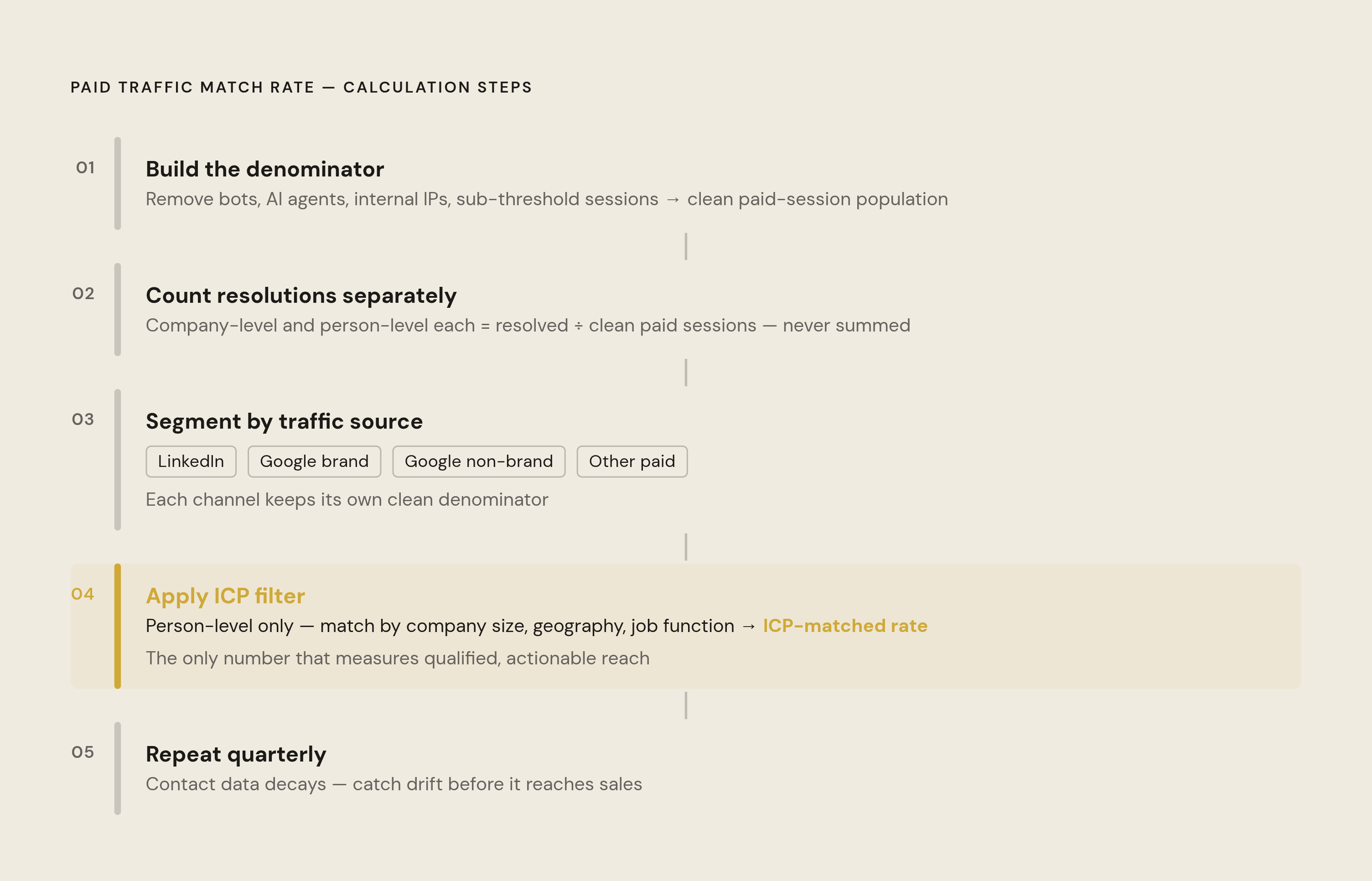
The first step is to build the denominator from paid sessions within a defined measurement window. Remove bot and AI agent traffic, internal IP visits, and sessions below a minimum time threshold from non-organic sources. The remainder is the clean paid-session population for this calculation. Because this method uses sessions, its numerator must also count sessions with a resolution rather than mixing unique contact totals with session counts.
The second step is to count company-level and person-level resolutions independently. Calculate each rate as resolved sessions at that level divided by clean paid sessions, expressed as a percentage. Keep both outputs visible throughout the analysis. A session resolved at both levels can appear in each separate calculation, but the two percentages must not be added into an overall rate.
The third step is to segment both calculations by traffic source. Calculate separate results for LinkedIn, Google brand, Google non-brand, and any other paid channels in the measurement window. Each channel needs its own clean denominator. This preserves the differences that an aggregate obscures and lets the analyst interpret weaker resolution against the audience, intent, and geographic constraints already established.
The fourth step is to apply the ICP filter to person-level resolutions. Count those that match the target company size, geography, and job function, using the available identification and CRM records. Then calculate their share of clean paid sessions. This ICP-matched person-level rate measures identifiable, qualified reach rather than rewarding every name returned, regardless of whether sales could use it.
The fifth step is to repeat the calculation quarterly. Contact data ages, so a deployment-time result can overstate the identification available a year later. Repeating the same method exposes decay before it reaches sales as bad data. Tracking the separate resolution rates and the ICP-matched result also preserves the distinction between reaching an account, identifying a person, and identifying someone who fits the target.
What the match rate on paid traffic should change about how you allocate and attribute spend
A channel with high click volume but low ICP-matched person-level coverage is not delivering many identifiable buyers for sales follow-up. Platform-reported conversions do not resolve that gap on their own. The allocation response is to favor channels that identify qualified buyers well and scrutinize weaker channels before increasing spend. That scrutiny must retain the geographic and resolution-level distinctions, rather than treating limited person-level availability as automatic evidence of poor traffic.
Attribution becomes more useful when a Google, Meta, or LinkedIn click connects to an identified company or person and then to a CRM opportunity. This ties campaign spend to a buyer record, so attribution can draw on more than modeled conversion credit. The operational layer completes that connection. Slack supports immediate routing, HubSpot or Salesforce supports CRM enrichment, and ad platform audience syncing enables retargeting based on identified visitors who did not convert.
Those connections turn measurement into a continuing feedback loop. Identified visitors can help shape later audiences, while opportunity records show what came from the initial traffic. Budget decisions then rest on qualified buyer reach and its pipeline connection. Properly calculated and activated, the match rate on paid traffic is not a vendor score to quote but evidence about the quality of the spend itself.