Finding Wasted LinkedIn Spend on Non-ICP Visitors
Visitor identity data exposes who LinkedIn's targeting really delivered.
Finding wasted LinkedIn spend on non-ICP visitors requires more than checking campaign performance. Targeting settings show who an advertiser wants to reach, while visitor identity data shows who came to the site. Connecting those records to campaign source and CRM outcomes makes the mismatch visible and gives practitioners a defensible basis for cutting waste.
Why LinkedIn's targeting dimensions don't tell you who actually visited
A marketer can open LinkedIn Campaign Manager, see acceptable CPL numbers, and later discover that the clickers are mostly coordinators and students. The apparent contradiction is a structural feature of audience targeting. LinkedIn's job-function, seniority, and company-size selectors set who the platform tries to reach. They do not guarantee that the people who respond have buying authority or fit the advertiser's ideal customer profile.
LinkedIn's targeting is probabilistic. Title bundles put decision-makers and non-buyers under the same targeting label, while nearby company-size tiers can let in firms outside the intended market. A campaign aimed at marketing leadership can therefore attract people who share a function but not the role. Campaign-level CPL and CTR average those responses together, allowing efficient acquisition and wasted spend to coexist in apparently healthy results.
LinkedIn does provide demographic breakdowns beyond those campaign totals. However, those aggregates do not connect an individual clicker's role to their subsequent website journey and CRM history.
How large the mismatch between intended and actual audiences tends to be
The best-managed accounts lose a relatively small share of spend, while the worst-managed accounts can waste a majority. That wide spread suggests that management and configuration contribute to waste. Waste also varies by industry, with HR Tech accounts wasting more than DevTools accounts.
Early-stage accounts waste much more than growth-equity-stage companies. This pattern suggests that targeting gets tighter as companies have more people devoted to demand-generation. Audience mismatch is also compounded by timing and traffic quality. GrowthSpree's dayparting analysis found that weekends consumed a substantial budget share while producing comparatively few conversions, and bots and AI crawlers further distort session counts. These drains require separate treatment, but audience mismatch begins with three predictable targeting mechanisms.
The three structural causes that produce most of the targeting waste
Job-function and title bundling is the first mechanism. LinkedIn groups dozens of title variations under function and seniority labels, so delivery intended for Directors can extend to Coordinators, Analysts, and Interns who share a LinkedIn-assigned function. The targeting label compresses several kinds of professional responsibility into one audience. That helps reach, but it weakens precision when only a narrow subset can buy.
Seniority mislabeling creates a second gap. LinkedIn assigns seniority using self-reported profile information, which members update inconsistently, and a “Senior” label covers different levels of actual authority. Lower-seniority audiences can produce cheap clicks without producing SQLs. Linking campaign data to CRM pipeline outcomes shows how the mismatch affects the business beyond the cost of a click.
Company-size leakage is the third cause. Broad, self-reported size tiers can let both very small businesses and very large enterprises into campaigns meant for mid-market buyers. Impressions and clicks from out-of-range firms that produce no conversions are a direct warning sign. Super Title bundling adds to these problems by showing ads to nearby title clusters that share a keyword but have different roles. These defaults are optimized for reach, so the advertiser's task is to constrain them against the ICP.
What LinkedIn's own reporting can surface — and where it stops
LinkedIn's Demographics Tab is a useful first audit layer. LinkedIn states that demographic reporting is available at the account, campaign group, campaign, and ad level in Campaign Manager. It exposes aggregate job titles, company sizes, industries, seniority levels, and company names, with performance measures including spend, CTR, and conversions. Those breakdowns can show non-buyer titles and company sizes that are hidden in campaign averages.
A monthly audit provides a practical starting cadence. Identify titles and company sizes with high impressions but zero conversions, add the relevant exclusions, and repeat. Over multiple quarters, that exclusion work can improve lead quality and reduce CPL. The tab shows these patterns without the need for another identity system.
Its boundary is that results are anonymized aggregates covering the top values. They do not show which specific visitors read key pages, how long they stayed, what they consumed, or whether they were already in the CRM. Nor does the tab separate human prospects from bots and AI crawlers. It therefore cannot establish which people who clicked a campaign and visited last month matched the ICP and had a realistic chance of becoming customers.
How visitor identity enrichment answers the question LinkedIn's reporting cannot
Visitor identification starts with an anonymous session signal, such as an IP address, browser fingerprint, or cookie match. It resolves that signal to either a company record or a named individual. Company-level identification maps an IP address to the organization that owns it. Person-level identification can return a name, work email, LinkedIn profile, job title, and company, although meaningful coverage depends on identity-graph reach and is primarily available for US traffic.
Campaign attribution makes that identity useful for a LinkedIn audit. When the visitor record includes the campaign, ad set, or creative that brought the person to the site, the actual role and company can be compared with the intended ICP. A named visitor from a five-person company arriving through a campaign targeting mid-market VPs is a concrete mismatch. The record connects a targeting failure to its acquisition source.
On-site behavior adds a different kind of evidence. Pages viewed, scroll depth, time on page, and exit intent help separate a brief click-through from a qualified visitor who read pricing information but did not convert. Bot and AI crawler sessions must remain distinct from human sessions when interpreting that evidence. Mixing them obscures both conversion rates and identification coverage, making headline match rates difficult to interpret.
Company-level vs. person-level identification (what each reveals about LinkedIn waste)
A company match establishes that an account visited. That is useful for ABM account scoring and retargeting, and an out-of-ICP company can expose waste without a named contact. However, a visit from a target account cannot establish whether the clicker was a decision-maker, coordinator, or intern. Person-level identification supplies the title and seniority needed to test that part of the targeting promise.
The two methods should therefore be evaluated separately. Adding company and person matches into one identification rate hides how much coverage represents an actionable individual. Geography also limits the comparison. Meaningful person-level coverage is mostly available for US traffic, while person-level identification of EU visitors under GDPR needs affirmative consent before the identification script fires.
Low person-level coverage is a fair concern, but even a partial sample, along with company-level coverage, shows things that demographic aggregates cannot. It does not make the unidentified visitors known, and it should not be presented as complete coverage. Before buying, run a tool against two weeks of your own traffic and assess the share identified, the share of identified visitors matching the ICP, and how many would merit contact. Identification rate alone does not establish usefulness.
The tools that connect LinkedIn spend to visitor identity
The market divides by identification level and by how deeply records connect to advertising and CRM data. RB2B uses a publisher network to match US website visitors to LinkedIn profiles and returns a name and LinkedIn URL. Verified business email is available on its Pro plan and above. It sends records to Slack in under five minutes, while CRM routing and native HubSpot and Salesforce integrations require Pro. Warmly combines person-level identification with on-site AI chat and SDR outbound automation.
Leadfeeder / Dealfront provides near-real-time company identification through IP-to-company matching. Its Activate plan and above offer two-way CRM integrations with Salesforce, HubSpot, Pipedrive, Zoho, and Microsoft Dynamics 365, and it provides Slack and email alerts for named-account visits. Pure IP-based identification can degrade in remote and hybrid work environments. ZoomInfo WebSights also identifies companies, adding intent data, target-account alerts, and native Salesforce and HubSpot sync. Contact-level identification is available through its opt-in Enhanced Visitor Identification or WebSights Buyer ID add-ons.
Factors.ai offers account-level identification and tracks touchpoints across the full journey from ad impression to revenue. Its capabilities include LinkedIn Ads influence and impression tracking, plus HubSpot and Salesforce integrations. Across these options, the decisive audit question is whether campaign source appears in the same record as the visitor's actual title and company. A profile delivered to Slack provides a useful notification and requires that source connection to support a campaign-specific waste finding.
How to run the actual waste audit using visitor identity data
Begin by tagging LinkedIn ad URLs with UTM parameters that carry campaign, ad set, and creative identifiers. A visitor identification tool that records where traffic came from can add those parameters to the records it identifies. Without that tagging, the audit lacks the campaign connection needed to trace a visitor back to the spend that brought them. Identity and attribution must meet before segmentation begins.
Next, export identified visitors by campaign and compare their titles, companies, company sizes, and seniority with the campaign's ICP definition. The non-ICP share of identified people is the person-level waste signal. Unresolved company matches still contribute evidence. A three-person company visiting through a campaign targeting 200-plus employee firms is outside the stated target even when the individual remains unknown.
Cross-reference those findings with the Demographics Tab. Agreement between the two sources strengthens the exclusion case, while disagreement calls for investigation before excluding an audience. Build exclusions before changing bids or budgets, using confirmed non-ICP company names, non-buyer title keywords, out-of-range company-size tiers, and non-converting industries. This addresses audience composition before changing how much the campaign spends on it.
Treat timing waste as a parallel task. LinkedIn offers no native ad scheduling, while third-party tools such as Zipeline can automate weekend and off-hours pausing. Manual pausing is also an option for smaller budgets. A review of the Demographics Tab each month, along with a regular visitor-identity export, keeps the audit easy to repeat as targeting drifts. Repeated exclusion work compounds because each cycle starts from a more constrained audience than the last.
What the recovered budget should fund — and how to attribute it cleanly
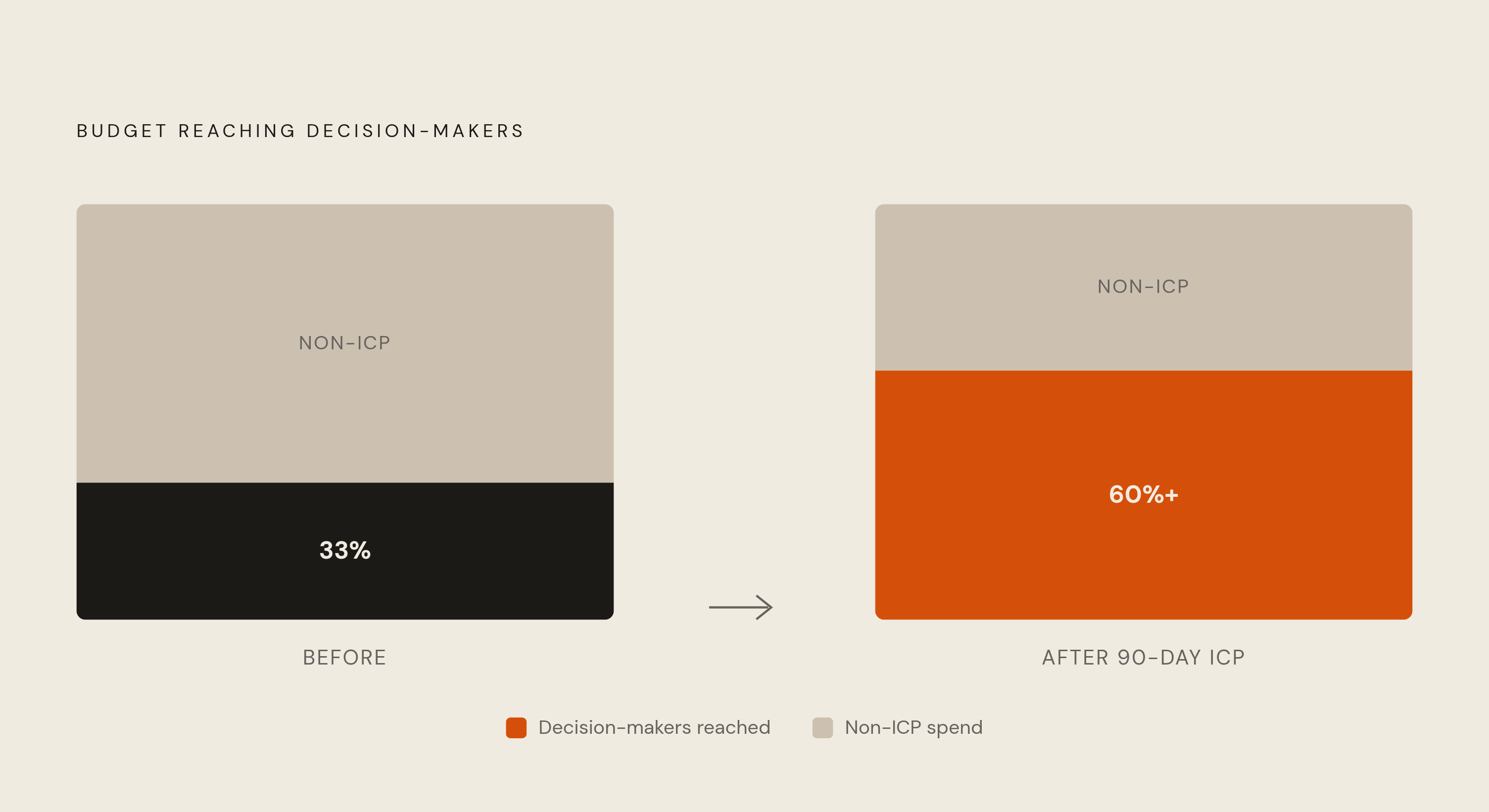
Recovered budget should go to the highest-converting ICP segments, with more weight given to conversions than to which campaigns have the cheapest leads. The relevant segments are the titles, company sizes, and seniority levels that produced pipeline when visitor records were joined to CRM outcomes. GrowthSpree's retroactive application of its 90-day framework shifted decision-maker budget share from roughly a third to more than three-fifths.
That budget can also go toward reaching non-converting ICP visitors again. A person who matched the ICP and visited the pricing page is a warmer target than an unqualified cold audience. Visitor identity turns that session into an addressable record that can populate LinkedIn retargeting lists, HubSpot sequences, or Salesforce workflows. Keeping the original campaign source attached preserves the connection between acquisition and follow-up.
LinkedIn spend, identified visitors, and CRM outcomes need to be linked in one view. An account that encountered an ad, visited pricing information, and later became a deal should be represented as one buyer journey. Person-level attribution gives stronger evidence than aggregate return on ad spend alone.